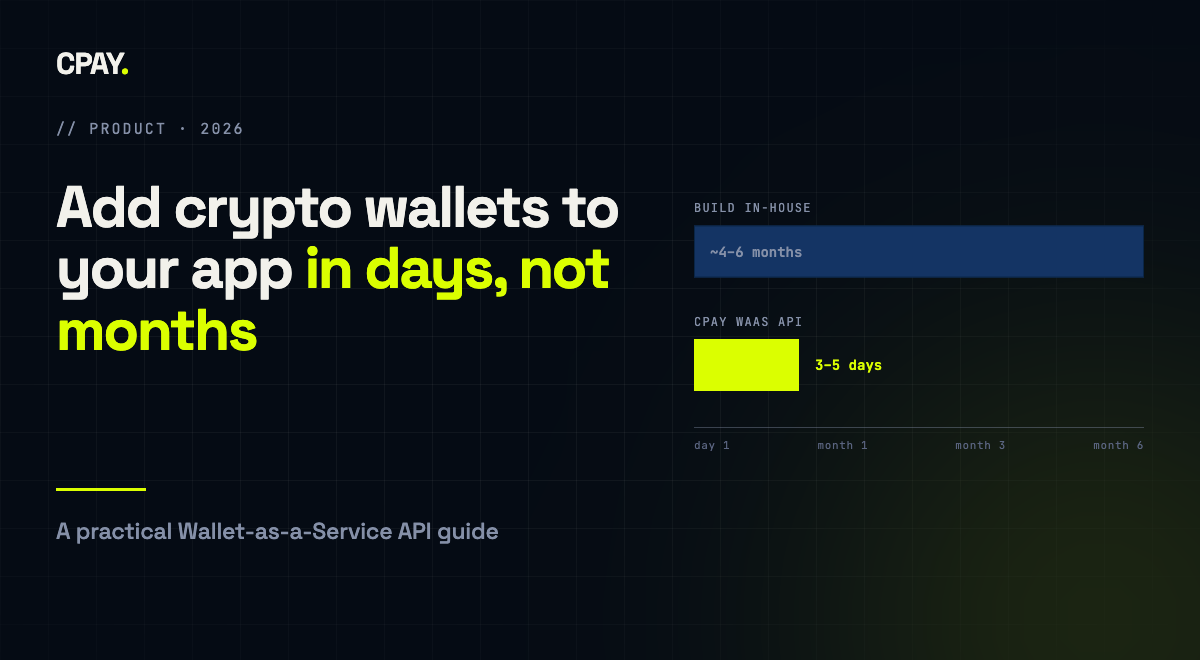
"We'll just add a wallet" is one of the more expensive sentences an engineering roadmap can contain. Not because wallets are conceptually hard — because key management, multi-chain support, and compliance screening are each their own multi-week project, and a wallet needs all three before a single real user touches it. A WaaS (Wallet-as-a-Service) API exists to remove that timeline, not the wallet.
01 — What "just add a wallet" actually involves
Building wallet infrastructure from scratch is really five separate projects wearing one ticket:
- Key management. Generating, storing, and rotating private keys safely — HSMs or an in-house MPC/multisig implementation, plus the operational discipline to run either one.
- Multi-chain support. Every additional network is its own RPC integration, its own fee model, its own confirmation logic.
- Compliance screening. KYC onboarding, sanctions and AML monitoring, Travel Rule data where it applies — none of it optional once real funds move.
- Monitoring and alerting. Watching balances, detecting stuck transactions, catching chain reorgs before any of it becomes a support ticket.
- Security hardening. Penetration testing, key-rotation drills, incident runbooks — the unglamorous work that turns a prototype into something you'd trust with real money.
None of that is wasted effort in the abstract — it's just rarely the thing your product is actually differentiated on. A WaaS API doesn't skip these steps; it moves them to infrastructure someone else already built, audited, and operates at scale.
02 — Day 0: before you write any code
Two decisions upfront save a rebuild later. First, which chains and assets your users actually need on day one — stablecoins on one or two fast, cheap chains cover the large majority of real use cases, and adding networks later is additive rather than a rewrite if the API is chain-agnostic from the start. Second, the custody model — confirm the provider is genuinely non-custodial, with wallets derived from keys or shares your platform controls, not "non-custodial" in marketing copy only.
With those settled, sign up for API credentials and a sandbox environment. Everything below runs against testnet first.
03 — Day 1: create your first wallet
The entire "build a wallet" step is one authenticated API request. No key ceremony, no HSM provisioning on your side — the provider's infrastructure handles key generation and storage; you get back a wallet identifier and an address.
That address is real and funded exactly like any other on-chain wallet — you can send testnet funds to it right away and watch the balance update. There is no separate "activation" step; the wallet exists the moment the request succeeds.
04 — Day 2: wire up webhooks, stop polling
Polling balances works for a demo and falls apart under real traffic. The provider should push events instead — a signed webhook the moment a deposit lands, a withdrawal confirms, or a transaction needs attention. Verify the signature, match the event to a known reference, and make the handler idempotent: the same event can be delivered more than once on retry.
At this point the loop is complete: create a wallet, receive funds, react to events — the same shape as a payments integration, not a blockchain one.
05 — Day 3: policy before production
A wallet that can move unlimited funds on a single API call is a liability, not a feature. Before anything touches real money, put policy controls in front of it: per-transaction and daily spend limits, an allow-list for withdrawal destinations, and a manual-approval threshold for anything unusual.
One honest caveat: a WaaS provider gives you KYC/AML tooling and screening endpoints — it does not run your compliance program for you. Onboarding checks, monitoring thresholds, and reporting obligations are still the platform's responsibility. Treat this as a day-3 task, not a launch-week afterthought.
The API call to create a wallet takes ten minutes. The policy layer around it is what actually takes the remaining days — and it's the part worth taking seriously.
06 — Day 4–5: the go-live checklist
Five things to confirm before mainnet traffic:
- Idempotent webhook handling — the same event can arrive twice; state changes must be safe to apply twice.
- Spend limits and destination allow-lists are live, not just configured in a dashboard nobody enforces against.
- Monitoring and alerting are wired to a real channel — a stuck withdrawal at 2am shouldn't wait for a support ticket to surface it.
- The key/share recovery path is documented and, ideally, tested once against a small real amount before it's load-bearing.
- Rate limits and retry behavior on the API are understood — know what happens under a burst of signups, not just steady-state traffic.
None of these five depend on the provider — they're the platform's own responsibility, and they're exactly the same five items whether the wallet took five days or five months to build. The time saved is entirely in the infrastructure underneath; the operational discipline on top doesn't get any smaller.
07 — Build in-house vs. WaaS API, honestly
The comparison comes down to a handful of lines. Time to first wallet: weeks to months in-house, minutes with an API. Key management: built and operated by your team versus provided, audited, and operated externally. Adding a new chain: a new integration project versus, usually, a config change. Compliance tooling: built or separately licensed versus built in. Ongoing maintenance: your team indefinitely, or the provider's.
And the honest last line: the compliance program and policy design are still your responsibility either way. A WaaS API removes an infrastructure project, not a responsibility. What it buys back is months of engineering time that would otherwise go into building and maintaining something that was never going to be the reason users chose your product.
The wallet was never the hard part of the product idea — the infrastructure underneath it was. A WaaS API doesn't make that infrastructure disappear; it moves the timeline from a roadmap quarter to a sprint, and leaves the parts that were always your job — policy, compliance, monitoring — exactly where they belong.