Compliance has a reputation problem: most teams meet it as a pile of abbreviations standing between the product and its launch. In practice, KYC and AML are better understood as a pipeline that every user quietly travels — and in 2026, with MiCA fully in force in the EU and the Travel Rule implemented across most major markets, that pipeline is simply part of what a crypto payment product is. Here's the whole picture, untangled.
01 — The three letters, untangled
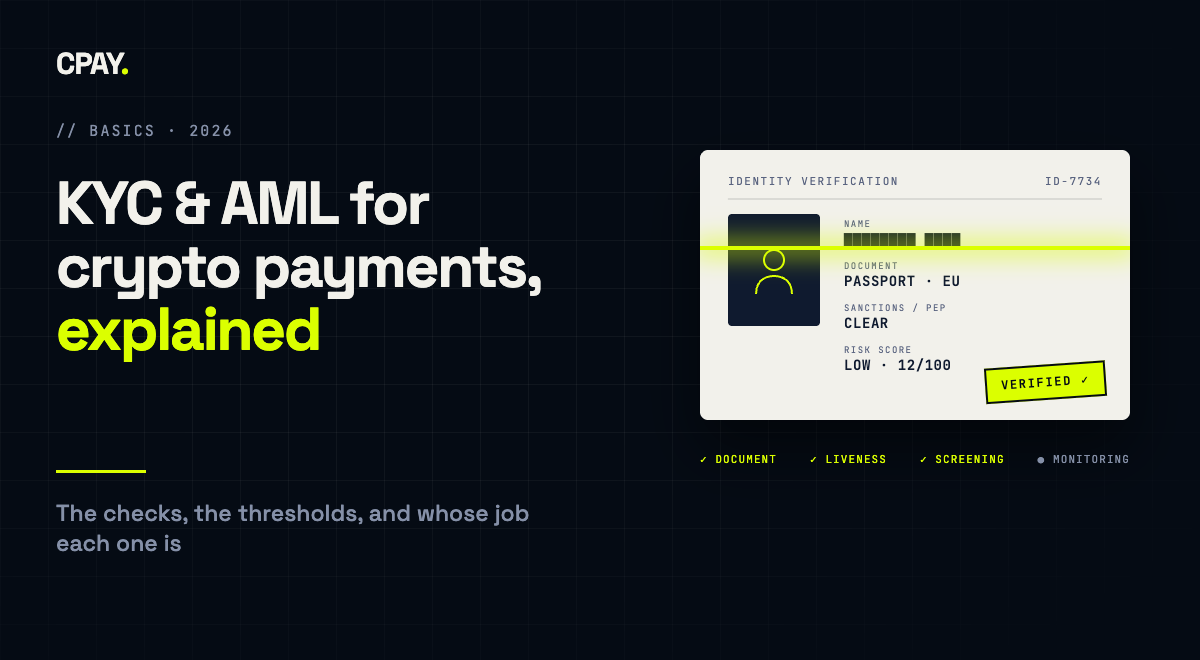
KYC (Know Your Customer) is identity: establishing that a user is a real person or business — document verification, liveness checks, proof of address where required. It happens at onboarding and at trust upgrades.
KYT (Know Your Transaction) is behavior: on-chain analytics applied to every transaction — where funds come from, where they go, whether the path touches sanctioned addresses, mixers, or known exploit proceeds. It never stops running.
AML (Anti-Money Laundering) is the umbrella program above both: the policies, thresholds, alert handling, and reporting obligations that turn checks into a defensible process. KYC and KYT are tools; AML is the discipline that uses them.
02 — One user, five checkpoints
The cleanest way to understand the machinery is to follow a single user through it:
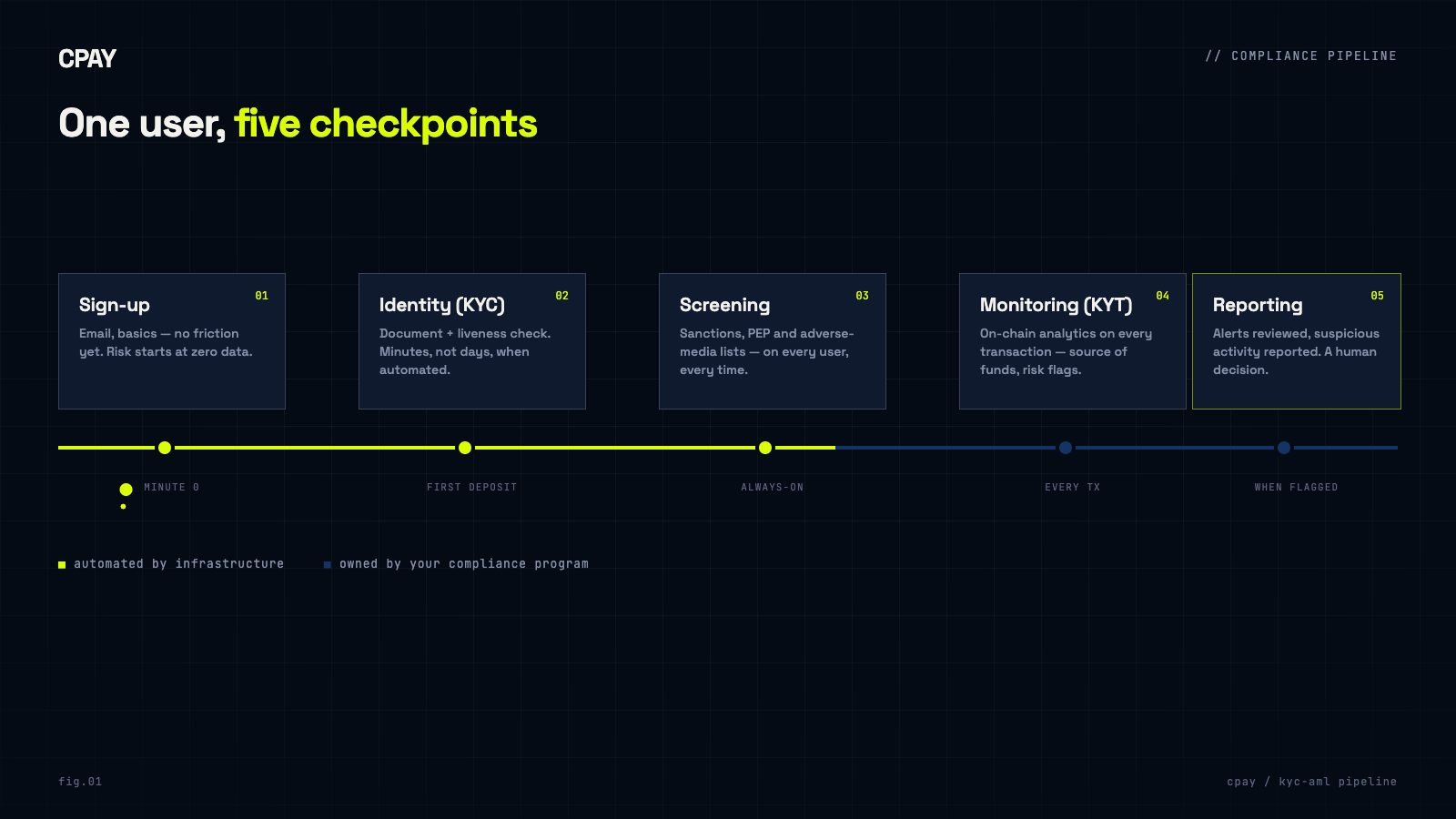
Two things in that pipeline matter more than the rest. First, sequencing: nothing heavy fires at sign-up — modern onboarding defers full verification to the moment real money appears, which is why a well-built flow loses almost no users. Second, the split of labor: the first four checkpoints are automated by infrastructure and resolve in seconds; only the fifth — deciding what a genuine alert means and reporting it — is inherently human, and it belongs to your compliance program, not your vendor.
03 — Verification depth is a dial, not a switch
The single most common design mistake is treating KYC as binary: nothing, or everything. Regulators themselves prescribe the opposite — a risk-based approach, where verification depth scales with the risk a user and a transaction actually represent. The FATF baseline that makes the Travel Rule bite at USD/EUR 1,000 is one such threshold; jurisdictions layer their own on top.
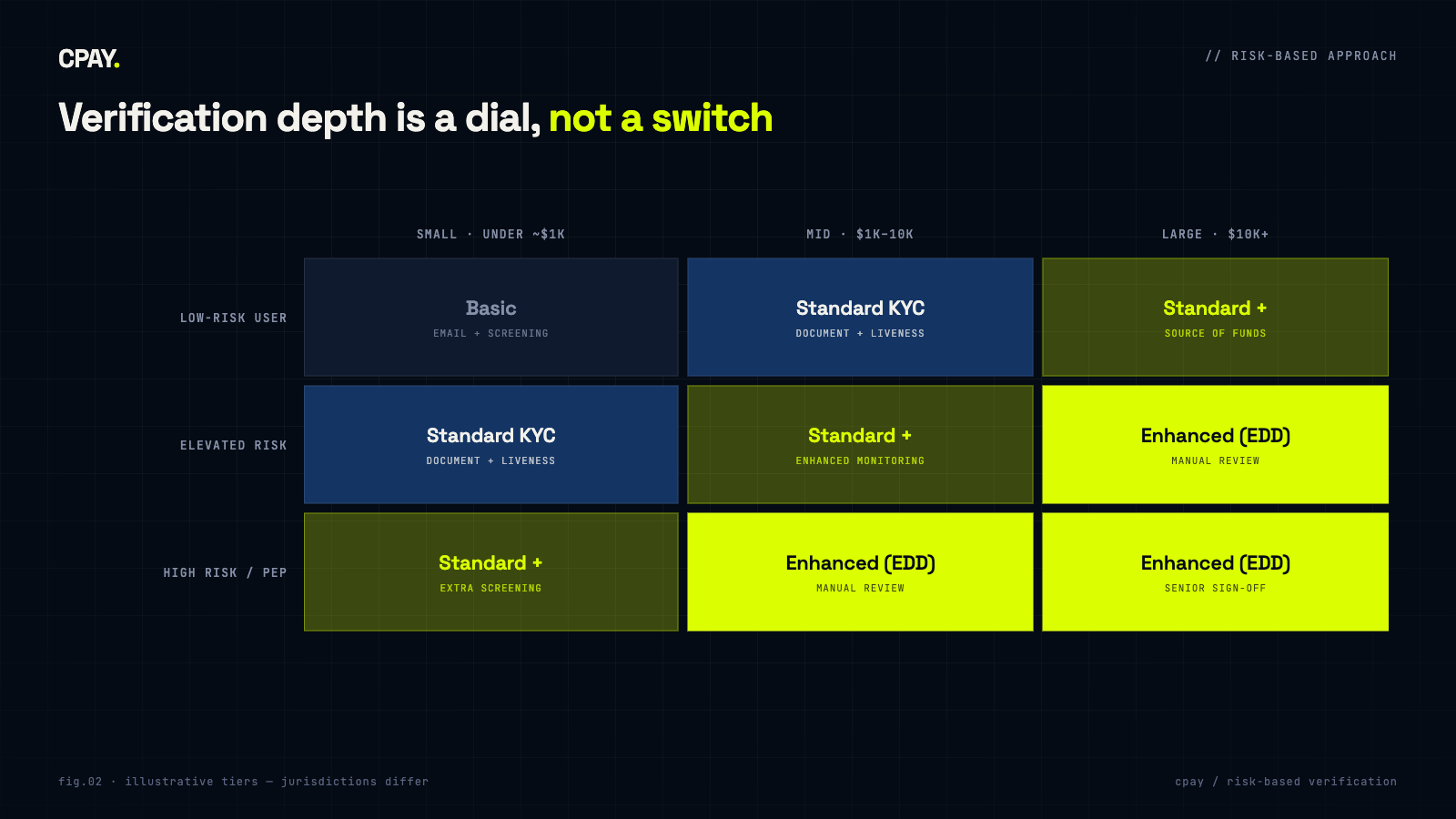
Read the matrix diagonally: a low-risk user making a small payment sails through with screening only, while a high-risk profile moving serious volume lands in enhanced due diligence with a human in the loop. That diagonal is where compliance and conversion stop fighting each other — friction concentrates exactly where the risk is, and nowhere else.
Good compliance is invisible to ninety-five percent of users and unmistakable to the five percent who needed to be looked at.
04 — Who owns what
The division of responsibility follows the same line it does everywhere in embedded finance:
- Infrastructure provides: identity verification flows, document and liveness checks, sanctions/PEP/adverse-media screening, on-chain KYT scoring, Travel Rule data exchange, and the audit trail underneath all of it.
- Your program owns: the risk policy (which tiers, which thresholds), decisions on alerts, regulatory reporting, record-keeping obligations, and a named person accountable for the whole thing.
A provider that claims to take the second list off your hands is overselling; a provider that doesn't fully deliver the first is underbuilt. The honest boundary is exactly the legend on the pipeline diagram above.
05 — Choosing a provider: the short checklist
- Coverage in your markets. Screening lists and document support for the jurisdictions where your users actually live.
- Risk-based configurability. Verification tiers you define — not one hard-coded flow for every user.
- KYT on-chain depth. Real attribution data behind transaction scoring, not just a sanctioned-address list.
- Travel Rule support. Structured originator/beneficiary data exchange with other VASPs, built in.
- An audit trail you can hand to a regulator. Every check, every decision, timestamped and exportable.
CPAY's KYC & AML layer is built into the same stack as payments and wallets — verification, screening, and KYT wired into the flows your users already travel, with the policy dials left where they belong: in your hands. If your product moves crypto and touches users, this pipeline is not a launch blocker. Built right, it's the reason the launch survives contact with its first regulator — and its first bad actor.