Non-custodial vs. custodial crypto payment gateways: which is right for your business?
Every claim in this debate sounds reasonable in isolation. Checked against what's actually happened to businesses that made the choice, most of them don't survive contact with reality.
Ask five people why they chose a custodial gateway and you'll hear the same handful of claims, repeated with total confidence. Most of them were true once. Fewer of them are true now. Here's what actually holds up.
"The provider handles security for you."
This is the pitch, and it isn't exactly false — a custodial provider does run security operations. What it leaves out is that those operations happen entirely out of your view. Your funds sit in a pooled wallet you cannot inspect, protected by controls you cannot audit, managed by people you've never met. "Handled" and "invisible" aren't the same thing, and a security model you can't verify isn't one you can actually rely on. Reality: you didn't remove the risk. You just lost the ability to see it.
"Custodial is the safer, default choice."
It used to be. Non-custodial infrastructure — MPC key management, smart-account wallets — was genuinely immature a few years ago, and custodial was the path of least resistance. That gap has closed. Non-custodial gateways now ship the same checkout, the same API, the same dashboard, with one structural difference: the provider never takes possession of the funds. Reality: by 2026, non-custodial is the default expectation for a serious payment platform, not the adventurous option.
"Non-custodial means we're on our own if something breaks."
This one confuses two separate questions: who holds the keys, and who answers the support ticket. They're not the same decision. A properly built non-custodial gateway still gives you an API, webhooks, a dashboard, reconciliation tools, and a support team — everything a custodial platform offers, minus the part where your funds sit in someone else's wallet. Reality: custody and service level are independent. You can have both non-custodial funds and full support.
"It's unlikely to happen to us."
This is the claim the whole decision actually rests on — and it's the one 2022 tested directly. FTX. Celsius. Voyager. BlockFi. Different stories, same root cause: customer funds pooled behind a custodian's keys, gone the moment that custodian failed. None of those businesses thought it would happen to them either. Reality: "unlikely" isn't the same as "won't happen," and pooled custodial wallets are the single largest loss vector in the industry's history — not a hypothetical risk, a documented one.
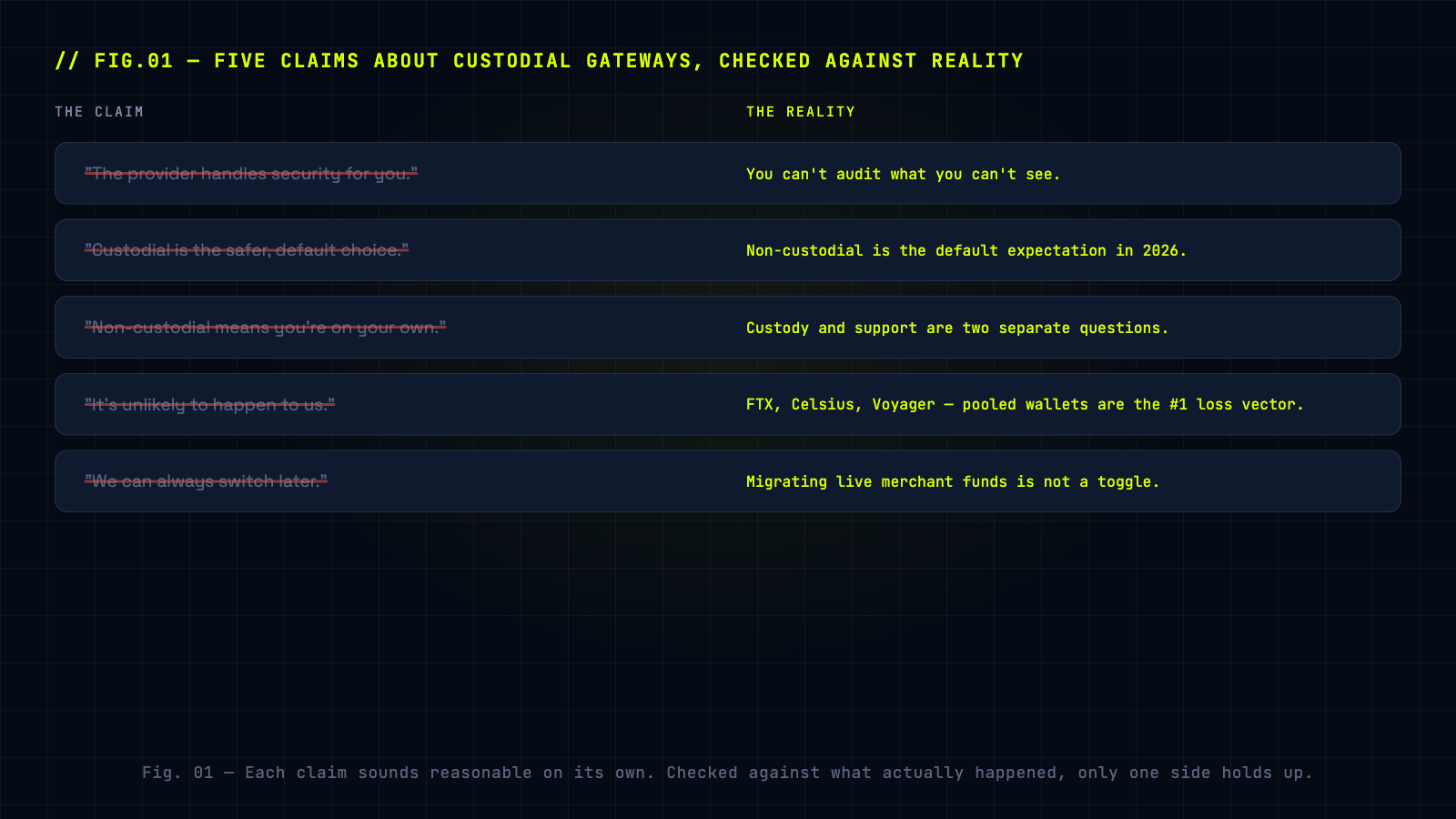
"We can always switch later, once we're bigger."
This sounds like a reasonable way to defer the decision. It isn't, because "switching later" means migrating live merchant funds, live integrations, and possibly your compliance posture — all while the business keeps running and merchants keep expecting uptime. It is not a settings toggle you flip on a quiet afternoon. Reality: the cost of switching custody models after you're already processing real volume is far higher than the cost of choosing correctly before you start.
"Custodial gives us more control, because the provider actively manages everything."
This one gets the word backwards. Custodial means the provider controls the funds — you get influence over what they do with your account, not control over the money itself. Non-custodial inverts that: you hold the keys, and the provider manages the process around a wallet that is actually yours. Reality: "control" in the custodial model belongs to the custodian. In the non-custodial model, it belongs to you.
"Every claim for custodial sounds reasonable the day you make it. The ones that don't hold up are the ones you find out about during an outage, a freeze, or a failure — not before."
So which one is actually right for your business?
Strip away the myths, and the real decision comes down to a much shorter question: how much of your risk are you willing to hand to a party you can't verify, in exchange for a marginally simpler pitch deck?
For a business processing meaningful volume, holding merchant trust, or operating in a regulatory environment that will ask hard questions after the fact, that trade rarely makes sense — the downside is asymmetric, and the "easier" side of custodial mostly disappears once you compare a real non-custodial integration, which is just as turnkey via a modern API. Custodial can still make sense for very early, very low-volume testing, where the operational discipline of key management genuinely isn't worth building yet. But that's a narrow, temporary case — not a foundation to build a payments business on.
CPAY is built non-custodial from the ground up: funds settle to wallets you control, not a pooled account CPAY holds — with the same checkout, API, and dashboard you'd expect from any modern gateway, custodial or not.
The myths about custodial gateways were mostly true once. What's actually true now is simpler: you can get the same convenience without handing over the funds. There isn't much of a trade left to make.