For decades, global finance has been built on paper-heavy processes, intermediaries, and slow-moving settlement cycles. But a silent revolution is underway: the tokenization of real-world assets (RWA).
Simply put, tokenization means taking something physical or traditional — like a U.S. Treasury bond, gold bar, or euro — and creating a blockchain-based token that represents its value.
And this isn’t just a trend. According to Boston Consulting Group, the market for tokenized RWAs could reach $16 trillion by 2030.
Why Tokenization Matters for Businesses
When a business manages payments or treasury operations, the goals are simple: speed, transparency, and liquidity. RWAs unlock all three.
- Faster Payments
- Settlement moves from T+2 days to near-instant.
- Tokenized currencies like EURC or USDC already make cross-border payments as seamless as sending an email.
- Settlement moves from T+2 days to near-instant.
- Enhanced Treasury Management
- Instead of parking liquidity in a slow bank account, companies can buy tokenized T-bills or bonds, earning yield while keeping capital liquid.
- Example: BlackRock’s BUIDL fund on Ethereum surpassed $500M AUM in 2024 — with 24/7 liquidity.
- Instead of parking liquidity in a slow bank account, companies can buy tokenized T-bills or bonds, earning yield while keeping capital liquid.
- New Asset Classes
- Commodities like tokenized gold (e.g., PAXG) allow businesses to hedge against inflation in real time.
- Tokenized carbon credits are becoming a compliance tool for ESG-driven companies.
- Commodities like tokenized gold (e.g., PAXG) allow businesses to hedge against inflation in real time.
Tokenized Bonds: The Backbone of Corporate Treasuries
Treasury bills (T-bills) and corporate bonds are the most popular RWA use case today. Franklin Templeton, Hamilton Lane, and Société Générale have all launched tokenized bond funds.
Why? Because treasurers want:
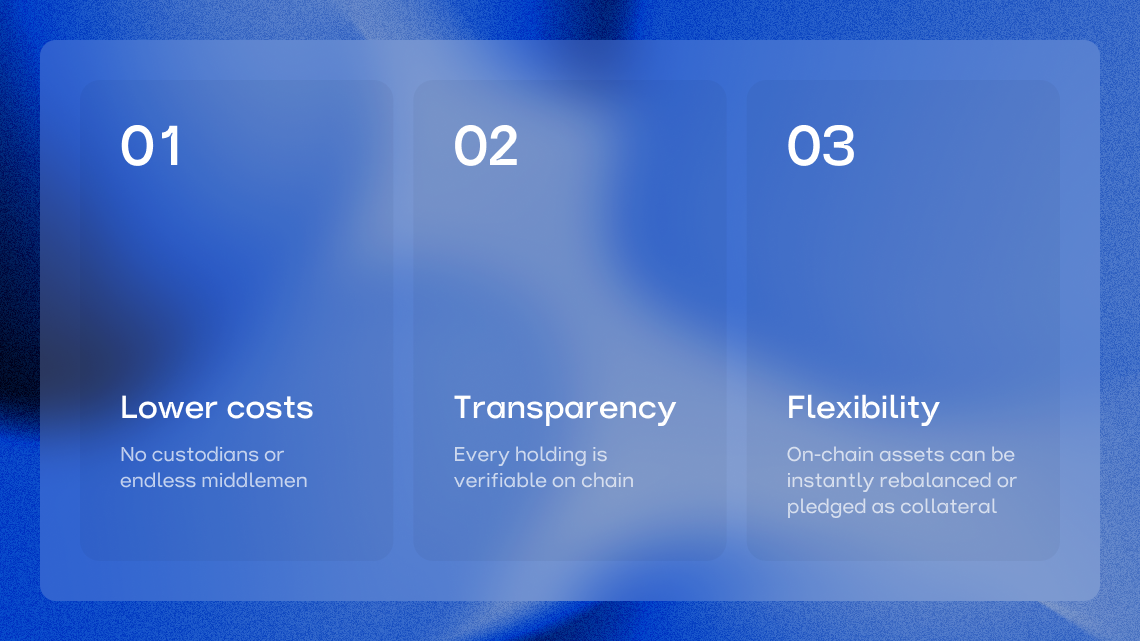
In 2025, tokenized U.S. Treasuries alone already exceed $7.6B across Ethereum, Polygon, and Stellar. Half of that growth came in just the last six months.
Commodities & Currencies: Unlocking Global Trade
- Gold on-chain: PAX Gold (PAXG) represents 1 ounce of London Good Delivery gold, tradable on Ethereum.
- Oil and agricultural tokens: Pilots are underway for tokenized barrels and grain certificates, bringing new liquidity to commodity trading.
- Stablecoins (digital currencies): With USDT, USDC, and EURC, businesses can make 24/7 global payments at a fraction of SWIFT’s cost.
This convergence of commodities and currencies on chain blurs the line between “treasury asset” and “payment tool.”
The Future: RWA as the Operating Layer of Finance
Tokenization isn’t about replacing banks or regulators. It’s about upgrading financial infrastructure.
Tomorrow’s CFO won’t log into five different systems for cash, investments, and payments. Instead, they’ll use a unified dashboard where tokenized bonds, currencies, and commodities flow seamlessly.

CPAY Perspective
At CPAY, we see this shift daily. Businesses using crypto payments already enjoy faster settlement, lower fees, and global accessibility. The next frontier is clear: merging payments with tokenized treasury tools.
When stablecoins, tokenized bonds, and commodities exist in one ecosystem, businesses don’t just move money — they manage it smarter.