Every in-house crypto gateway project starts the same way: someone puts together a budget with engineering salaries and infrastructure costs, the number looks manageable, and the project gets a green light. The problem is never the numbers on that spreadsheet. It's the numbers that were never on it.
01 — The quote that starts every build
"One senior payments engineer, three months." That's the classic opening estimate for an in-house gateway — and it's not entirely wrong, if the goal is a demo that accepts one asset on one chain in a test environment. A production gateway that merchants can actually rely on is a different project wearing the same name, and the gap between the two is where budgets go to die.
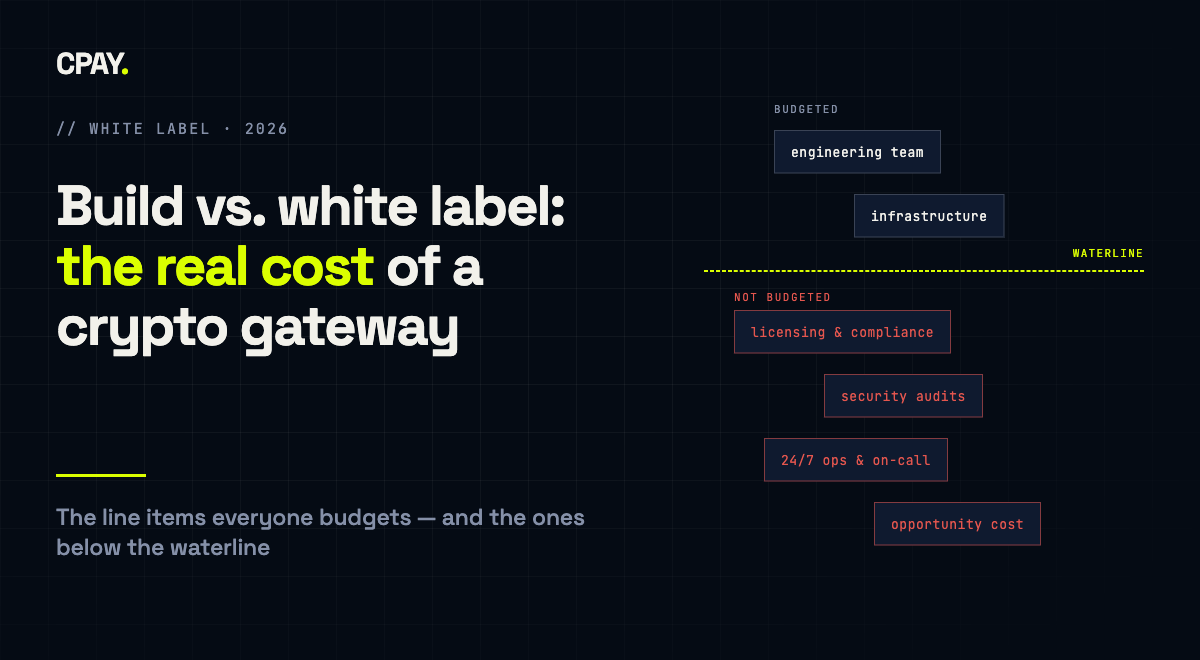
02 — Above the waterline: the costs everyone budgets
The visible line items are real, and they're not small:
- The team. Realistically two to four engineers with payments and blockchain experience — a scarce, expensive profile — for six months to a year before the first production transaction.
- Infrastructure. Nodes or RPC providers across every supported chain, hot and cold wallet architecture, monitoring, redundancy.
- Integrations. Every asset, every network, every wallet format your merchants expect — each one its own mini-project with its own edge cases.
Painful, but plannable. A disciplined team can budget all of this to within twenty percent. It's the next category that doesn't behave.
03 — Below the waterline: the costs nobody budgets
- Licensing and compliance. Depending on jurisdiction and custody model: VASP registration, money-transmitter licensing, KYC/AML program build-out, Travel Rule support. This is months of legal work, and in some markets it gates the launch entirely.
- Security audits. A gateway holding or routing real funds needs independent audits before launch and after every significant change — plus the internal discipline of key ceremonies, rotation drills, and incident runbooks.
- 24/7 operations. Chains fork, nodes fall behind, transactions get stuck, a stablecoin migrates contracts. Someone is on call for all of it, forever. That someone is usually your best engineer.
- Maintenance as a permanent tax. The gateway is never "done." New chains, deprecated RPCs, protocol upgrades, wallet standard changes — the maintenance load grows with every integration you add.
- Opportunity cost. The quietest and largest number: everything your team didn't build for your actual product during the year they spent rebuilding payments infrastructure that already exists.
The in-house gateway doesn't fail in the budget meeting. It fails eighteen months later, when the team realizes payments has become their full-time product — and their actual product is the side project.
04 — The white-label math
A white-label gateway flips the structure of the cost. Instead of salaries, infrastructure, and a compliance program, you pay a per-transaction fee — CPAY's is a flat 0.5% — and launch on rails that already exist: your brand and your merchant relationships on top, the provider's infrastructure, security, chain maintenance, and KYC/AML tooling underneath.
What that buys, concretely: launch in weeks instead of quarters; no licensing project standing between you and revenue where the provider's non-custodial architecture keeps you out of the custody regime; no on-call rota for chain incidents; and a cost that scales with actual volume instead of a fixed burn that starts on day one. For most platforms — PSPs adding crypto, SaaS products monetizing payments, agencies packaging services — the white-label route is the difference between a Q1 launch and a maybe-next-year one.
05 — When building in-house is still right
Honesty requires the other side of the ledger. Building makes sense when the gateway is the product — when your differentiation lives in the payment flow itself and owning every layer is the moat; when you operate at a volume where the per-transaction economics of any provider genuinely lose to your own fixed costs — a bar that sits far higher than most teams assume; or when you already hold the licenses and run regulated financial infrastructure as your core business, so the compliance cost is marginal rather than new.
If none of those three describe your company, the honest reading of the ledger points one way.
06 — The decision in five questions
- Is a payment gateway the product you sell — or a feature your product needs?
- Do you have payments and blockchain engineers to spare for a year, including the ones who'll carry the pager afterwards?
- Do you hold, or want to acquire, the licenses your custody model requires?
- Does your realistic volume actually beat a flat 0.5% on cost — after salaries, audits, and infrastructure?
- What would the same team ship for your core product in the same year?
The real cost of building a crypto gateway in-house was never the engineering estimate — it's everything below the waterline, paid for as long as the gateway runs. White label exists precisely so that bill lands on infrastructure built to carry it.