CPAY Moves Toward Agentic Payments
A Vision for the Future
How CPAY plans to bring AI into crypto payments, wallet infrastructure, and machine-to-machine commerce
The future of payments is changing
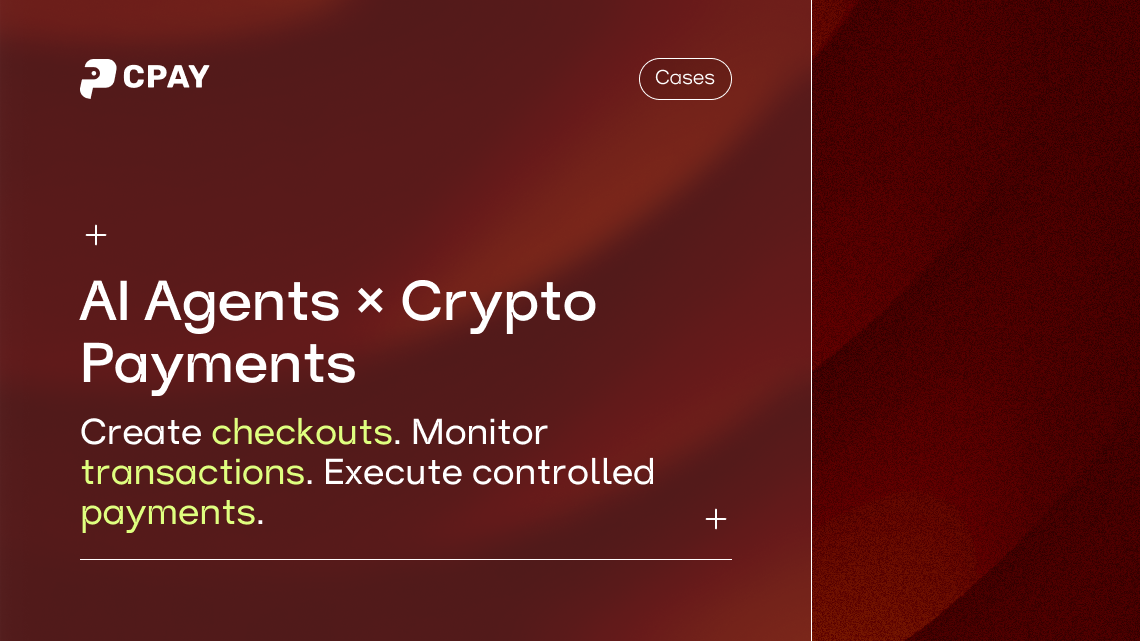
At CPAY, we believe today is the beginning of a new payment category: Agentic Payments.
We see a major future where AI agents can safely interact with crypto payment and wallet infrastructure. They will help businesses create checkouts, monitor transactions, manage wallets, prepare payouts, generate reports, and eventually make controlled stablecoin payments between digital services.
CPAY is committed to moving in this direction. Our goal is to make CPAY an AI-ready crypto payment and wallet infrastructure platform.
Why CPAY is moving toward Agentic Payments
CPAY already provides crypto payment and wallet infrastructure for businesses. Our platform allows clients to:
- create crypto checkouts;
- create wallets for their users;
- process crypto transactions;
- manage wallet infrastructure;
- perform multisend operations;
- integrate with CPAY through API;
- receive payment status updates;
- build crypto payment flows inside their own products.
This foundation is very relevant for the AI-agent economy. AI agents need exactly this type of infrastructure:
- API-based access;
- wallet creation;
- payment creation;
- payment verification;
- transaction monitoring;
- reporting;
- automated workflows;
- stablecoin support;
- permission-based controls.
The next step is to make this infrastructure more accessible, more intelligent, and safer for AI-driven workflows.
For CPAY, Agentic Payments are not only about “AI making payments.” They are about using AI across the full payment lifecycle:
integration
support
checkout creation
transaction review
wallet operations
multisend preparation
payment analytics
risk monitoring
machine-readable payments
controlled agent wallets
CPAY wants to help businesses connect AI agents to crypto payments safely.
Our vision
CPAY’s vision is to become a payment and wallet infrastructure platform that is ready for the AI-agent economy.
We believe businesses will increasingly use AI agents to support customers, sell products and services, create payment links, check payment statuses, investigate failed transactions, reconcile payments, manage reports, prepare payouts, prepare multisend batches, monitor wallet balances, pay for digital services, and interact with APIs.
This means payment infrastructure must evolve. It should no longer be built only for human dashboard users and traditional API integrations. It should also be built for AI systems that can understand tasks, call tools, and operate under strict permissions.
That is the direction CPAY is moving toward.
What CPAY means by Agentic Payments
For CPAY, Agentic Payments means a secure payment environment where AI agents can interact with crypto payment infrastructure through controlled tools and permissions.
This does not mean giving AI agents unlimited access to client funds. It means creating a structured and safe model where AI can:
- read payment data;
- explain transaction statuses;
- create checkouts;
- prepare payment actions;
- generate reports;
- detect issues;
- request approvals;
- execute limited actions only when allowed by policy.
The most important principle is control. AI should not replace financial governance. AI should improve payment operations while CPAY provides the infrastructure for permissions, limits, approvals, and audit logs.
Why crypto and stablecoins matter
We believe crypto payments and stablecoins are one of the strongest foundations for Agentic Payments.
AI agents need payment rails that are programmable, API-friendly, global, fast, available 24/7, suitable for digital services, easy to verify, and compatible with automated workflows.
Stablecoins and crypto wallets can provide these capabilities. A stablecoin payment can be created, sent, verified, and recorded through digital infrastructure. A wallet can be assigned to a user, a business, a platform, or even an AI agent. A payment request can be created through API. A transaction can be checked automatically. A digital service can be unlocked after payment confirmation.
This is why CPAY sees a strong connection between crypto payment infrastructure and the future of AI agents.
CPAY’s future Agentic Payments products
To support this direction, CPAY is exploring four major product directions:
- CPAY AI Copilot
- CPAY MCP Server
- CPAY Agent Wallets
- CPAY Machine Payments
Together, these products create a roadmap for bringing AI into payment operations, client integrations, wallet infrastructure, and future machine-to-machine stablecoin payments.
1. CPAY AI Copilot
AI assistant for crypto payment operations
CPAY AI Copilot is an AI assistant inside the CPAY dashboard. Its goal is to help clients work with crypto payments, wallets, transactions, API integration, webhooks, analytics, and multisend operations using simple natural language.
Instead of manually searching through dashboard pages, documentation, logs, and reports, clients will be able to ask CPAY AI Copilot questions directly.
“Why is this checkout still pending?”
“Show me failed payments from yesterday.”
“Help me create a checkout using the API.”
“Why did my webhook fail?”
“Prepare a multisend summary for this batch.”
“Show payment volume for the last 7 days.”
Integration support
CPAY AI Copilot can help developers integrate faster with CPAY. It can explain how to create checkouts, create wallets, use API keys, receive webhooks, validate webhook signatures, check transaction status, use sandbox, and debug API errors. This can reduce integration time and lower the need for manual support.
Transaction investigation
One of the strongest use cases is payment investigation. Clients often need to understand why a transaction is pending, failed, delayed, underpaid, overpaid, or not reflected in their system.
CPAY AI Copilot can check checkout status, blockchain confirmations, selected network, expected amount, paid amount, checkout expiration, wallet balance, internal processing status, and webhook delivery status. Then it can explain the situation in simple language.
“This checkout is pending because payment was detected, but it has only 3 confirmations. Your account requires 10 confirmations for this network.”
Webhook debugging
Webhook issues are common in payment integrations. CPAY AI Copilot can help clients understand whether a webhook was sent, whether the client endpoint responded successfully, what HTTP status code was returned, whether retry attempts happened, whether signature validation failed, and whether the webhook can be replayed.
Metrics and reporting
CPAY AI Copilot can help clients understand payment performance. It can generate summaries for payment volume, successful checkouts, failed payments, expired checkouts, underpayments, overpayments, top assets, top networks, average payment size, confirmation time, webhook issues, and multisend activity.
Multisend assistant
For clients using Multisend, CPAY AI Copilot can help prepare and validate batches. It can validate wallet addresses, detect duplicate recipients, identify unsupported networks, calculate total amount, estimate network fees, flag invalid or risky records, and prepare a final summary before approval.
Value
CPAY AI Copilot is designed to help clients reduce support workload, speed up integration, investigate payments faster, understand payment metrics, debug webhooks, manage multisend more safely, and improve operational efficiency.
CPAY AI Copilot will help businesses manage crypto payments and wallets through an intelligent assistant inside the dashboard.
2. CPAY MCP Server
Connecting external AI agents to CPAY API
Many businesses are already starting to use LLMs and AI agents in their internal workflows. They may have AI support bots, AI sales agents, finance assistants, internal company copilots, developer assistants, or workflow automation agents.
These AI systems need a safe way to interact with external tools and APIs. CPAY MCP Server is intended to become a secure bridge between external AI agents and CPAY API.
CPAY MCP Server will allow clients to connect their LLMs and AI agents to CPAY payment and wallet infrastructure.
What AI agents could do through CPAY MCP Server
Through MCP, a client’s AI agent may be able to call selected CPAY tools such as create checkout, get checkout status, get transaction status, get wallet balance, list wallet transactions, estimate network fee, check webhook status, generate payment report, and prepare multisend.
The important word is selected. AI agents should not receive full raw access to every API endpoint. They should receive controlled tools with clear permissions.
Example: AI sales agent
A client may have an AI sales agent on a website, in Telegram, or inside a customer support flow. A customer says: “I want to buy the annual plan.” The AI sales agent can call CPAY through MCP and create a checkout. CPAY returns a payment link. The AI sales agent sends the payment link to the customer. After payment, the AI agent can check checkout status and confirm the order.
Example: AI support agent
A customer asks: “I paid, but my order is still pending.” The client’s AI support agent can call CPAY MCP tools to check checkout status, transaction status, confirmations, and webhook delivery. Then it can give the customer a clear answer based on real CPAY data.
Example: AI finance agent
A finance team may ask its internal AI assistant: “Generate a report of all completed checkouts this month.” The AI assistant can call CPAY reporting tools through MCP and return structured results.
Security and permissions
CPAY MCP Server should be built around strong security principles. Each AI agent should have scoped permissions.
Support Agent
Allowed: read checkout status, read transaction status, check webhook delivery
Not allowed: withdraw funds, execute multisend, change wallet settings, change settlement addresses
Sales Agent
Allowed: create checkout, check checkout status, send payment link
Not allowed: refund payments, access treasury wallets, execute payouts
Finance Agent
Allowed: read balances, generate reports, prepare multisend
Requires approval: execute multisend, execute payout, process refund
Value
CPAY MCP Server will help clients connect LLMs to CPAY, build AI payment workflows, create AI support agents, create AI sales agents, automate finance reporting, reduce custom integration work, and safely expose payment tools to AI systems.
CPAY MCP Server will make CPAY API usable by AI agents in a controlled and secure way.
3. CPAY Agent Wallets
Controlled wallets for AI agents
Today, wallets are usually created for human users, businesses, merchants, or platforms. In the future, businesses may also need wallets for AI agents. This is the idea behind CPAY Agent Wallets.
An Agent Wallet is a crypto wallet created specifically for an AI agent, with strict rules and controls. It can include allowed assets, allowed networks, spending limits, daily and monthly limits, approved counterparties, approval rules, risk checks, restricted permissions, and full audit history.
The goal is not to let AI freely control money. The goal is to give AI agents limited financial capabilities within clear business rules.
Example: AI sales agent wallet
A company may create an Agent Wallet for an AI sales agent. The agent can create checkouts, receive payments, track paid orders, send payment confirmations, and issue small approved refunds.
The AI sales agent can refund up to 20 USDT automatically, but anything above that requires manager approval.
Example: AI procurement agent wallet
A business may use an AI procurement agent to pay for digital services such as API access, software tools, reports, subscriptions, cloud services, and AI tools. An Agent Wallet can limit the agent’s activity.
Monthly spending limit: 500 USDT
Allowed assets: USDT, USDC
Allowed networks: Base, TRON
Allowed counterparties: approved vendors only
Approval required: above 50 USDT
Example: AI finance wallet
An AI finance agent can help manage internal workflows. It can monitor balances, prepare transfers, suggest top-ups, prepare payouts, request approvals, and assist with settlement workflows. Larger or risky actions can require human approval.
Example: rewards and payout agent
Agent Wallets can support automated payout workflows, including affiliate rewards, cashback rewards, referral rewards, gaming rewards, creator payouts, and platform incentives. The AI agent can prepare or execute payments within predefined limits.
Safety model
Every Agent Wallet should be policy-based.
Agent Wallet: Support Refund Agent
Permitido:
- reembolso de hasta 20 USDT por transacción
- máximo 200 USDT por día
- reembolso solo a la dirección del pagador original
- reembolso solo de compras completadas
No permitido:
- enviar fondos a nuevas carteras externas
- cambiar límites
- retirar el saldo completo
- usar redes no compatibles
- aprobar su propio aumento de límite
Valor
Las Carteras de Agente CPAY ayudarán a los clientes a crear cuentas financieras para agentes de IA, separar los fondos de los agentes de los fondos de la empresa, controlar el gasto de la IA, automatizar pequeños pagos de forma segura, gestionar la actividad de los agentes con registros de auditoría y respaldar futuros casos de uso de comercio de IA.
Las Carteras de Agente CPAY proporcionarán a los agentes de IA carteras controladas con límites, permisos, aprobaciones y un historial de auditoría completo.
4. Pagos de Máquina CPAY
Pagos automatizados con stablecoins para APIs, agentes de IA y sistemas de software
CPAY Machine Payments es la parte más vanguardista de la visión de Pagos Agénticos de CPAY. Se trata de pagos entre agentes de IA, API, servicios digitales, sistemas de software, plataformas y máquinas.
Hoy en día, la mayoría de los flujos de pago están diseñados para humanos. Un usuario abre una página de pago, ve una dirección de pago o un código QR, envía fondos y espera la confirmación. Pero los agentes de IA y los sistemas de software necesitan un flujo diferente.
Necesitan solicitudes de pago legibles por máquina, verificación de pago automatizada, pagos con stablecoins para pequeñas acciones digitales, flujos de pago nativos de API y confirmación de pago sin proceso de compra manual.
API de pago por uso
Uno de los casos de uso más sólidos son las API de pago por uso. Imagina que una empresa vende acceso a una API de datos. Un agente de IA solicita datos premium. La API responde que se requiere el pago. CPAY genera una solicitud de pago legible por máquina. El agente de IA paga en USDT o USDC. CPAY verifica el pago. La API concede el acceso.
El agente de IA solicita acceso a la API
↓
La API indica que se requiere pago
↓
CPAY genera solicitud de pago legible por máquina
↓
El agente de IA paga en USDT/USDC
↓
CPAY verifica el pago
↓
La API concede el acceso
Agentes de IA pagando por servicios digitales
Los agentes de IA pueden necesitar pagar por llamadas a la API, acceso a datos, herramientas de IA, acciones en la nube, informes, suscripciones digitales, contenido premium, servicios de verificación y acciones de software. CPAY Machine Payments puede proporcionar infraestructura de pago con stablecoins para estos flujos.
Solicitudes de pago legibles por máquina
Un humano puede usar un enlace de pago. Un agente de IA necesita datos de pago estructurados.
{
"payment_request_id": "payreq_123",
"amount": "0.10",
"asset": "USDC",
"network": "Base",
"recipient": "0x...",
"expires_at": "2026-05-05T15:00:00Z",
"status_url": "https://api.cpay.com/payments/payreq_123"
}
Verificación automática de pagos
Después del pago, CPAY puede verificar la transacción y notificar al sistema del cliente mediante comprobaciones de estado de la API, webhooks, recibos de pago firmados, tokens de confirmación de pago y puntos finales de estado de transacción. Esto permite que un servicio desbloquee automáticamente el acceso después de la confirmación del pago.
Flujos de pago estilo x402
En el futuro, CPAY también podría admitir flujos de estilo x402. En este modelo, el pago puede formar parte del ciclo de solicitud HTTP/API.
1. El agente de IA solicita acceso a una API de pago.
2. La API responde con "402 Payment Required" (Pago Requerido).
3. El agente de IA paga con stablecoin.
4. El agente de IA repite la solicitud con la prueba de pago.
5. La API concede el acceso.
Nuevos modelos de negocio
Los pagos automáticos de CPAY pueden admitir el pago por llamada a la API, el pago por informe, el pago por acción, los pagos de IA a API, los pagos de agente a agente, la facturación de stablecoins basada en el uso, las microtransacciones para servicios digitales y los pagos de software automatizados.
Valor
Los pagos automáticos de CPAY ayudarán a los clientes a aceptar pagos de agentes de IA, monetizar API y servicios digitales, automatizar la verificación de pagos, admitir modelos de negocio de pago por uso, utilizar stablecoins para pagos de máquina a máquina y prepararse para el futuro comercio agéntico.
Los pagos automáticos de CPAY permitirán a los agentes de IA, las API y los sistemas de software realizar y recibir pagos automatizados con stablecoins sin un flujo de pago tradicional.
Principios de seguridad de CPAY
A medida que CPAY avanza hacia los pagos agénticos, la seguridad debe seguir siendo la base.
La IA no debe tener acceso ilimitado a los fondos.
Los agentes de IA solo deben acceder a las herramientas y acciones que tienen permitido usar.
Las acciones sensibles deben requerir aprobación.
Los pagos grandes, reembolsos, ejecución de multisend, cambios en la liquidación y cambios de billetera deben requerir aprobación humana, a menos que la política lo permita explícitamente.
Empiece con acciones de solo lectura y solo preparación.
El primer paso más seguro es permitir que la IA lea, explique, investigue y prepare. La ejecución debe venir después, con límites y aprobaciones.
El backend de CPAY sigue siendo la fuente de la verdad.
La IA no debe adivinar el estado del pago. El backend de CPAY, los datos de la cadena de bloques, los registros de transacciones y el libro mayor interno deben seguir siendo la fuente de la verdad.
Cada acción de IA debe registrarse.
Los clientes necesitan visibilidad total. Los registros de auditoría deben incluir:
- ID del agente;
- ID del cliente;
- ID del usuario;
- herramienta utilizada;
- entrada;
- salida;
- marca de tiempo;
- estado de aprobación;
- resultado de la política;
- hash de la transacción, si corresponde.
Los permisos deben ser específicos
Los diferentes agentes de IA necesitan accesos distintos. Un agente de soporte, un agente de ventas, un agente financiero, un agente de tesorería y un agente de adquisiciones deberían tener permisos diferentes.
Hoja de ruta de Pagos Agénticos de CPAY
Fase 1: CPAY Copiloto de IA
Enfoque: soporte de integración, investigación de transacciones, depuración de webhooks, métricas de pago, generación de informes, preparación de envíos múltiples y asistente de panel de control.
Objetivo: Ayudar a los clientes actuales de CPAY a operar la infraestructura de pagos y monederos de forma más rápida y eficiente.
Fase 2: Servidor CPAY MCP
Enfoque: conectar agentes de IA externos a la API de CPAY, exponer herramientas CPAY seguras, crear permisos de agente, soportar flujos de solo lectura y de creación de pagos, y permitir a los clientes usar CPAY dentro de sus propios sistemas de IA.
Objetivo: Hacer que la infraestructura de CPAY sea utilizable por LLMs y agentes de IA.
Fase 3: Monederos de Agente CPAY
Enfoque: monederos controlados para agentes de IA, límites y permisos, activos y redes aprobados, gasto controlado, historial de auditoría y flujos de trabajo de aprobación.
Objetivo: Permitir a los clientes otorgar a los agentes de IA capacidades financieras limitadas y seguras.
Fase 4: Pagos de Máquina CPAY
Enfoque: solicitudes de pago legibles por máquina, pagos con stablecoins para APIs y servicios digitales, verificación de pagos automatizada, modelos de pago por uso, flujos estilo x402 y comercio de agente a agente.
Objetivo: Permitir que los agentes de IA, las APIs y los sistemas de software realicen y reciban pagos automatizados con stablecoins.
Consideraciones finales
El futuro de los pagos no se limitará a los flujos de pago gestionados por humanos. Incluirá agentes de IA, APIs, servicios digitales, sistemas de software y máquinas interactuando directamente con la infraestructura de pagos.
Esto no significa que los pagos deban volverse incontrolados. Significa que la infraestructura de pagos debe volverse más inteligente, segura, programable y preparada para la IA.
CPAY ya cuenta con la base: pagos, monederos, transacciones, multienvío y API. Ahora CPAY avanza hacia la siguiente capa: Pagos Agénticos.
Con CPAY AI Copilot, los clientes podrán gestionar las operaciones de pago de forma más eficiente. Con CPAY MCP Server, los clientes podrán conectar sus agentes de IA y LLMs a la infraestructura de CPAY. Con CPAY Agent Wallets, los agentes de IA podrán operar monederos controlados con límites y aprobaciones. Con CPAY Machine Payments, las APIs, los agentes de IA y los sistemas de software podrán realizar y recibir pagos automatizados con stablecoins.
Este es el futuro para el que CPAY se está preparando.
CPAY avanza hacia los Pagos Agénticos para ayudar a las empresas a conectar agentes de IA con pagos cripto de forma segura, inteligente y a escala.