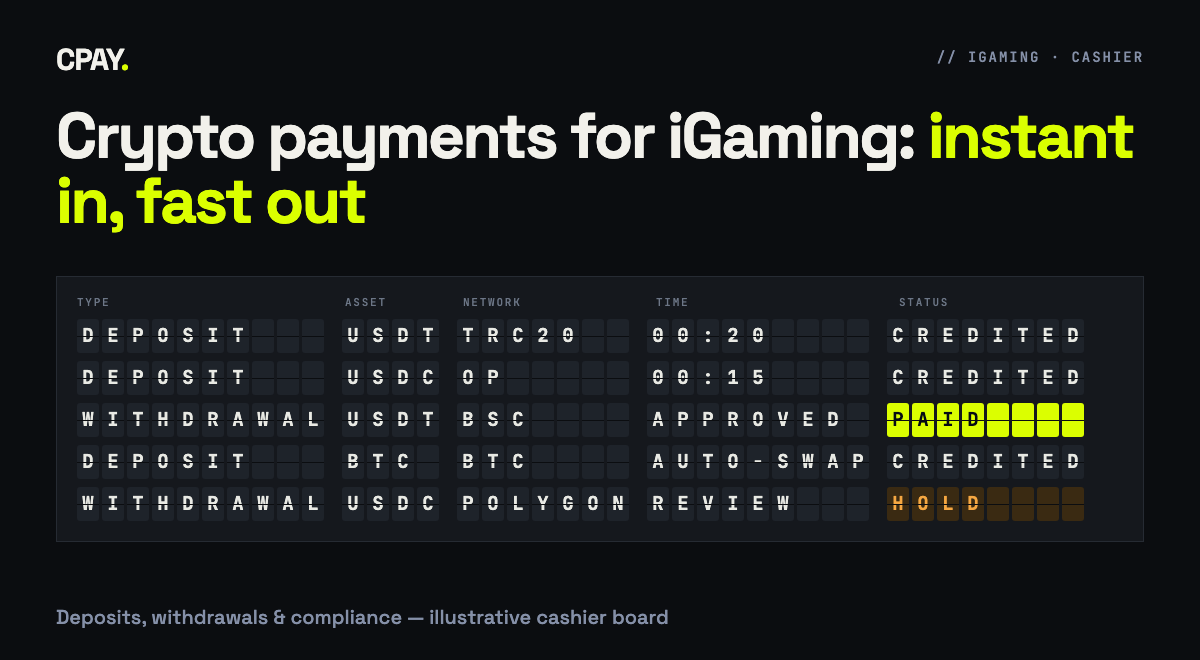
In iGaming, the cashier is the product's most honest screen. Players forgive a slow lobby; they don't forgive a deposit that hangs or a withdrawal that takes a week. That's a large part of why many operators now offer crypto next to cards: it credits deposits in minutes and can pay out winnings the same day. But "accept crypto" is the easy part. The hard part is everything around it — keeping balances stable, paying out to the right wallet, and running the same compliance programme your licence already requires. This guide walks through the cashier screen by screen, and what has to happen behind each one.
Fast in, fast out — with the same rules as before. Crypto changes the speed and cost of deposits and withdrawals. It does not change your licence conditions: player verification, AML monitoring, geo-restrictions and responsible-gambling controls all still apply. The operators who do well with crypto are the ones who build those controls into the cashier rather than around it.
Before the screens: Why operators add a crypto cashier
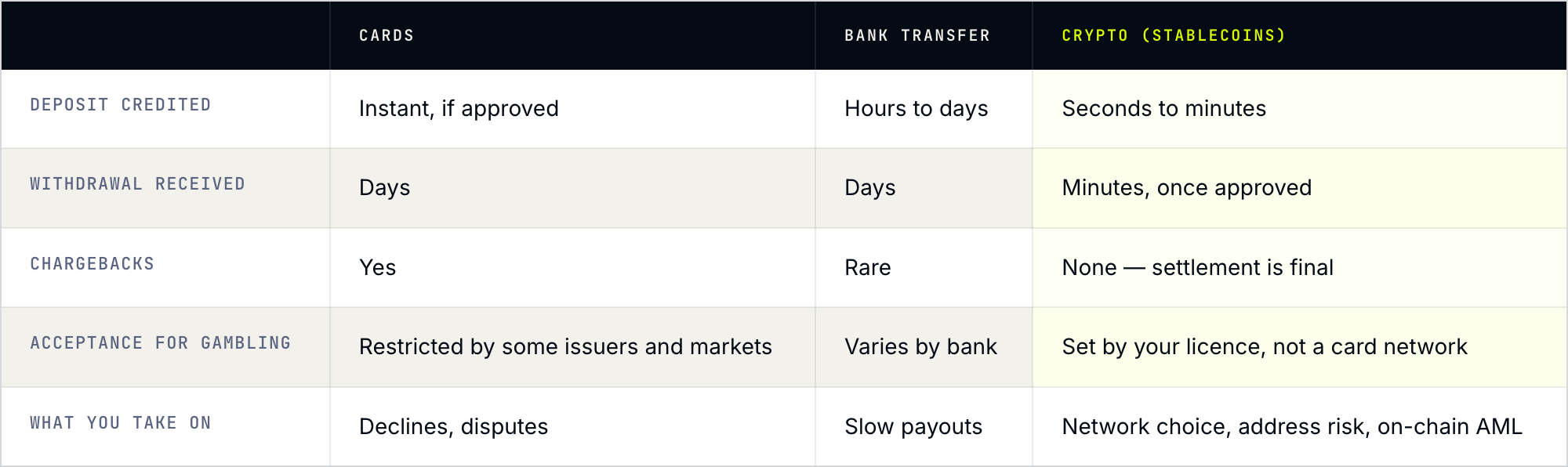
Three reasons come up again and again. Acceptance: gambling transactions are a category many card issuers and processors treat cautiously, and in some markets restrict outright — the UK, for example, has banned gambling with credit cards since April 2020. Speed: players judge a casino by how fast they get paid, and bank withdrawals measured in days lose to on-chain payouts measured in minutes. Finality: a confirmed on-chain deposit can't be charged back, which removes a class of disputes that card-funded deposits invite.
None of that is a reason to drop cards. It's a reason to give players who prefer crypto a cashier that works as well as the rest of the product — which is the job of the four screens below.
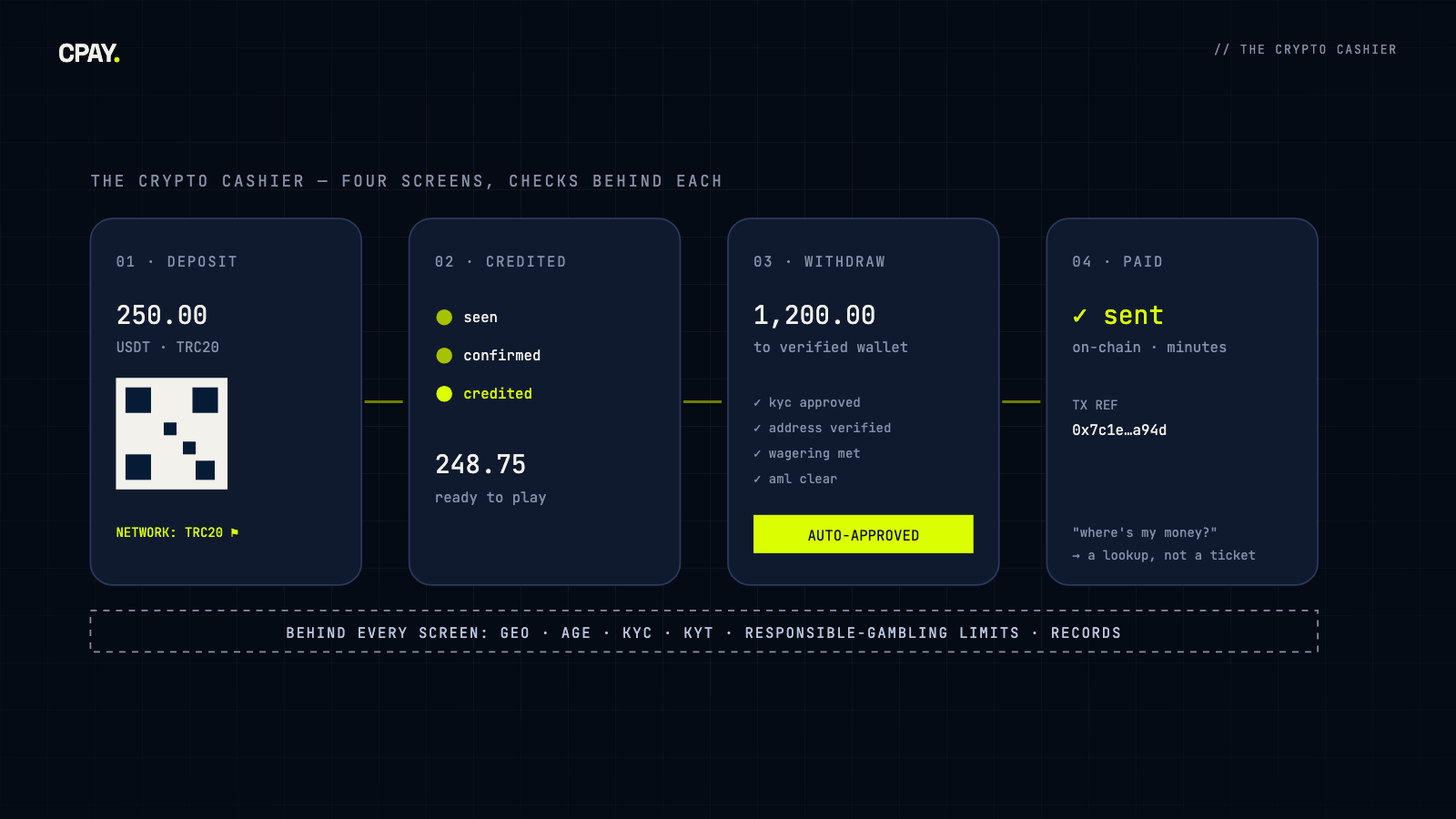
Screen 1 — Deposit: Pick an asset, pick a network, send
The deposit screen does three things: shows the player which assets and networks you accept, gives them an address (or QR code) that belongs to their account, and tells them clearly what will happen next. Two design choices make the biggest difference.
Lead with stablecoins. A balance in USDT or USDC means a $100 deposit stays $100 while the player plays; no one is surprised by what their bankroll is worth an hour later. On CPAY's iGaming rails, players can deposit stablecoins on TRC20, BSC, Polygon or Optimism, and the wider gateway accepts 100+ assets — but if you take a volatile coin, auto-swap rules can convert it into the stablecoin you keep balances in once it arrives.
Make the network impossible to miss. The most common deposit support ticket in crypto is the right token on the wrong network. Label the network next to the address in the same visual weight as the amount, and show only the combinations you actually support.
Screen 2 — Credited: From "seen" to "ready to play"
Between "the player pressed send" and "the balance went up" sits confirmation: the transaction is seen on-chain, then confirmed, then credited. How long that takes depends on the network and how many confirmations you wait for — seconds on fast chains, longer on others. Show the player which stage they're in, so a payment that's merely pending doesn't look lost.
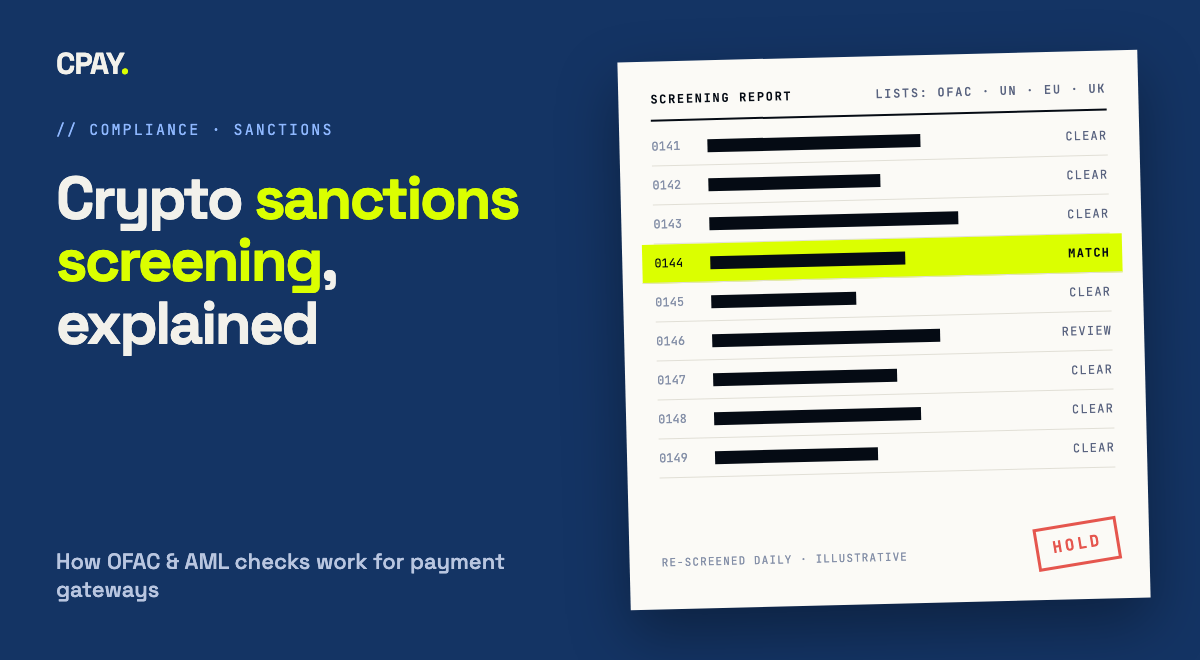
Behind the screen, this is also where the first compliance checks run. Every deposit is a transaction you can risk-score on-chain before you credit it: exposure to sanctioned addresses, mixers or other high-risk sources should raise an alert, not silently top up a balance. Our guide to sanctions screening covers how to treat those alerts.
Players remember two moments: when the money went in, and when it came out. Design the cashier around both. (A rule of thumb, not a quote.)
Screen 3 — Withdraw: The request, and the checks behind it
The withdrawal screen is where speed and control meet. Players want their winnings now; your licence wants you to know who you're paying and why. The answer is to make the checks automatic, so the payout can be too. A typical approval rule looks like this:
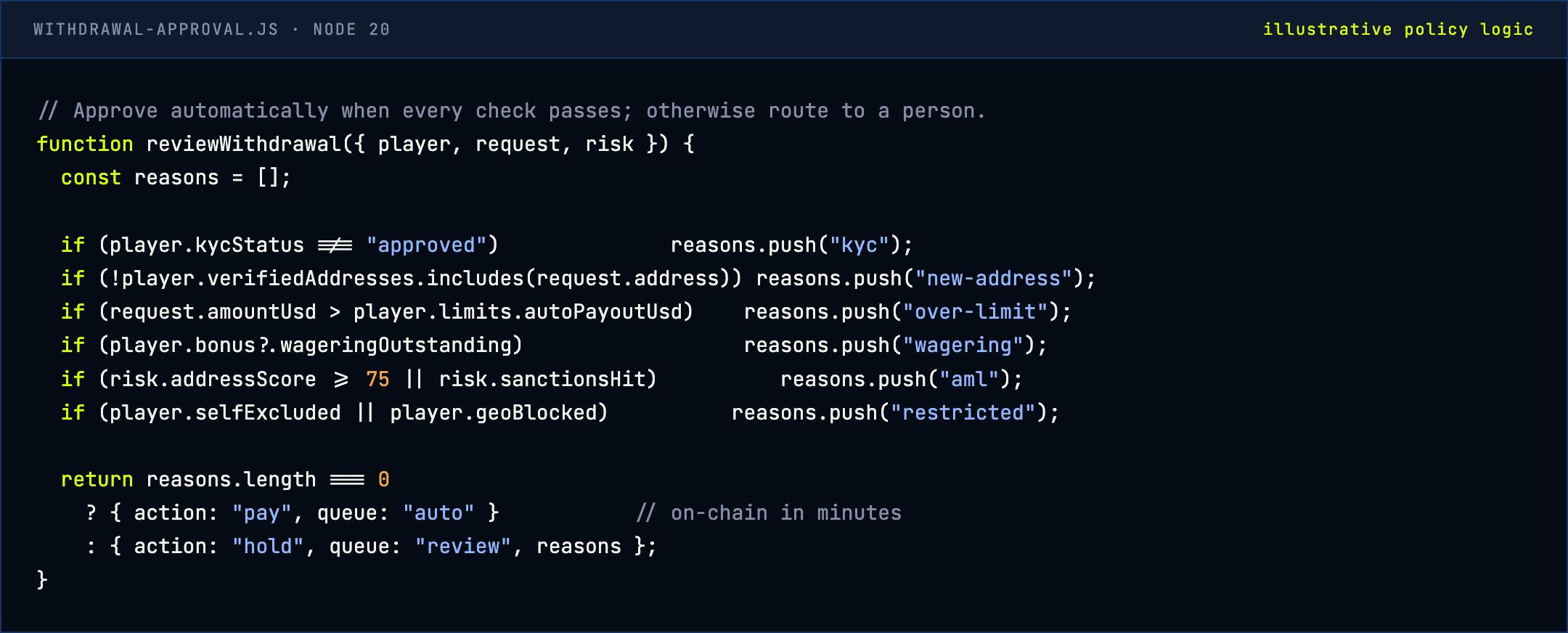
Two of those checks deserve a word. Verified addresses: pay out to a wallet the player has confirmed through their account, not to whatever address appears in a request — the crypto version of the "same method in, same method out" rule many operators already apply to cards. Thresholds are yours: small, routine withdrawals from verified players can go straight out, while large or unusual ones wait for a person. The values in the sketch are placeholders; your risk assessment and licence conditions set the real ones.
Screen 4 — Paid: Pushing the payout, one or thousands at a time
Once a withdrawal is approved, the payout itself is an outgoing on-chain transfer from the operator's wallet to the player's — minutes, not days. Show the player the transaction reference so "where's my money?" becomes a lookup, not a ticket. On the operator side, CPAY's non-custodial wallets keep each brand's funds under the operator's control, and approved withdrawals can be pushed one by one or cleared in a single batch from the dashboard or the API. Batching is also how affiliate commissions are usually paid — the same controls apply, covered in our mass payouts guide.
Side by side: The cashier on three rails
Behind every screen: Compliance doesn't change with the rail
Crypto is a payment method, not a licence. Accepting crypto doesn't change where you're allowed to operate. Players in jurisdictions your licence doesn't cover must be blocked whether they pay by card or by wallet, and location checks belong at sign-up and at every deposit. Age verification, self-exclusion and deposit limits apply to crypto deposits exactly as they do to card ones.
The rest of the programme maps directly onto the cashier; the exact requirements come from your regulator. Know your player: verification at sign-up or before the first withdrawal, according to your licence — ideally one verification that serves both the regulator and the cashier rather than two separate checks. CPAY's KYC/AML layer is designed to work from the player record you already hold for licensing, with Travel Rule support built in. Monitor transactions: on-chain risk scoring for deposits and payout addresses, plus the behavioural patterns your AML team already watches for — deposits withdrawn with little play, rapid cycling between accounts, many accounts sharing a wallet. Keep the record: every deposit, check, approval and payout traceable to a player, with the transaction hash attached.
Launch checklist: A crypto cashier in eight lines
- Assets & networks: stablecoins first, a short list of networks, each clearly labelled at deposit.
- Balances: held in a stablecoin; volatile deposits auto-converted on arrival.
- Geo & age: licence-based location blocking and age checks apply to crypto exactly as to cards.
- Deposit screening: every incoming transaction risk-scored before the balance is credited.
- Withdrawal rules: verified payout addresses, auto-pay thresholds, wagering and bonus checks.
- Responsible gambling: deposit limits, cool-offs and self-exclusion enforced at the crypto cashier too.
- Payout operations: single and batch payouts, with references shown to players.
- Records: one trail from player to deposit to payout, exportable for your regulator.
FAQ — Common follow-ups
How fast are crypto deposits and withdrawals for players?
Deposits are credited once the transaction is confirmed — seconds to minutes depending on the network and the number of confirmations you require. Withdrawals reach the player within minutes of approval, because the payout is a direct on-chain transfer rather than a bank process.
Which coins should an online casino accept?
Start with USDT and USDC on a small set of networks: stable balances, low fees and the assets players most often hold. Add BTC or ETH if your players ask for them, ideally with automatic conversion into your balance currency on arrival.
Do players still need to complete KYC?
Yes, wherever your licence requires it. The payment method doesn't change player-verification obligations. The practical goal is one verification that satisfies both the licence and the cashier, so players aren't asked twice.
Can crypto deposits be charged back?
No. A confirmed on-chain transfer is final, so there's no chargeback mechanism. Disputes are handled under your own terms — which makes clear, published withdrawal and bonus rules more important.
Does CPAY integrate with casino platforms?
CPAY connects through its REST API and webhooks, SDKs, or ready-made plugins; its iGaming page lists SoftSwiss, EveryMatrix and BetConstruct alongside custom stacks. Confirm the specifics of your platform version with the CPAY team.
Want a crypto cashier that pays out in minutes? See CPAY for iGaming or book a call.
Sources: CPAY — Crypto payment gateway for iGaming platforms, CPAY Docs — Auto-swap. Licensing and responsible-gambling requirements differ by regulator; this article is general information, not legal advice.