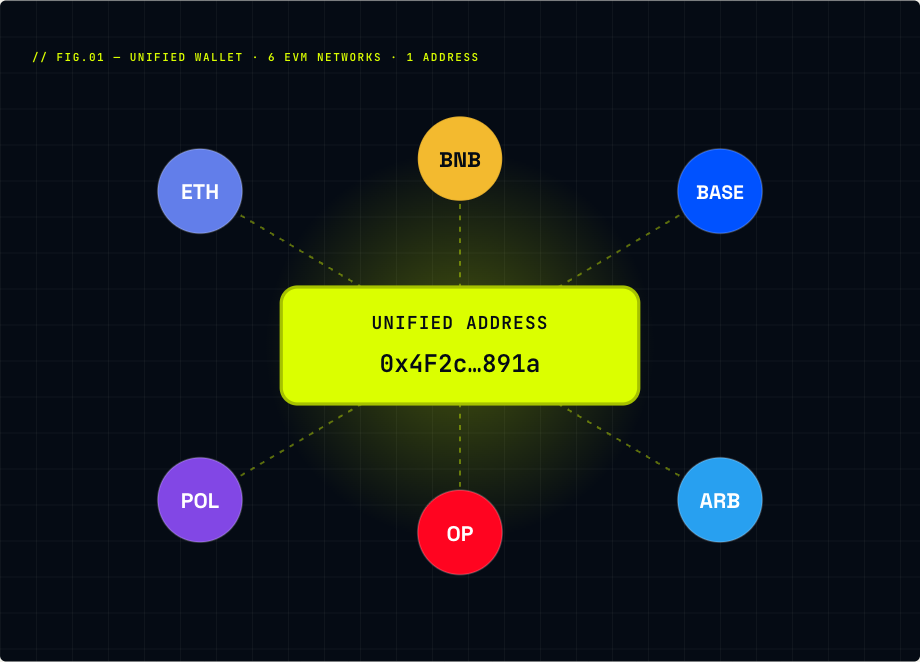
Las carteras de criptomonedas multicadena tienen un problema de UX del que nadie habla: necesitas saber en qué cadena estás, qué dirección pertenece a qué red y dónde reside cada token. Si te equivocas en cualquiera de ellos, tus fondos terminan en un lugar del que no se pueden recuperar. Hoy lanzamos Carteras Unificadas — una única dirección que funciona en todas las redes EVM que admitimos, con enrutamiento automático gestionado por CPAY.
01 — Por qué lo creamos:
El coste de la fragmentación multicadena
Las cadenas compatibles con EVM comparten el mismo formato de dirección: una cadena hexadecimal de 42 caracteres que comienza con 0x. Una dirección de cartera que funciona en Ethereum también recibirá fondos en BNB Chain, Polygon, Base y Arbitrum a nivel de protocolo . Pero hasta hace poco, casi todos los productos de cartera y procesadores de pagos trataban cada cadena como una cartera separada, con direcciones separadas, saldos separados e interfaces de usuario separadas.
Eso no fue una elección de UX. Fue una limitación de infraestructura. Las diferentes cadenas tenían distintos puntos finales RPC, diferentes tokens de gas, diferentes profundidades de confirmación y (hasta 2022 aproximadamente) suposiciones de seguridad muy diferentes. Tratar cada una como una cartera separada simplificaba la ingeniería. El coste de esa ingeniería más sencilla lo pagaban los usuarios:
- Los errores de cadena equivocada siguen siendo la principal causa de pérdidas irrecuperables en los pagos de criptomonedas. Los fondos enviados a la dirección correcta en la cadena equivocada se pierden a menos que el operador pueda recuperarlos manualmente, lo que generalmente significa que no se pueden recuperar.
- La conciliación se vuelve más difícil cuantas más cadenas admitas. Tus contables tienen que hacer un seguimiento de los saldos en N IDs de cartera, tu equipo de soporte tiene que averiguar qué red utilizó un cliente y tus paneles de control se llenan de duplicados.
- La incorporación de clientes empeora. Decirle a alguien "envía a esta dirección" es una instrucción. Decirles "envía USDT en Polygon a esta dirección, pero USDT en Ethereum a esa dirección" es una trampa de fricción.
Las Carteras Unificadas invierten el patrón. En lugar de una dirección por red, tienes una dirección que funciona en todas las redes, y CPAY gestiona el enrutamiento de forma transparente.
02 — Qué hace:
Una cartera, todas las cadenas EVM
Una Cartera Unificada es un único registro de cartera de CPAY que:
- Tiene una dirección. Una dirección EVM estándar de 42 caracteres. Se ve idéntica a una dirección de Ethereum normal porque, en el fondo, es una dirección EVM normal.
- Recibe en cualquier red compatible. Los depósitos a esa dirección se detectan automáticamente, ya sean enviados en Ethereum, BNB Chain, Polygon, Base, Arbitrum, Optimism o cualquier otra cadena EVM compatible con CPAY.
- Mantiene saldos separados por red. Verás USDT en Polygon y USDT en BNB Chain como dos entradas de saldo distintas en tu panel de control: misma dirección, cadenas diferentes, libros de contabilidad separados.
- Enruta los pagos salientes a la red correcta. Cuando retiras, eliges la red al momento de enviar. CPAY firma y transmite en la cadena correcta.
La dirección es tuya, derivada de forma determinística de las credenciales de tu cuenta CPAY. Es la misma dirección que verías en cualquier explorador de bloques si la consultaras directamente — Etherscan, BscScan, Polygonscan, todos devuelven el mismo registro porque el espacio de direcciones es compartido.

03 — Cómo funciona:
En el fondo
La criptografía aquí no es nueva — ha estado integrada en el estándar EVM desde el primer día. Lo que ha faltado es una buena infraestructura para usar esta propiedad. La mayoría de las interfaces de usuario de las carteras preguntan "¿qué cadena?" porque solo escuchan una red a la vez. La mayoría de los procesadores de pagos generan una nueva dirección por cadena porque las mantienen en espacios de nombres de alcance separados. Los productos de puente cobran tarifas por "mover" tokens que, en realidad, nunca necesitan moverse.
Las Carteras Unificadas de CPAY cierran esa brecha de infraestructura con cuatro componentes clave:
- Una clave, múltiples oyentes de cadena. Una única clave no custodial controla los fondos en cada cadena compatible. CPAY ejecuta un indexador que monitorea los depósitos a esa dirección en todas las redes simultáneamente.
- Derivación determinística por cuenta. La dirección que ves en tu cuenta se deriva de forma determinística de las credenciales de tu cuenta utilizando
BIP-32 / BIP-44a nivel de cuenta, y luego se expone como una única dirección compartida entre redes. - Contabilidad de saldos por cadena. Tu panel de control muestra los saldos por red porque eso es lo que tiene un significado económico — USDT en Polygon tiene diferente liquidez, gas y puentes que USDT en Base. La dirección está unificada; los fondos son por cadena.
- Enrutamiento al momento de enviar. Cuando retiras, CPAY firma la transacción en la red correcta. Si estás moviendo USDT de Polygon a un destinatario de Polygon, no hay puenteo involucrado — es una transacción directa de Polygon.
El cambio en la infraestructura es real, pero el cambio en la UX es lo importante: una sola dirección, sin malabarismos, enrutamiento automático. Desde fuera, parece una cartera más sencilla. Bajo el capó, es un indexador multicadena con un espacio de direcciones compartido.
04 — Antes / después:
Qué cambia realmente
Concretamente, esto es lo que cambia para una empresa que opera en múltiples cadenas.

Para tu panel de control, el número de carteras se reduce de más de 5 a 1. Entradas de la libreta de direcciones: de más de 5 a 1. La pregunta de la "red incorrecta" desaparece de los tickets de soporte al cliente. La conciliación se simplifica significativamente: misma dirección, búsquedas por cadena.
Para tus clientes, la confusión desaparece. El riesgo de cadena incorrecta desaparece. La confianza en tu plataforma aumenta, porque lo que siempre pareció frágil (las direcciones multicadena) ya no lo es.
05 — Extra incluido:
Tarifa de red dinámica
Mientras reescribíamos la lógica de la cartera, también reescribimos cómo calculamos el gas. Anteriormente, CPAY utilizaba una prima de gas fija y conservadora para asegurar que las transacciones se confirmaran rápidamente. La contrapartida: pagabas más de lo necesario durante las horas de bajo tráfico.
Ahora, cada transacción lee datos de tarifas de red en tiempo real y se ajusta. Cuando la red está tranquila (3 a.m. UTC en Ethereum, la mayor parte del tiempo en Base), pagas menos y confirmas rápido. Cuando está congestionada (un lanzamiento importante de DeFi, una acuñación de NFT, una subida de fin de semana), pagas lo que realmente se necesita para confirmar en un tiempo razonable, no el triple "por si acaso".

Confirmaciones más rápidas cuando la red está tranquila. Sin pagar de más cuando no lo está. Nada que configurar, simplemente funciona.
06 — Compromisos honestos:
Cuándo NO usar Carteras Unificadas
Existen casos reales en los que se desean billeteras segregadas por cadena. Vale la pena ser transparentes sobre las compensaciones:
- Contabilidad estricta por unidad de negocio. Si su política contable exige que los fondos de cada unidad de negocio estén en billeteras físicamente separadas —no solo etiquetadas como separadas—, las direcciones unificadas lo dificultan. En su lugar, utilice direcciones por unidad de negocio.
- Direcciones específicas para contrapartes. Algunas configuraciones de cumplimiento asignan una dirección por cada contraparte principal para el monitoreo de transacciones. Una dirección unificada puede soportar esto, pero requiere un registro contable adicional de su parte.
- Rotación de direcciones por pago. Si genera una dirección nueva para cada pago para evitar la reutilización de direcciones (privacidad, a veces seguridad), ya no se encuentra en el ámbito de las billeteras unificadas.
Para más del 90% de los casos de uso de pagos y tesorería, las Billeteras Unificadas son la opción predeterminada correcta. Para los casos excepcionales mencionados, CPAY sigue siendo compatible con las billeteras clásicas por cadena; solo tiene que desactivar el modo unificado en el interruptor del panel de control.

07 — Primeros pasos:
Dos clics para activar
¿Ya es cliente de CPAY? Cambiar es cuestión de dos clics:
- Abra su CPAY panel de control → Billeteras
- Active el control segmentado en la parte superior para Billeteras Unificadas
Eso es todo. Ahora tiene una nueva dirección EVM unificada. Las antiguas direcciones por cadena siguen funcionando; los depósitos entrantes en ellas se dirigen al mismo saldo. Nada se interrumpe durante la transición.
¿Aún no está en CPAY? Regístrese: la billetera unificada se genera inmediatamente en su primer inicio de sesión, sin tarifa de configuración, sin tarjeta de crédito. Realice un depósito de prueba en cualquier red compatible y vea cómo el saldo aparece en el panel de control en cuestión de segundos.