Ask three different platforms how they secure wallets and you'll get three different answers: a seed phrase, a multisig setup, a system built on MPC. All three can technically hold funds. Only one question actually separates them: when something breaks, what happens next?
01 — What each one actually is
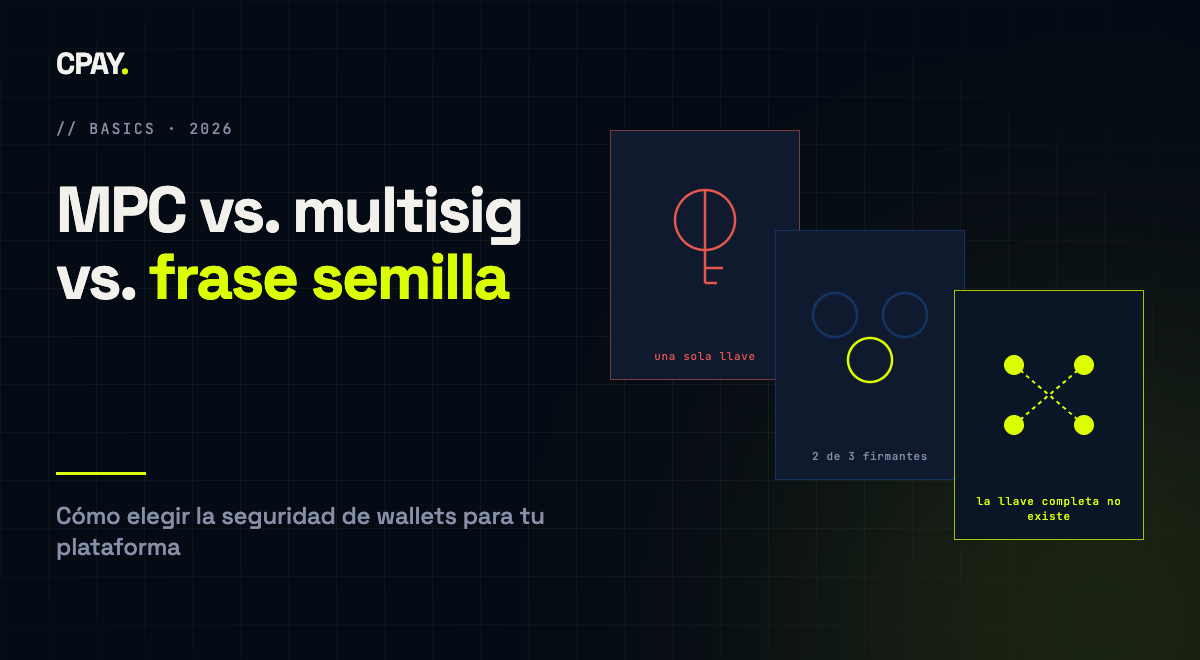
A seed phrase is a single, human-readable secret — usually twelve or twenty-four words — that reconstructs one private key. Whoever has it has complete, unconditional access. There is no partial state: the phrase is either secret, or the wallet is gone.
Multisig replaces that single key with several independent ones, requiring a threshold — say two of three — to approve any transaction, enforced directly on-chain by a smart contract.
MPC (multi-party computation) goes further: the key itself is never assembled as a whole. It exists only as distributed shares, and signing happens through a collaborative off-chain protocol — a valid signature comes out without a full key ever existing anywhere.
02 — The stress test: same four failures, three different outcomes
Definitions don't tell you which model is right for a platform. What tells you that is how each one behaves under pressure — so run all three against the failures that actually happen in production.
- Device lost or stolen. Seed phrase: funds are gone if the phrase was on it. Multisig: one key down — the others still hold the account. MPC: one share down — the remaining shares recover access.
- One credential leaks. Seed phrase: game over — the leak is the whole key. Multisig: an attacker needs the threshold, not one signature. MPC: a single share alone signs nothing.
- An insider goes rogue. Seed phrase: whoever holds the phrase holds everything. Multisig: requires collusion with other signers. MPC: can't sign without the other shares' cooperation.
- Need to swap a signer, fast. Seed phrase: regenerate everything and migrate the funds. Multisig: update the signer set on-chain and pay gas. MPC: rotate shares — funds and address never move.
With a seed phrase there is no partial failure state — the whole key is either safe or it isn't. Multisig and MPC both survive a single point of failure the same way, structurally: one incident becomes something to respond to, not a catastrophe to recover from.
03 — Insiders and change
A departing or coerced employee who holds the seed phrase holds the entire account, unconditionally. Multisig requires that person to get collusion from other signers — a meaningfully higher bar, though not an impossible one if the signer set is small. MPC creates the same requirement structurally, with one added benefit: shares can typically be rotated without ever moving the underlying funds.
That last point matters more than it looks. With a seed phrase, the only real option after a compromise is generating a new wallet and migrating funds live, under time pressure. Multisig makes it a defined on-chain operation with its own gas cost. MPC handles it internally: shares rotate, the wallet's address and funds never move at all.
A security model that only gets tested in the demo isn't tested at all. The one that matters is the day a device goes missing or someone walks out the door.
04 — Trade-offs: what each one costs you
Seed phrase is simple and universally understood, but that simplicity is exactly what makes it fragile — one point of failure, no recovery path, no way to bound the damage of a single mistake.
Multisig is transparent and enforced on-chain, a real strength for auditability — but every signer change and every recovery action is a visible, gas-costing transaction, and support is uneven across chains.
MPC is chain-agnostic and its policy logic lives off-chain, which makes rotation and recovery cheap and largely invisible — but it depends entirely on the quality of the implementation behind it. Ask any MPC provider how shares are generated, stored, and rotated, and whether the protocol has been independently audited — "trust us" is not an answer for infrastructure holding real funds.
05 — When a seed phrase still makes sense
- A single developer's testnet wallet. No real funds, no other stakeholders — the overhead of shares or signer coordination buys nothing.
- A cold-storage reserve with one clearly accountable owner. Air-gapped and rarely touched — simplicity is a feature when almost nothing should be able to move it.
- An individual's personal wallet. One person, one set of consequences, full informed consent to the trade-off — a different risk profile than a platform holding wallets for users.
Outside these three, a seed phrase behind a platform's production treasury is usually a decision nobody explicitly made — it's just what came out of the box.
06 — Choosing: what fits your platform
A platform processing real volume, holding user trust, or operating many wallets across a team outgrows the seed phrase model quickly. Between multisig and MPC, the deciding factor is usually operational: multisig suits platforms that want every control action visible and enforced on-chain with a small, stable signer set. MPC suits platforms that need frequent signer changes, low operational overhead, and chain-agnostic wallets — including ones issuing wallets programmatically to many users or agents, where rotation and recovery can't require moving funds or paying gas every time something changes.
Every key-security model looks fine until it's tested. The difference between a seed phrase, multisig, and MPC isn't which one is easiest to explain in a pitch — it's which one survives the day a device disappears, a credential leaks, or someone who shouldn't have access anymore still does.