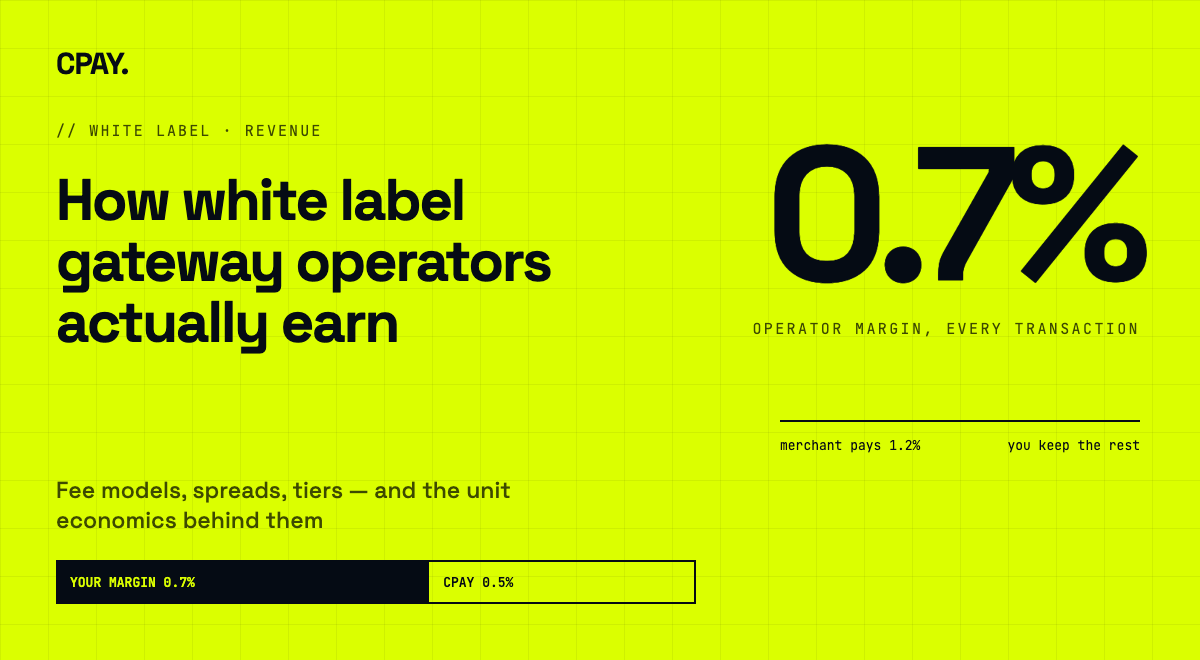
Ask an operator why they launched a white-label gateway and the answer is rarely about technology — it's a margin story. The infrastructure costs a flat 0.5% per transaction; everything charged above that line is revenue the operator designed. This article is about designing that line well.
01 — The fee stack, from the merchant's card to your ledger
Every transaction through a white-label gateway carries one visible price and two invisible layers. The merchant sees your fee — say 1.2%. Underneath it sits the infrastructure cost — CPAY's flat 0.5% — and between the two lives the operator margin. Unlike card acquiring, there are no interchange tables, no scheme fees, no rolling reserve eating the difference: the stack is two layers, and you control the top one.
That simplicity is the whole design space. Price too high and merchants compare you to going direct; price too low and volume can't carry the business. The operators who get it right treat the fee not as a number but as a portfolio — which is where the levers come in.
02 — The four revenue levers
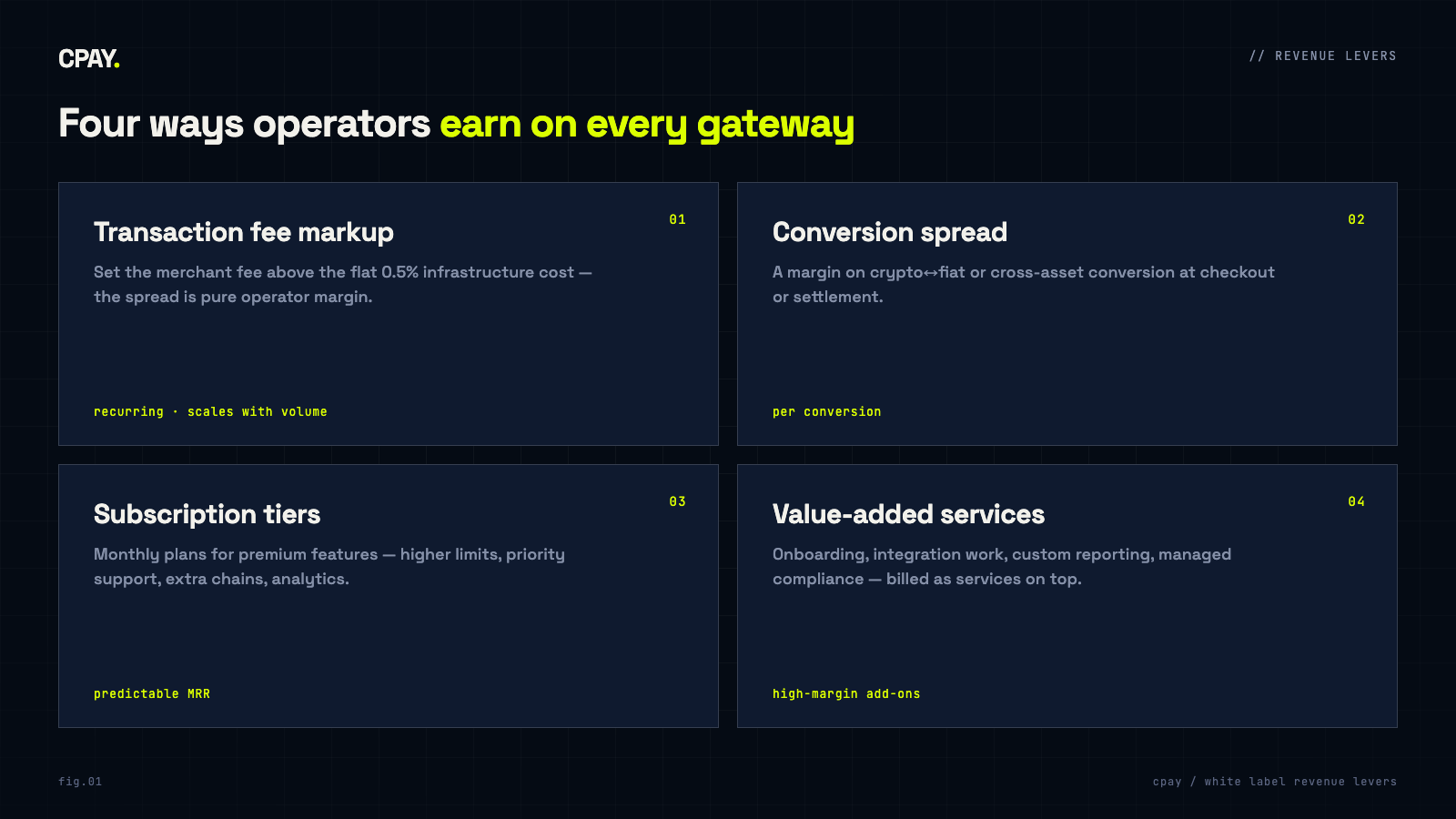
Transaction markup is the workhorse — recurring, predictable, scaling one-to-one with merchant volume. Conversion spread monetizes the crypto-to-fiat moment, where merchants are least price-sensitive because the alternative is managing treasury themselves. Subscription tiers turn power users into MRR — higher limits, more chains, analytics, priority support. And value-added services — integration work, custom reporting, managed compliance — carry the highest margins precisely because they're sold as expertise, not infrastructure.
Mature operators rarely run on one lever. The healthiest mix in practice: markup as the base, spread as the multiplier, subscriptions as the stabilizer.
03 — One month on the receipt
Here's what the mix looks like on a concrete, illustrative month — a mid-size operator processing $1M of merchant volume:
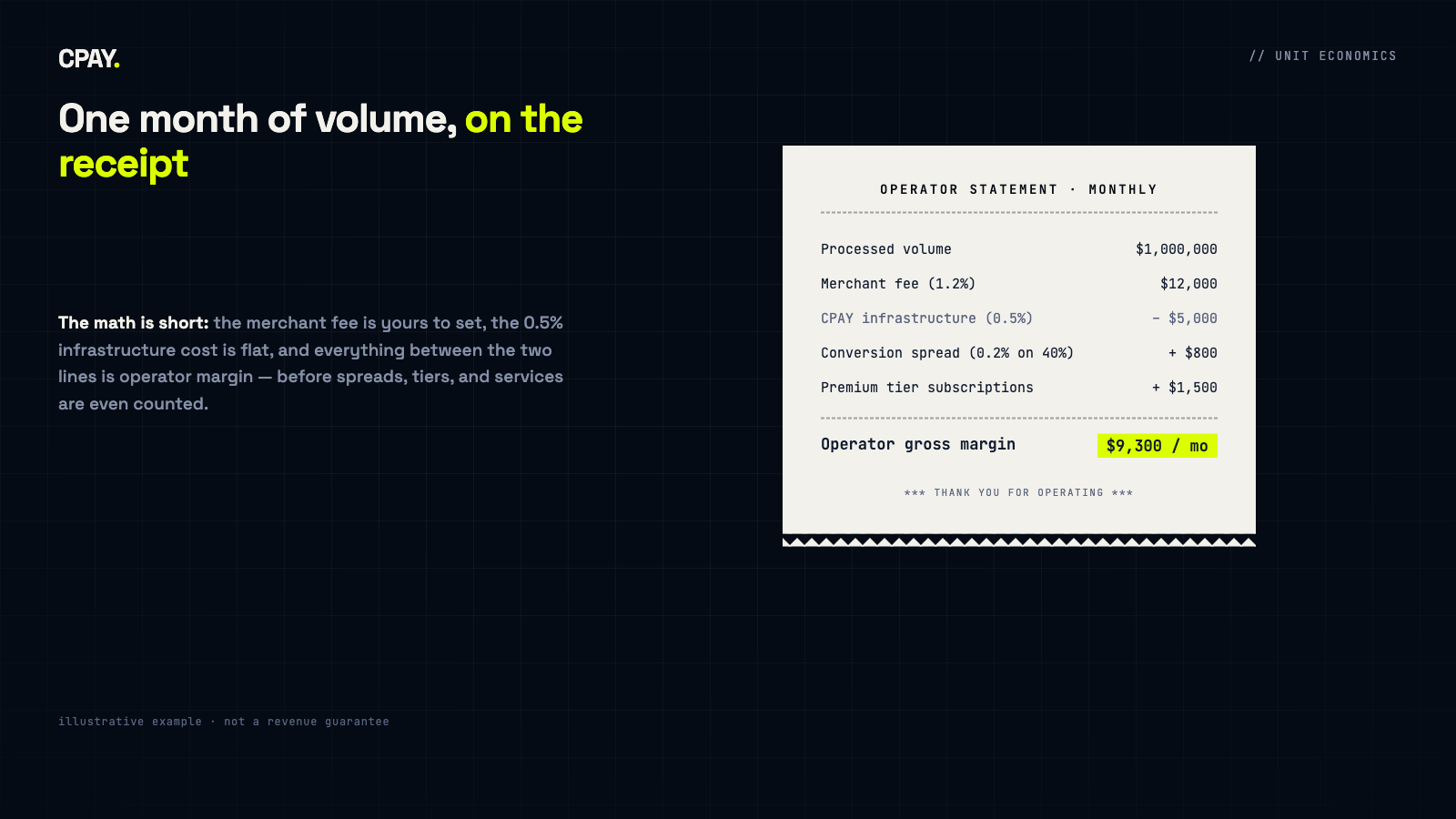
Two things worth noticing in that statement. The infrastructure line is the only fixed-rate cost on it — there is no minimum, no monthly platform fee scaling against you, so the margin exists from the first dollar of volume. And the two smaller lines — spread and subscriptions — add roughly a third on top of the markup margin, which is typical: the levers compound quietly.
The markup pays for the business. The spread and the tiers are where the business becomes profitable.
04 — The pricing mistakes that eat the margin
- Racing to the bottom on the headline rate. Merchants churn over reliability and settlement speed far more than over twenty basis points. Competing at 0.6% leaves nothing to operate on.
- Giving the spread away. Auto-conversion priced at cost is the most common silent loss — merchants value the convenience; charge for it.
- One price for every merchant. A high-volume exchange and a small e-commerce store have different alternatives and different price sensitivity. Tiered pricing isn't complexity — it's captured margin.
- Ignoring the fixed-fee floor. On very small transactions a pure percentage fee can round to nothing; a modest minimum per transaction protects the unit economics.
05 — Designing your fee card
The practical sequence: start from your merchants' next-best alternative and price just under the pain of switching; put the markup where volume is, the spread where convenience is, and the subscriptions where power users are; and revisit the card quarterly against actual volume — the right price at $200K/month is the wrong price at $2M.
The infrastructure side of the equation stays flat — 0.5% per transaction on CPAY's white-label gateway — which means every basis point you design above it is yours. The gateway is the product you run; the fee card is the product you own.