How do you give users full ownership of their crypto without turning your product into a custodian — and without sacrificing usability, scale, or security?
This question increasingly defines how serious crypto products are built. Wallets are no longer optional add-ons or standalone apps for advanced users. They have become a core layer inside payment platforms, fintech products, marketplaces, and on-chain services. And the moment a company touches private keys, it also inherits regulatory exposure, operational risk, and a fragile trust model.
Non-custodial crypto wallet API infrastructure emerged as a response to this tension. It allows platforms to deliver full wallet functionality while structurally avoiding custody.
Why Non-Custodial Infrastructure Became Inevitable
Early crypto products often chose custody for speed. It simplified onboarding and reduced user error. Over time, however, the drawbacks became obvious.
Custodial systems concentrate risk. Assets, liability, compliance, and technical responsibility collapse into a single operational layer. Any failure — technical, legal, or organizational — directly impacts user funds.
Non-custodial infrastructure inverts this model. Control is cryptographic, not contractual. Users retain ownership, while platforms focus on orchestration, reliability, and experience. This shift aligns far better with both regulatory direction and user expectations.
What “Non-Custodial” Really Means at the Infrastructure Level
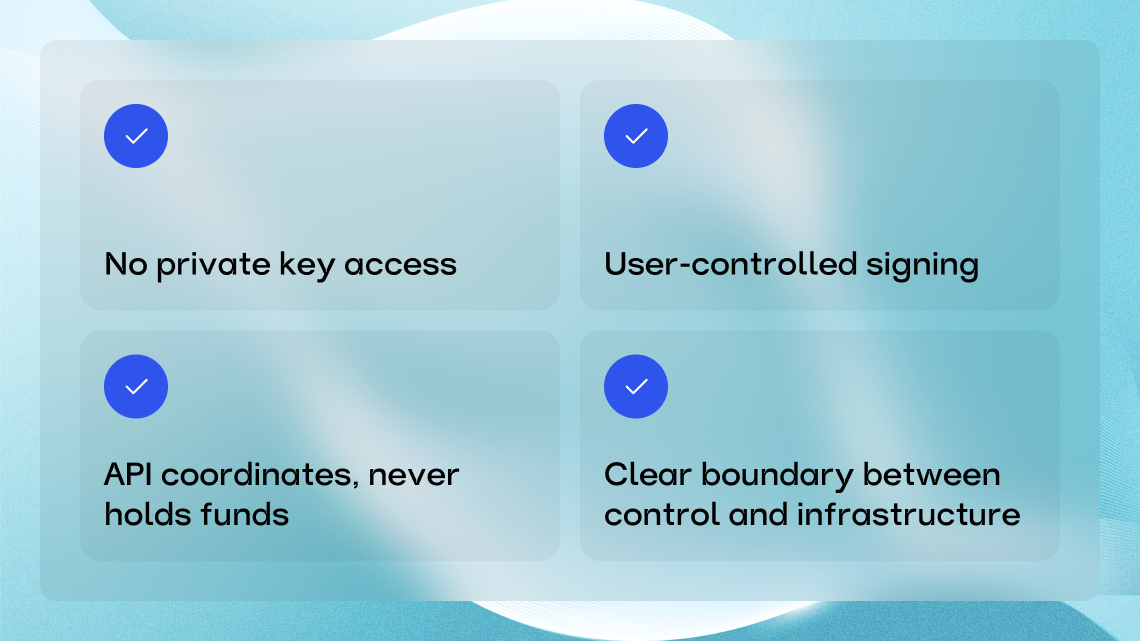
Non-custodial wallet infrastructure is often misunderstood as “keys live on the client.” In reality, it is a broader architectural principle.
The infrastructure layer provides wallet creation, transaction construction, network communication, indexing, and monitoring. What it deliberately does not do is hold or reconstruct full private keys.
Modern systems rely on distributed signing, secure execution environments, and recovery models that avoid single points of compromise. The API coordinates actions, but never becomes the owner of funds.
This separation is subtle but fundamental. It defines where responsibility ends — and where it does not begin.
The Hidden Complexity Wallet APIs Are Designed to Absorb
Building a wallet is not about generating a key pair. It is about managing everything around that key.
Blockchains differ in fee mechanics, confirmation models, nonce logic, address formats, and transaction lifecycles. Without abstraction, this complexity leaks directly into product design.
Non-custodial wallet APIs act as a normalization layer. They unify multi-chain behavior behind consistent interfaces, allowing developers to think in terms of intent rather than protocol rules. Transactions become predictable. Balances stay coherent. User experience remains stable even as underlying networks evolve.
This is where infrastructure quietly determines product quality.
Security Without Custody
One of the most important shifts enabled by non-custodial architecture is how security is enforced.
Instead of controlling assets, infrastructure systems control execution flows. Transactions can be simulated before signing, analyzed for anomalies, rate-limited, or delayed for additional verification. Recovery mechanisms can be offered without access to funds. Risk is mitigated without seizing control.
This model preserves user sovereignty while still meeting professional security standards — something custodial wallets often struggle to balance.
Why API-First Design Changes the Business Equation
From a business perspective, non-custodial wallet APIs reduce friction far beyond engineering.
They lower regulatory exposure, simplify market expansion, and reduce liability tied to asset storage. They also make partnerships easier, since wallet functionality can be embedded without transferring custody responsibilities between parties.
API-first infrastructure turns wallets into modular components rather than core liabilities. That flexibility becomes a competitive advantage as products scale.
Infrastructure vs. Wallet Applications
It is important to draw a clear line between wallet infrastructure and wallet apps.
Wallet apps focus on interface and user interaction. Infrastructure focuses on uptime, throughput, security guarantees, and integration depth. The two solve different problems and operate on different timelines.
Most scalable crypto products today do not build wallets from scratch. They build on infrastructure layers that abstract complexity and let teams focus on differentiation rather than protocol maintenance.
Where Non-Custodial Wallet Infrastructure Is Headed
The trajectory is clear. Wallet APIs are evolving into programmable financial accounts.
Account abstraction is reducing friction around signing and fees. Gas abstraction is making transactions invisible to users. Cross-chain routing is becoming native. Compliance signals are embedded without custody. Crypto and fiat rails are converging behind unified interfaces.
In this model, the wallet is no longer a tool. It is an access layer to value.
CPAY and API-Level Non-Custodial Infrastructure
For teams that want to build self-custodial products without absorbing custody responsibility, CPAY provides an API-first wallet infrastructure designed specifically for this purpose.
The platform offers a non-custodial architecture where keys remain under user control, while CPAY handles transaction orchestration, multi-chain support, indexing, and system reliability. This approach allows companies to integrate wallets, payments, and on-chain functionality through a unified API, keeping the product scalable and the asset layer fully independent.
More details: https://cpay.world/crypto-wallet-api
Final Thoughts
Non-custodial crypto wallet API infrastructure is no longer a niche choice for ideologically driven teams. It is a pragmatic foundation for products that want to scale without inheriting risks they were never meant to carry.
By separating control from coordination, these systems allow companies to build powerful financial products while respecting user ownership by design.
The future of wallets will not be defined by who holds the keys.
It will be defined by who builds the most reliable, invisible, and user-centric rails around them.