What is a crypto payment gateway? How it works in 2026
The crypto equivalent of a card processor — but built on public blockchains. Here is what a crypto payment gateway is, how the payment flow actually works end to end, and what separates a modern 2026 gateway from a basic one.
If you sell online, you already understand a payment gateway: it is the layer that takes a customer's money and gets it into your account. A crypto payment gateway does the same job on public blockchains — it lets a business accept, verify, and settle cryptocurrency payments without dealing with blockchain complexity directly. This guide explains what it is, how the flow works step by step, and what to look for in 2026.
01 — What a crypto payment gateway actually is
A crypto payment gateway is the infrastructure that connects a business to blockchains so it can get paid in crypto. It creates payment requests, detects incoming transactions, confirms them, tells your system what happened, settles the funds, and lets you pay out — all through a simple API or plugin, so your team never has to write blockchain code.
It is easy to confuse three things, so it is worth separating them clearly:
- A wallet stores keys and holds funds. It is where money sits.
- An exchange trades one asset for another. It is where money is converted.
- A payment gateway orchestrates getting paid: request, detect, confirm, notify, settle, pay out. It is the process around the money.
The closest analogy is a traditional processor like the ones behind card checkouts. The job is identical — accept a payment and settle it to the merchant — but the rails are different. Instead of card networks and banks, a crypto gateway runs on blockchains, which changes the economics (lower, more predictable fees), the speed (minutes, not days), and the risk profile (no chargebacks, on-chain verifiability).
The reason a dedicated gateway exists at all is that accepting crypto directly is deceptively hard. There are dozens of networks, each with its own confirmation rules, fee tokens, and quirks. Payments can arrive short, arrive late, or land on the wrong chain. Exchange rates move between the moment a price is shown and the moment funds clear. Compliance obligations apply the same way they do to any money movement. Building and maintaining all of that in-house is a serious, ongoing engineering commitment that has nothing to do with your actual product. A gateway exists so you can treat "accept crypto" as a feature you switch on — not as a second business you have to run.
02 — How a crypto payment gateway works, step by step
The whole point of a gateway is to turn a messy on-chain reality into a clean, predictable flow. Here is what actually happens when a customer pays.
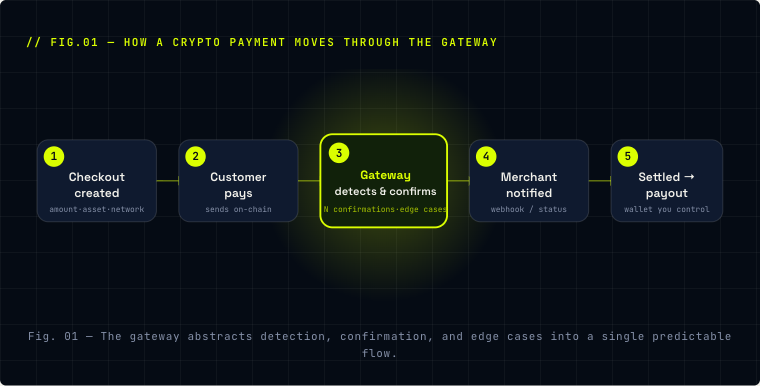
- Checkout created. Your system asks the gateway — via API, a hosted checkout link, or a plugin — for a payment of a given amount, asset, and network. The gateway returns a payment address and a checkout (often with a QR code).
- Customer pays. The customer sends the crypto from their own wallet to that address on the chosen network. Nothing about your infrastructure touches the blockchain directly.
- The gateway detects and confirms. The gateway's indexers watch the chain and see the incoming transaction within seconds, then wait for the required number of block confirmations before treating it as final. This is also where the hard parts live — underpayments, overpayments, late transfers, and wrong-network deposits are all handled here.
- Your system is notified. A webhook (callback) tells your backend the payment status — paid, pending, or failed — so an order can be fulfilled or a service unlocked automatically, without anyone checking a block explorer.
- Settlement and payout. The funds are credited to your balance. In a non-custodial gateway they land in a wallet you control, ready to withdraw, auto-forward, or use for your own payouts.
You can plug into this flow in three ways, depending on how much control you want. A hosted checkout is the fastest — the gateway hosts the payment page and you just redirect to it. A direct API integration gives you full control over the experience and is what most product teams build against. And a ready-made plugin for platforms like Shopify or WooCommerce gets a store live with almost no code. All three drive the same underlying flow.
One detail is worth understanding because it defines the whole model: confirmations. A blockchain transaction is not final the instant it appears — it becomes progressively harder to reverse as more blocks build on top of it. The gateway's confirmation policy (how many blocks to wait, per network and per amount) is what turns "a transaction showed up" into "this payment is safe to act on." Too few confirmations is risky; too many is needlessly slow. Getting that balance right, per chain, is a large part of what you are actually paying a gateway to do.
From the customer's side it feels like any modern checkout. From your side, weeks of blockchain engineering are replaced by a few API calls.
03 — Custodial vs non-custodial gateways
The single most important difference between gateways is who holds the funds. It shapes your risk, your control, and your compliance exposure.
- Custodial — the gateway holds incoming funds in its own pooled wallets and then settles to you. Convenient, sometimes with an easier fiat off-ramp, but you carry counterparty risk: your money sits behind someone else's keys.
- Non-custodial — the keys stay with you. The gateway orchestrates detection, confirmation, and settlement, but never takes possession of your funds. There is no shared pool to breach, and every transaction is verifiable on-chain.
For businesses that care about control and want to avoid the failure modes that have sunk custodial platforms, non-custodial has become the default expectation in 2026.
What this means for security and compliance
Custody and compliance are two different questions, and a good gateway answers both. On the security side, a non-custodial model removes the single biggest target — a pooled wallet holding everyone's funds — and, in modern systems, protects keys with MPC or multisig rather than a lone private key. On the compliance side, accepting crypto does not exempt a business from the rules that govern any money movement: identity checks (KYC), anti-money-laundering screening (AML), and, increasingly, Travel Rule data exchange between providers. A capable gateway builds these in so you can stay compliant without assembling a separate stack — a point we return to in the buyer's guide below.
04 — What a modern gateway handles for you
A basic gateway takes a payment. A modern one absorbs the entire operational surface of crypto so you do not have to. Expect it to handle:
- Multichain and multi-asset — many networks and 100+ assets, including stablecoins, from one integration.
- Address generation and detection — a payment address per checkout and real-time monitoring across chains.
- Confirmation policy and edge cases — under- and overpayments, late or wrong-network transfers, and expiry, all resolved predictably.
- Dynamic network fees — gas calculated at send time so you neither overpay nor stall during congestion.
- Webhooks and idempotency — reliable notifications your system can trust, even through restarts.
- Reporting and reconciliation — clean records that match your accounting.
- Payouts and multisend — send funds out, in bulk when needed.
- Compliance — KYC, AML, and Travel Rule support where required.
Complexity in, simplicity out. A good gateway turns the entire messy reality of blockchains — networks, confirmations, fees, edge cases, compliance — into a single API and a predictable settlement. That abstraction is the product.
05 — Fees and settlement
Crypto gateway pricing is usually simpler than card pricing. You typically pay a transaction fee — often below 1%, for example a flat 0.5% — plus the underlying network (gas) fee. There is no interchange, no monthly card scheme complexity, and no chargeback risk, because on-chain settlement is final.
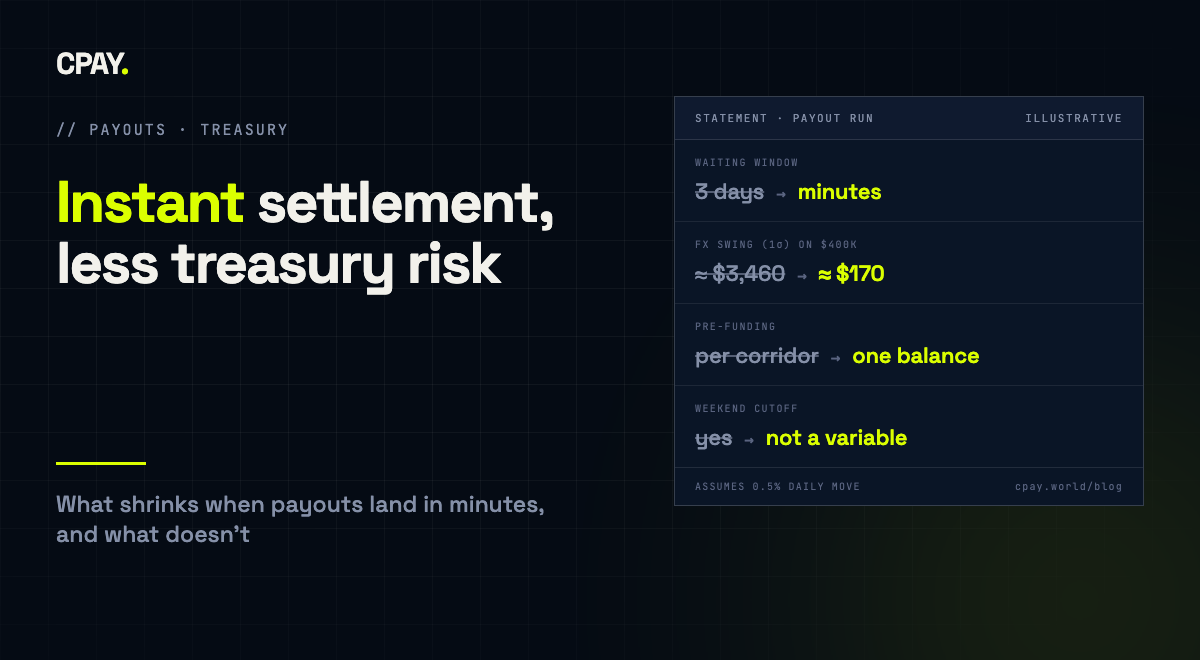
Speed is the other advantage. Card payments often settle in two business days; a crypto payment settles in minutes. With stablecoins such as USDT and USDC, that fast settlement comes without price volatility — you receive dollar-pegged value that is easy to reconcile and use. For a business, faster and more predictable settlement is not a cosmetic win; it is working capital freed up on every transaction.
How it compares to a traditional card gateway
Put the two side by side and the differences are consistent:
- Fees — las comisiones de intercambio, esquema y procesador de las redes de tarjetas, a menudo del 2-3% o más; una pasarela de criptomonedas suele cobrar una única tarifa plana inferior al 1%, más el coste del gas de la red.
- Contracargos — las tarjetas permiten reversiones y "fraude amistoso" semanas o meses después; la liquidación en cadena es definitiva, por lo que los contracargos simplemente no existen.
- Liquidación — las tarjetas liquidan en días (T+2); las criptomonedas liquidan en minutos (T+0).
- Alcance — las tarjetas dependen de los bancos emisores y la geografía; las criptomonedas funcionan en cualquier lugar con conexión a internet.
- Transparencia — los flujos de las tarjetas son en gran medida opacos para el comerciante; cada transacción de criptomonedas es verificable en un libro mayor público.
Nada de esto convierte a las criptomonedas en un reemplazo universal — las tarjetas siguen ganando en familiaridad para el consumidor general, y la mayoría de las empresas utilizan ambas. Pero para operaciones transfronterizas, con altas comisiones o propensas a contracargos, la economía de las pasarelas es difícil de refutar.
"El trabajo de una pasarela de pagos es hacer invisible la parte difícil. En el ámbito de las criptomonedas, la parte difícil es todo lo que hay entre 'el cliente lo envió' y 'podemos confiar en ello' — y eso es exactamente lo que gestiona la pasarela."
06 — Qué buscar en una pasarela de pagos de criptomonedas en 2026
No todas las pasarelas son iguales. Si vas a elegir una este año, compárala con esta referencia:
- Opción sin custodia — las claves y los fondos permanecen contigo.
- Soporte para stablecoins — USDT y USDC como mínimo, para eliminar la volatilidad.
- Cobertura multicadena y comisiones bajas y dinámicas — paga por la ruta más económica posible.
- Una API real y webhooks fiables — con sandbox y documentación clara.
- Manejo robusto de casos límite — pagos insuficientes/excedentes, red incorrecta, caducidad.
- Cumplimiento normativo integrado — KYC, AML y Travel Rule donde opere.
- Desembolsos y multienvío — para que el dinero entre y salga con la misma facilidad.
- Precios transparentes y fijos — sin márgenes ocultos.
- Opción de marca blanca — si desea ofrecer la experiencia bajo su propia marca.
07 — Quiénes utilizan pasarelas de pago de criptomonedas
El patrón es el mismo en negocios muy diferentes: buscan una liquidación más rápida, comisiones más bajas, sin contracargos y un alcance global. Esto incluye eCommerce y marketplaces, iGaming y apuestas, forex y plataformas de trading, SaaS y suscripciones, educación en línea, casas de cambio y fintechs, y B2B flujos donde las facturas y pagos transfronterizos son lentos y costosos en los sistemas tradicionales.
08 — Dónde encaja CPAY
CPAY es una pasarela de pago de criptomonedas sin custodia e infraestructura de monedero: acepta más de 100 activos a través de múltiples redes con una tarifa fija inferior al 1%, con soporte para stablecoins, una API abierta y un proceso de pago alojado, webhooks fiables, pagos y envío múltiple, KYC/AML, y una opción de marca blanca — mientras las claves permanecen en tu poder. Es la capa de pago descrita anteriormente, lista para integrar, sin el compromiso de la custodia.
09 — Preguntas Frecuentes
¿Es una pasarela de pago de criptomonedas lo mismo que un monedero de criptomonedas?
No. Un monedero almacena claves y guarda fondos; una pasarela orquesta los pagos — procesos de pago, detección, confirmación, notificaciones, liquidación y desembolsos. Una pasarela sin custodia utiliza monederos que tú controlas, pero la pasarela es la capa de pago que los rodea.
¿Cuánto tiempo tarda en confirmarse un pago de criptomonedas?
Normalmente, de segundos a unos pocos minutos. La pasarela detecta la transacción casi de inmediato, luego espera las confirmaciones de bloque requeridas, que varían según la red y el importe. Las cadenas más rápidas y las transferencias de stablecoins se confirman en segundos.
¿Cuánto cuesta una pasarela de criptopagos?
Normalmente, una comisión por transacción —a menudo inferior al 1%, por ejemplo, un 0,5% fijo— más la comisión de red (gas). Esto se compara favorablemente con los sistemas de tarjetas, que añaden comisiones de intercambio, comisiones del procesador y exposición a contracargos.
¿Tengo que mantener criptomonedas para usar una?
No necesariamente. Con stablecoins como USDT y USDC, aceptas y liquidas en valor vinculado al dólar, evitando la volatilidad. Con una pasarela no custodial, los fondos permanecen en las carteras que controlas desde el momento en que se liquidan.
¿Qué ocurre si un cliente paga de menos o envía en la red equivocada?
Una pasarela capaz detecta estos casos límite y los informa a través de su sistema de estado y webhook: un pago insuficiente se señala (a menudo con la opción de solicitar la diferencia), un pago en exceso se abona, y las transferencias en red equivocada o tardías se hacen visibles en lugar de perderse silenciosamente. Gestionar esto de forma predecible es una parte fundamental de lo que separa una pasarela robusta de una básica.
¿Es conforme a la normativa aceptar pagos con criptomonedas?
Sí, cuando se implementan los controles adecuados. Los pagos con criptomonedas están sujetos a las mismas normas de movimiento de dinero que cualquier otro, por lo que una pasarela debe admitir verificaciones de identidad KYC, cribado AML e intercambio de datos de la Regla de Viaje cuando sea necesario. Las obligaciones exactas dependen de tu jurisdicción y tipo de negocio.
Conclusión
Una pasarela de criptopagos no es una cartera, un exchange ni un misterio. Es la misma idea que cualquier procesador de pagos —aceptar dinero y liquidarlo—, implementada en sistemas que son más rápidos, más baratos y finales. Comprende el flujo, insiste en el control no custodial, y el resto es solo integración.