White label crypto payment gateway: how to launch your own in 2026
Nine months, or six weeks. Both get you a crypto payment gateway with your name on it. The difference is what you spend those months — or weeks — actually doing. What follows is a composite scenario, drawn from how these launches typically play out.
The board says yes. Now what?
A regional payment service provider — call it Northwind Pay — has spent eight years wiring up cards and bank transfers for mid-market merchants across a few neighboring countries. Merchants keep asking about crypto. The board finally says yes. And the question that lands on the CTO's desk isn't "should we do this" — it's "do we build it, or do we buy it and put our name on top?"
That question has a real cost attached either way. Build it, and the company becomes, whether it intends to or not, a crypto infrastructure business: key management, multi-chain support, security audits, compliance, an on-call rotation for a system that never sleeps. Buy it — white label it — and Northwind gets the same branded product, the same merchant relationships, the same pricing control, on top of infrastructure someone else already built and hardened.
The CTO does the honest math. Building would mean six to twelve months and a permanent security team the company doesn't have and doesn't want to become. White label means weeks — and the brand, the pricing, and the merchant relationships stay exactly where they belong: with Northwind.
Choosing infrastructure, not a slogan
The pitch decks all look similar. What actually matters turns out to be a short, unglamorous checklist, and Northwind's team works through it line by line.
Is the underlying gateway non-custodial? This is the question that gets asked first, and for good reason — if the provider pools merchant funds in its own wallets, Northwind has just adopted someone else's single point of failure without a say in how it's managed. A provider outage, insolvency, or bad day becomes Northwind's crisis, inherited rather than chosen. Non-custodial infrastructure means funds settle to wallets Northwind or its merchants control — the provider orchestrates, but never holds.
Is the branding actually invisible? Some "white label" products still leak the underlying provider's name somewhere — a support email footer, an API response header, a line in the terms of service. Northwind's merchants need to see one name only: Northwind's.
What does the fee structure actually look like? The provider quotes Northwind a flat rate. Everything above that, charged to merchants, is Northwind's to keep. That gap is the entire business model, and it needs to be large enough to fund support and compliance overhead while still beating what merchants would pay elsewhere.
Is compliance tooling built in, or bolted on? KYC, AML, and Travel Rule support that comes with the platform saves Northwind from assembling a compliance stack from zero — critical, since the team has eight people, not eighty.
Six weeks, start to first transaction
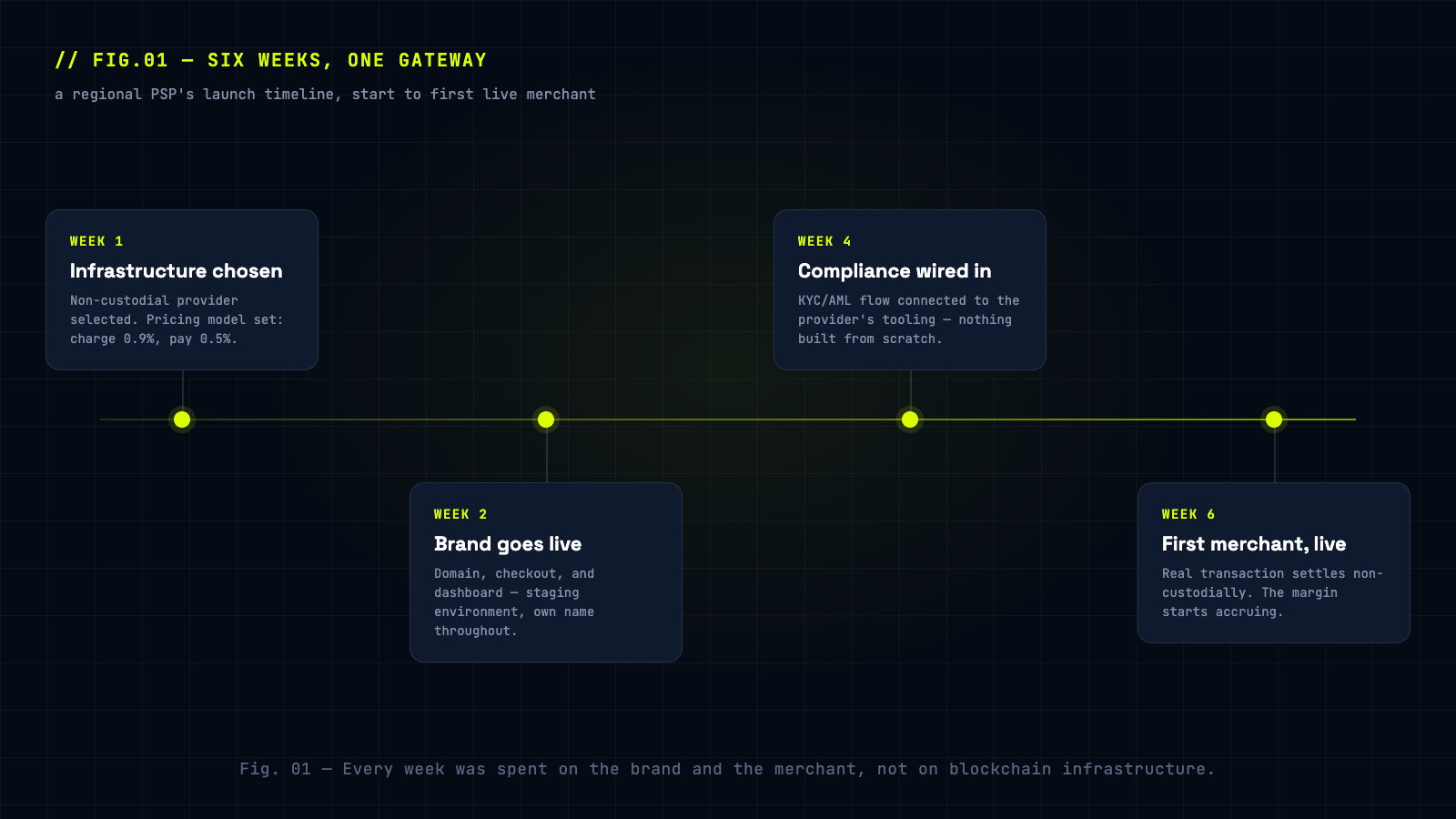
Northwind's actual timeline ran close to that shape. The first week went to picking the provider and settling the numbers: charge merchants 0.9%, pay the provider 0.5%, keep the 0.4% spread. By week two, the checkout and dashboard were live in staging — Northwind's domain, Northwind's logo, nothing borrowed. Week four was compliance: rather than building KYC screening from scratch, the team wired their onboarding flow into the provider's existing tooling. By week six, the first real merchant went live, and the first real transaction settled — to a wallet Northwind's merchant controlled, with the 0.4% margin landing in Northwind's account.
Almost none of that time went to blockchain engineering. All of it went to the parts of the business Northwind actually understood: pricing, brand, and merchants.
The line item nobody put on the slide deck
Midway through the build-vs-buy debate, one of Northwind's engineers had asked a question that almost got waved away: "If we build this ourselves, who's on call the night a key-management bug shows up?"
Nobody had a good answer. That single question did more to settle the decision than any cost spreadsheet. Building a wallet and settlement layer doesn't end at launch — it becomes a permanent commitment: security reviews, key rotations, incident response, audits, indefinitely. White labeling moved that commitment onto infrastructure that had already been through it, while Northwind kept the one thing that actually needed to stay in-house: the relationship with its merchants.
"We didn't buy a shortcut. We bought the right to stay a payments company instead of becoming a security company by accident."
What actually shipped
Six weeks after the board meeting, Northwind Pay had a live, branded crypto payment gateway: its own checkout, its own dashboard, its own merchant contracts — settling non-custodially, with a transparent margin on every transaction. The infrastructure underneath belonged to a provider. Everything the merchant saw belonged to Northwind.
That is the actual shape of the build-vs-white-label decision, stripped of the slogans: not "control vs no control," but which control matters enough to build yourself, and which is safely someone else's job. For a payments business, the brand and the merchant relationship were always the asset. The blockchain plumbing was always a commodity — as long as the provider underneath it was one Northwind could trust with its merchants' funds.