Somewhere right now, a product team is sketching a crypto wallet with their own logo on it — and a few floors up, someone is about to approve six months of engineering to build it. The uncomfortable truth: the logo is the only part of that wallet that actually needs to be theirs. Everything underneath already exists as infrastructure.
01 — What "white label" actually means for a wallet
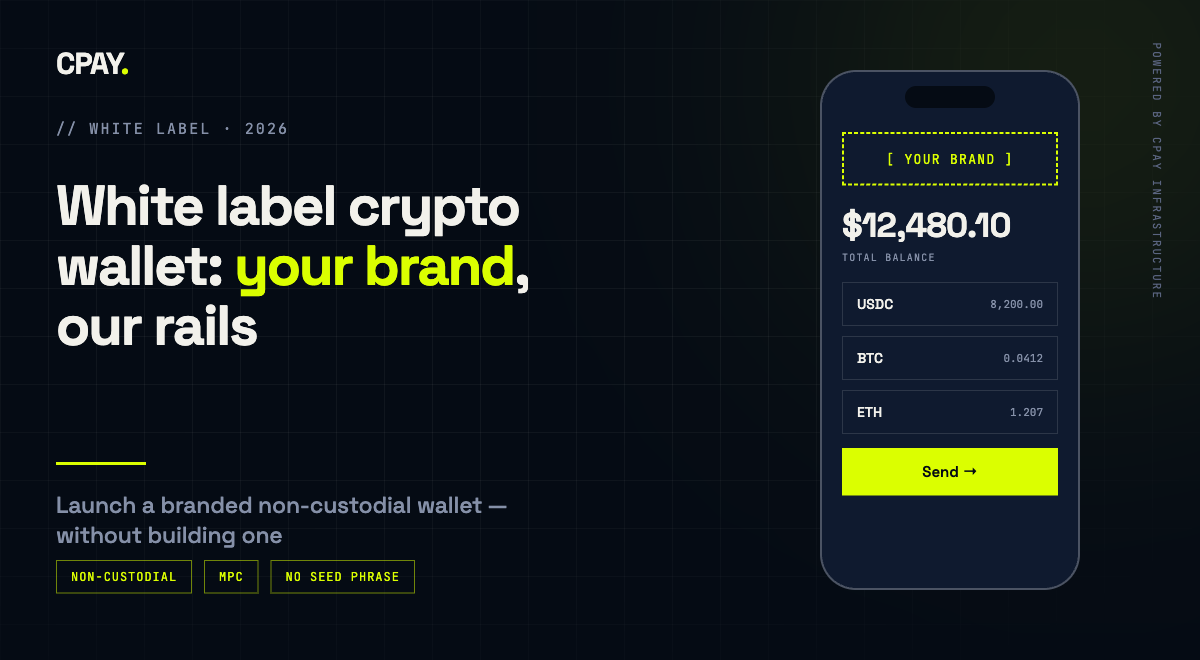
A white-label wallet is a split down the middle of the product. The brand layer — name, design, onboarding flow, the relationship with the user — is entirely yours. The infrastructure layer — key management, chain integrations, transaction processing, screening — belongs to the provider and hides behind your interface. Users see one thing: your wallet.
The reason the split works is that the two layers reward completely different skills. Brand and distribution are where platforms genuinely differ; key management and chain maintenance are where they all need exactly the same, extremely unforgiving machinery.
02 — Three launches, one stack
Three composite examples — illustrative, not real clients — of who ships branded wallets and why:
- A fintech app adding crypto. The product already owns daily attention for fiat; a branded wallet keeps users in-app for crypto instead of losing them to an exchange. Custody licensing was the blocker — a non-custodial white-label wallet removes it.
- An iGaming platform. Players already pay in crypto through the cashier; a branded wallet turns a payment method into a retention layer — balances, instant deposits, and withdrawals under the operator's own brand.
- A Web3 project with a community. The token has holders; the project wants the wallet those holders use daily to be its own surface, not a third-party app — without hiring a wallet-security team.
Different businesses, same buy: the wallet as a branded surface, the infrastructure as a service.
03 — Why non-custodial changes the pitch
A branded wallet where the operator holds user keys drags the operator into custody territory: licensing, capital requirements, safeguarding audits — a bank's obligations without a bank's margins. A non-custodial white-label wallet inverts that: keys are managed through MPC, split into shares so no single party — including you or the provider — can move user funds alone, and there's no seed phrase for users to lose.
The strongest sentence in a branded wallet's pitch is the one most wallets can't say: "we can't touch your funds — and neither can anyone else."
For the operator, the same architecture is a regulatory position, not just a security feature: software provider rather than custodian, with KYC/AML tooling still built in where your business needs it.
04 — What you own vs. what the provider runs
Yours: the brand and UI, user relationships and support, pricing and monetization, which assets and networks to enable, the compliance program built on the provider's tooling.
The provider's: MPC key management and recovery flows, chain integrations and their permanent maintenance, transaction infrastructure, screening and KYT endpoints, uptime and the on-call rota that protects it.
That division is the whole economic argument: everything on your side compounds into your business; everything on the provider's side would have been pure cost.
05 — The launch checklist
- Define the asset map. Which coins and networks day one — stablecoins on one or two fast chains cover most real usage; more can come later without a rebuild.
- Choose the wallet surface. Embedded in your existing app via SDK, or a standalone branded app — the same rails power both.
- Wire the compliance tier. Decide verification levels and limits, connect the KYC/KYT endpoints to your policy.
- Brand and test the flows. Onboarding, send, receive, recovery — the recovery path especially, once, with a real small amount.
- Go live and measure. Activation, balances held, transaction volume — the numbers that tell you the wallet became a product, not a feature.
With CPAY's white-label wallet, that checklist is weeks, not quarters — the same MPC, multi-chain, KYC/AML-ready infrastructure that powers CPAY's own wallet stack, wearing your brand.
The wallet your users open every day doesn't have to be the wallet your engineers spend a year building. It has to carry your name, hold their funds safely, and never make them think about the machinery underneath. That's exactly the part you can buy — so the part you build is the business on top of it.