Accepting crypto payments may sound simple.
A customer sends Bitcoin, Ethereum, or a stablecoin. The transaction appears on the blockchain. The merchant receives the funds.
But once a business begins processing hundreds or thousands of transactions daily, the reality becomes very different. What initially looked like a wallet integration quickly turns into a question of financial infrastructure.
How do you track thousands of incoming transactions across multiple blockchains?
How do you reconcile payments with orders in real time?
How do you protect the system from fraud, operational risks, or network instability?
This is where crypto payment gateways become essential. Behind every seamless payment experience lies a complex architecture responsible for transaction monitoring, wallet infrastructure, settlement automation, and risk management.
Designing such systems requires thinking far beyond simply receiving crypto.
Why Scalability Matters in Crypto Payments
Over the past few years, digital assets have moved from experimental payments to real global settlement rails.
Stablecoins now process billions of dollars in daily transaction volume, and companies across eCommerce, SaaS, digital services, and gaming industries are increasingly integrating crypto payments into their financial operations.
But scale introduces new challenges.
A business that accepts crypto must be able to manage:
- transactions across multiple blockchains
- different tokens and stablecoins
- real-time payment confirmations
- treasury management and liquidity routing
- compliance monitoring and transaction screening
Without scalable infrastructure, payment processing quickly becomes difficult to manage.
That is why modern crypto payment gateways are designed as modular financial systems, not simple wallet connections.
Core Architecture of a Crypto Payment Gateway
At the foundation of any crypto payment gateway lies wallet and address management.
When a customer initiates a payment, the gateway generates a unique deposit address linked to a specific order or user. This allows the system to automatically associate incoming blockchain transactions with the correct payment request.
The infrastructure then performs continuous blockchain monitoring, scanning networks for incoming transactions and validating confirmations.
Once a payment is detected, several automated processes begin:
- transaction verification
- confirmation tracking
- payment reconciliation
- internal accounting updates
In scalable systems, these components operate as independent infrastructure layers. Transaction monitoring, wallet management, and accounting systems work in parallel, ensuring the platform can handle large transaction volumes without delays.
This architecture allows businesses to support multiple assets and chains while maintaining operational reliability.
Settlement Logic: From Payment to Treasury
Receiving a crypto payment is only the first step. The next challenge is how funds move through the system after the transaction arrives.
Settlement logic determines how incoming payments are processed, consolidated, and routed to treasury wallets.
A scalable payment gateway typically includes automated settlement flows such as:
- confirmation thresholds depending on blockchain security
- automated routing of funds to operational wallets
- liquidity management across multiple assets
- optional asset conversion for treasury management
For businesses operating globally, these mechanisms significantly simplify accounting and treasury operations.
Instead of manually managing hundreds of small transactions, companies can automate settlement and maintain clear financial visibility.
Risk Layers and Transaction Monitoring
Crypto payment infrastructure must also address several layers of operational and financial risk.
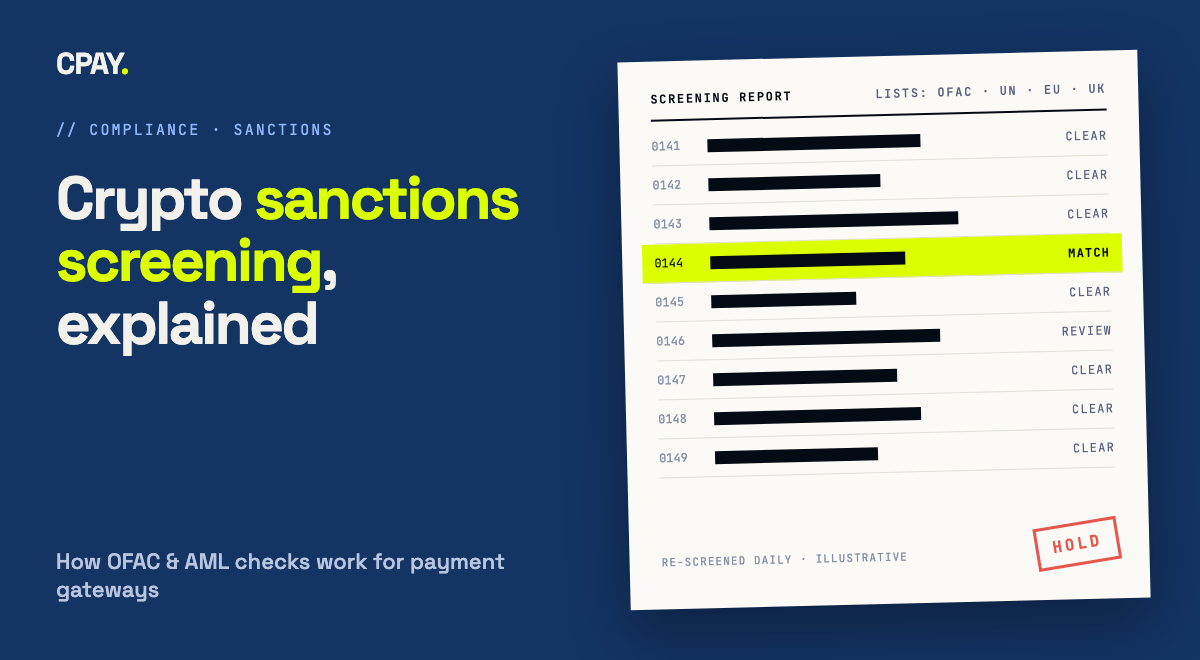
One key component is transaction monitoring. Incoming payments are analyzed to identify potentially suspicious transactions or interactions with sanctioned addresses.
Payment gateways often integrate with blockchain analytics providers and compliance tools to perform:
- AML screening
- sanctions list monitoring
- transaction scoring
- suspicious activity detection
Operational risks must also be considered. Blockchain networks can experience congestion, reorganization events, or temporary instability.
A scalable gateway therefore includes confirmation logic that adapts depending on the network and asset type before a payment is considered final.
These risk layers ensure payment systems remain secure while maintaining a smooth user experience.
Building Infrastructure for Real-World Crypto Payments
As digital assets continue to integrate into global financial systems, businesses increasingly require infrastructure designed for real transaction volumes and operational scale.
That means payment gateways must support:
- multi-chain payment processing
- automated settlement and treasury routing
- scalable wallet architecture
- built-in risk and monitoring systems
Infrastructure providers like CPAY are designed with these requirements in mind.
CPAY offers a non-custodial decentralized crypto payment and wallet infrastructure, allowing businesses to integrate crypto payments while maintaining control over funds. The platform supports scalable payment processing, multi-asset transactions, and efficient settlement flows with some of the lowest processing fees in the market.
Another advantage is operational flexibility. CPAY enables businesses to integrate crypto payments without complex internal blockchain infrastructure, while also supporting models such as payment gateways with simplified onboarding and optional KYC configurations depending on integration requirements.
This allows companies to focus on their core products while relying on robust crypto payment infrastructure.
Conclusion
Designing a scalable crypto payment gateway requires much more than connecting a wallet.
Reliable payment infrastructure must combine wallet management, blockchain monitoring, settlement automation, and risk control into a unified system capable of supporting global transaction flows.
As crypto payments continue to grow, businesses will increasingly rely on infrastructure that treats digital assets not as an experiment, but as a fully integrated part of modern financial operations.
Platforms like CPAY are part of this evolution, helping companies build payment systems that are ready for the next stage of digital finance.