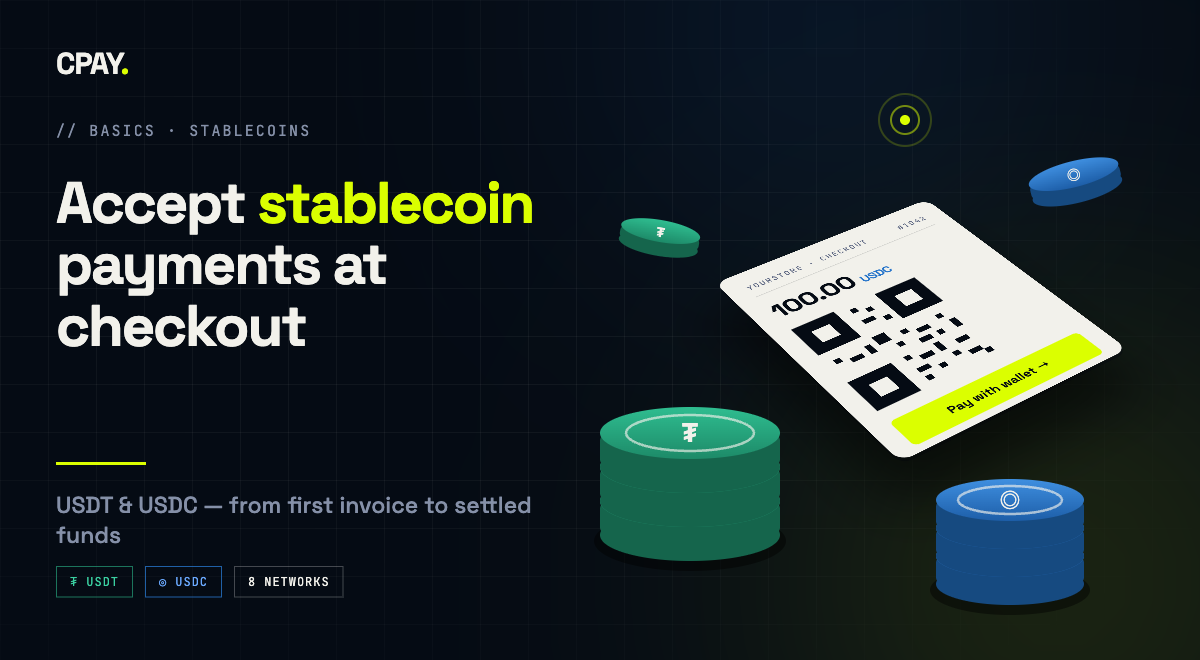
Strip away the noise around crypto and one corner of it already behaves exactly like money should: a customer sends $100 in USDC, you receive $100 in USDC, and the whole thing settles in minutes on a Saturday night. That corner is stablecoins — and putting them on your checkout is far more practical than most teams expect. Here's the whole path, decision by decision.
01 — Why stablecoins are the place to start
For a business, stablecoins remove the two objections that stall every "should we accept crypto" conversation: volatility and settlement pain. USDT and USDC are pegged to the dollar, so the price on the invoice is the value that arrives. And the rail itself is simply faster than what you're using now:
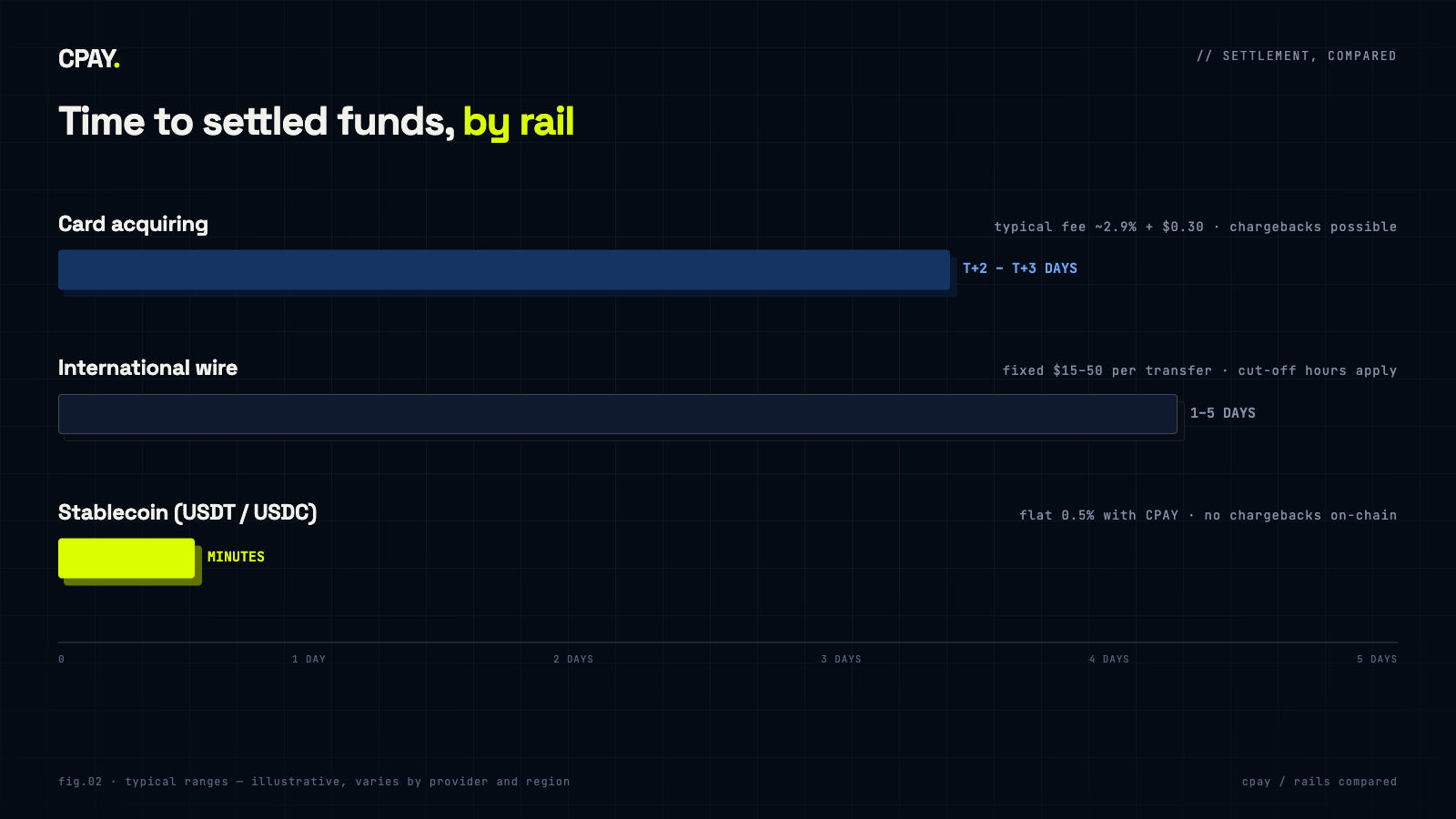
The third line of that chart is the business case in one row: minutes to finality, a flat fee instead of a percentage stack, and no chargeback mechanism on-chain. For cross-border invoices in particular, the comparison stops being close.
02 — What to decide before the first invoice
Which coins. USDT and USDC together cover the overwhelming majority of stablecoin volume. Accept both: USDT dominates in Asia, LatAm and on TRON; USDC is the default for US-facing and DeFi-native customers.
Which networks. The same coin lives on many chains, and the network decides the customer's fee and speed. The practical set: TRON (TRC-20) for USDT — cheap and ubiquitous; Ethereum (ERC-20) — the standard everyone supports; Base and Polygon — fast, cheap, growing quickly. A good gateway lets the customer pick at checkout and handles all of them into one settlement stream.
Gateway or DIY. A bare wallet address technically works — until you need per-order matching, underpayment handling, exchange-rate locking, webhooks for your order system, and KYT screening on incoming funds. That operational layer is what a payment gateway is; non-custodial means it does all of the above without ever holding your money.
03 — The payment, end to end
Here is the entire journey of one stablecoin payment — four stops, no bank in the middle:

The customer scans a QR or clicks a payment link; the checkout locks the amount and shows the address for their chosen network; the transfer confirms on-chain — seconds on Base or TRON, a few minutes on Ethereum — and the gateway fires a webhook to your order system the moment the payment is final. From your side it feels like any other payment notification, except the funds are already yours.
04 — Settlement: keep, convert, or split
Once the USDC lands, you have three honest options. Keep it — treat stablecoins as working capital, pay suppliers and contractors on the same rail. Convert it — auto-convert to fiat through an off-ramp and land it in your bank account, if your accounting prefers dollars in a bank. Split it — keep a percentage on-chain and convert the rest. The right answer is a treasury policy, not a technical constraint — a non-custodial setup leaves all three open because the funds arrive in a wallet you control.
05 — The edge cases worth handling on day one
- Underpayment. A customer sends $97 against a $100 invoice — usually their wallet deducted the network fee from the amount. Decide the policy up front: request the difference, or accept within a tolerance.
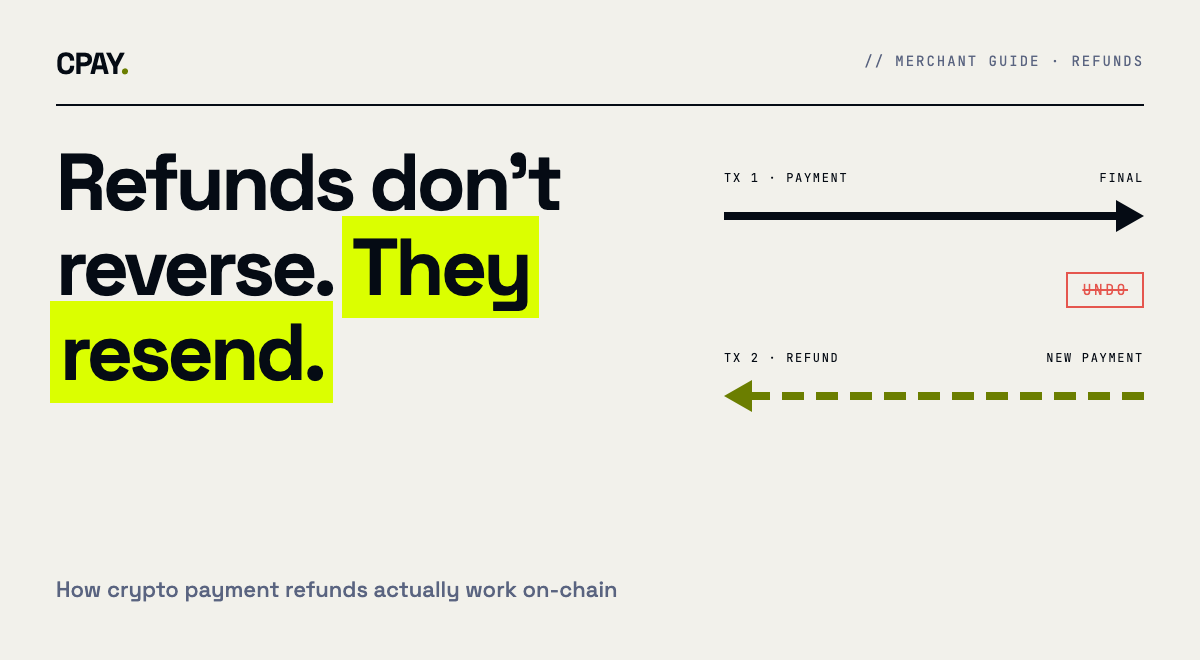
- Overpayment and duplicates. Rarer, but real: refund the excess to the sender address, and make your handler idempotent so a re-broadcast doesn't mark two orders paid.
- Wrong network. USDT sent as ERC-20 to a TRC-20 address is the classic support ticket. A checkout that generates a per-network address and validates it prevents almost all of these before they happen.
- Rate lock windows. Even a stablecoin invoice needs a time limit — quote expiry (15–30 minutes is typical) keeps stale payment pages from becoming disputes.
06 — Launch checklist
- Enable USDT + USDC on at least TRON, Ethereum, and one low-fee EVM chain (Base or Polygon).
- Wire the webhook to your order system and test it with a real small payment on each network.
- Set the policies: underpayment tolerance, quote expiry, refund path.
- Decide settlement: keep, auto-convert, or split — and where the wallet keys live.
- Check the fee math: with CPAY the infrastructure cost is a flat 0.5% per transaction — price your checkout knowing exactly what the rail costs.
Stablecoin acceptance is the rare crypto project that ships in days and pays back immediately: faster settlement, lower fees, and customers — especially cross-border ones — who simply couldn't pay you before. Start with USDT and USDC, handle the four edge cases above, and the rest is just watching payments arrive on a rail that never closes for the weekend.