Agent-to-agent payments: how A2A crypto settlement actually works
Two pieces of software just did business — no human clicked "pay," no invoice was emailed, no bank sat in the middle. That is agent-to-agent payment, and it is quietly becoming a real transaction pattern.
Most conversations about AI and money still assume a human at one end: a person asks an agent to buy something, or an agent helps a person check out. Agent-to-agent (A2A) payments are different. Here, both sides of the transaction are software — one agent buying a service, dataset, or task result from another, entirely on its own. No human approves the individual purchase. The question this raises is not philosophical; it is architectural: what does a payment rail look like when neither party is a person?
01 — What makes A2A payments different
A normal payment has a human on at least one side, deciding to spend money. A2A payments remove that human entirely from the transaction loop. One autonomous agent needs something — data, a computation, access to another agent's specialized skill — and the agent that can provide it charges for it. The requesting agent has to decide to pay, on its own, in the middle of completing a task.
That single shift breaks assumptions built into almost every existing payment system:
- No account relationship. Human payment systems assume a signup, a stored card, a merchant agreement. Two agents transacting for the first time have none of that.
- No invoice-and-wait cycle. A human business can email an invoice and wait 30 days. An agent mid-task cannot pause for net-30 terms — it needs a price and a settlement in the same request.
- No card rails. Cards require a human cardholder, a billing address, a fraud-review process built around human behavior. None of it maps to a wallet-holding piece of software.
- Machine-scale, machine-speed. A2A payments are typically small and extremely frequent — fractions of a cent, thousands of times a day — which is exactly the regime where card minimums and settlement delays break down.
02 — The anatomy of an A2A payment
Strip away the jargon and an A2A payment is a short, structured exchange between two wallets, wrapped around whatever work actually got done.
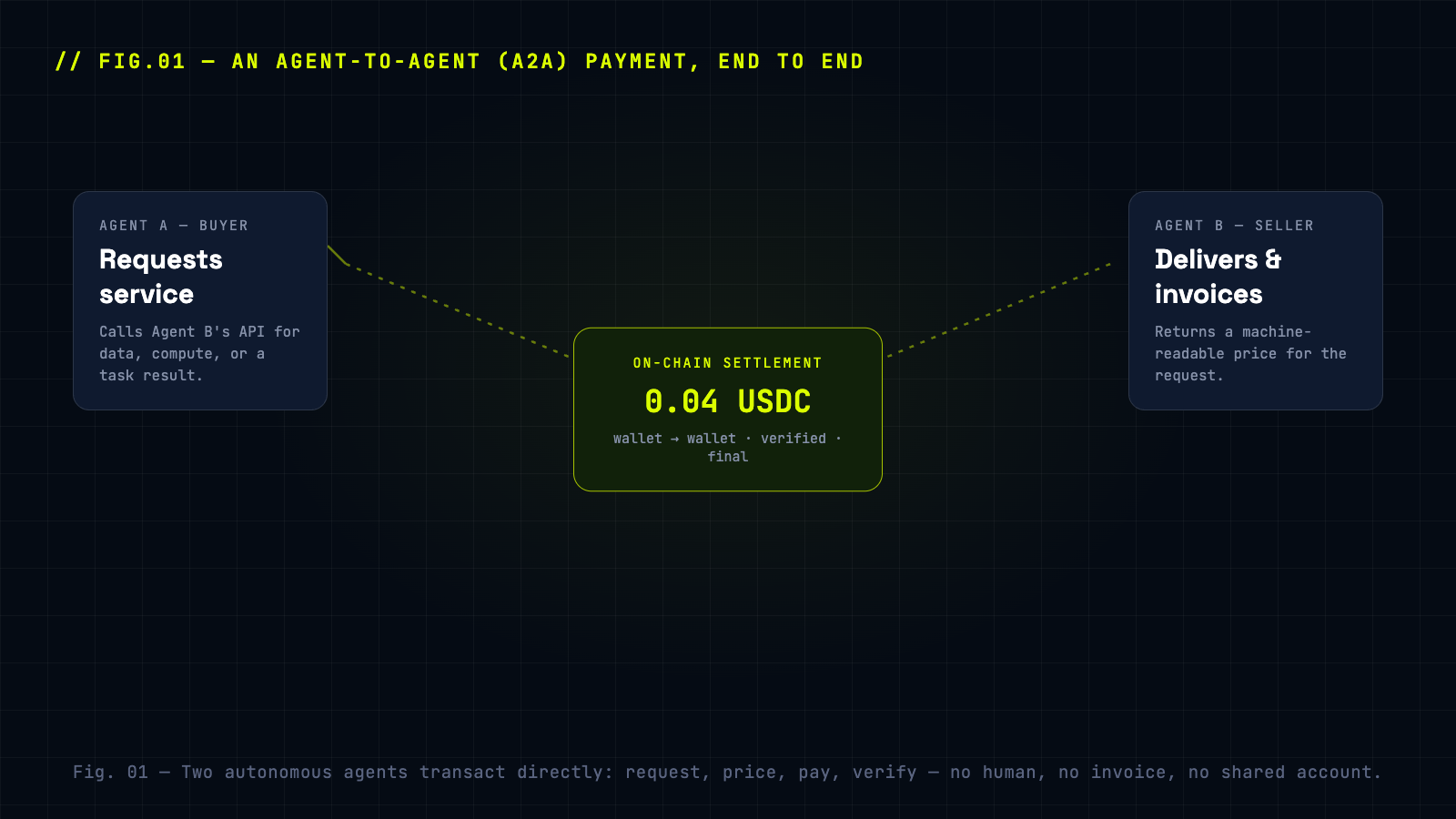
- Request. Agent A calls Agent B — an API call for data, a compute job, a completed task.
- Price. Agent B returns a machine-readable price for that specific request, not a human-facing invoice.
- Pay. Agent A settles the amount directly, wallet to wallet, typically in a stablecoin.
- Verify. Agent B checks the payment on-chain and releases the result — the data, the compute output, the access token.
Nothing in that loop requires a name, an address, or a signed agreement. It requires a wallet, a price, and a settlement asset — which is precisely what a blockchain-based payment rail is built to provide.
03 — Why crypto and stablecoins are the natural rail
Card and bank rails were built around human identity and human-paced settlement. A2A payments need the opposite: no onboarding, instant finality, and a value unit that does not need explaining.
Crypto wallets fit because a wallet is just a keypair — it can be created for an agent as easily as for a person, with no bank account or business registration behind it. Settlement happens on-chain, typically in minutes, without waiting on a banking calendar. And stablecoins solve the one problem a raw cryptocurrency would introduce: an agent charging $0.02 per call cannot function if the value of that $0.02 swings 5% before the counterpart even receives it. A dollar-pegged asset like USDC keeps machine pricing simple and predictable.
This is also the same foundation behind x402, the emerging standard that lets a server reply with an HTTP 402 status and machine-readable payment terms, and a client — often an agent — pay in stablecoin and retry the request. A2A payments and x402-style flows are two views of the same underlying shift: software, not humans, negotiating and settling value.
04 — Real A2A scenarios
The pattern shows up anywhere one agent's output is another agent's input, and a price sits between them:
- Data and API access — a research agent pays a data-provider agent per query instead of holding a pre-negotiated subscription.
- Compute and inference — one agent pays another to run a model, render an image, or execute a heavy computation on demand.
- Task delegation — a coordinating agent hires a specialist agent for a sub-task and pays for the completed result.
- Marketplaces of agents — a directory of agent services where discovery, pricing, and payment all happen without a human comparing options first.
In every case, the defining feature is the same: the decision to pay is made by software, inside a task, without a person reviewing that specific transaction.
05 — The part that has to be controlled
Autonomous payment is only acceptable if it is bounded. Nobody serious is proposing that an agent gets unrestricted access to a company's funds — the goal is limited, policy-governed spending, not open access.
That means every A2A-capable agent should operate inside explicit constraints:
- Spending limits — per-transaction and daily caps, so a bug or a bad actor cannot drain an account.
- Allowlisted counterparties — an agent pays only wallets or services that have been approved in advance, where that is practical.
- Approval thresholds — routine, small payments clear automatically; anything above a set size requires a human or a higher-privilege process to sign off.
- Full audit logs — every payment attributable to a specific agent, request, and outcome, so the activity is reviewable after the fact.
The design goal is straightforward: an agent should be able to transact within a policy a business defined, never outside it. Control does not disappear in A2A payments — it just moves from approving each transaction to defining the rules the transactions must obey.
06 — What this requires from infrastructure
For A2A payments to work in practice, the plumbing underneath has to support machine behavior directly, not human behavior with an API bolted on:
- Wallets that can be created and governed programmatically — for agents, not just for people, with limits and permissions attached at creation.
- Stablecoin settlement — so pricing is predictable and value does not need explaining to either side.
- Machine-readable pricing and payment requests — structured data an agent can parse, not a checkout page built for a human eye.
- Fast, verifiable settlement — so a payment can be confirmed and acted on inside the same task, not days later.
- Non-custodial control — so the business, not a third party, holds the keys governing every agent wallet.
This is a different shape of requirement than "add a payment button." It is closer to giving every agent its own bounded bank account, with the rules of that account enforced by the infrastructure rather than by hoping the agent behaves.
07 — Where CPAY fits
CPAY's move toward agentic and machine payments is built for exactly this shape of transaction. It provides non-custodial wallets that can be issued to agents, with spending limits, approvals, and full audit logs enforced through an open API — plus stablecoin settlement in USDT and USDC across multiple networks, so an A2A payment clears in minutes at a predictable value. Agents can request, price, and settle directly with each other, while the business that deployed them keeps the keys and the policy in its own hands.
08 — FAQ
Is agent-to-agent payment the same as an AI buying something for a human?
No. That is an agent acting on behalf of a person, who ultimately approves the purchase. A2A payments happen between two agents, where neither side is a human deciding on that specific transaction — a business only sets the policy in advance.
Do agents need their own crypto wallets?
Yes, typically a dedicated wallet per agent (or per agent role), scoped with its own limits and permissions, rather than shared access to a company's main funds.
What stops an agent from spending too much?
Policy enforced at the infrastructure level — per-transaction and daily limits, allowlisted counterparties, and approval thresholds for larger amounts, all logged for audit.
Why stablecoins instead of a volatile cryptocurrency?
A2A payments are often small and frequent, so predictable pricing matters. Stablecoins like USDC hold a steady dollar value, which keeps a $0.02 charge meaningfully $0.02 between request and settlement.
How is this related to x402?
x402 is a protocol for exactly this kind of exchange — a server responds with a 402 status and payment terms, and the client pays in stablecoin and retries. It is one concrete implementation of the same underlying idea: software negotiating and settling payment without a human in the loop.
Conclusion
Agent-to-agent payments are not a hypothetical corner case — they are the logical result of agents that call other agents' services to get work done. The infrastructure that makes this safe is not exotic: non-custodial wallets, stablecoin settlement, and policy enforced in code rather than trust. Get that right, and two pieces of software really can do business with each other — quickly, cheaply, and within limits a business actually set.