A crypto gateway's pricing page shows one number. The money that actually lands in your wallet depends on five or six. There's the processing fee, the network fee, the cost of moving funds between wallets, conversion if you don't want to hold what you received, and the off-ramp if you need bank money at the end. This guide reads a crypto payment like an itemised receipt, line by line, then puts it next to a card payment of the same size so you can compare what you keep.
The short version: Six lines on every crypto payment
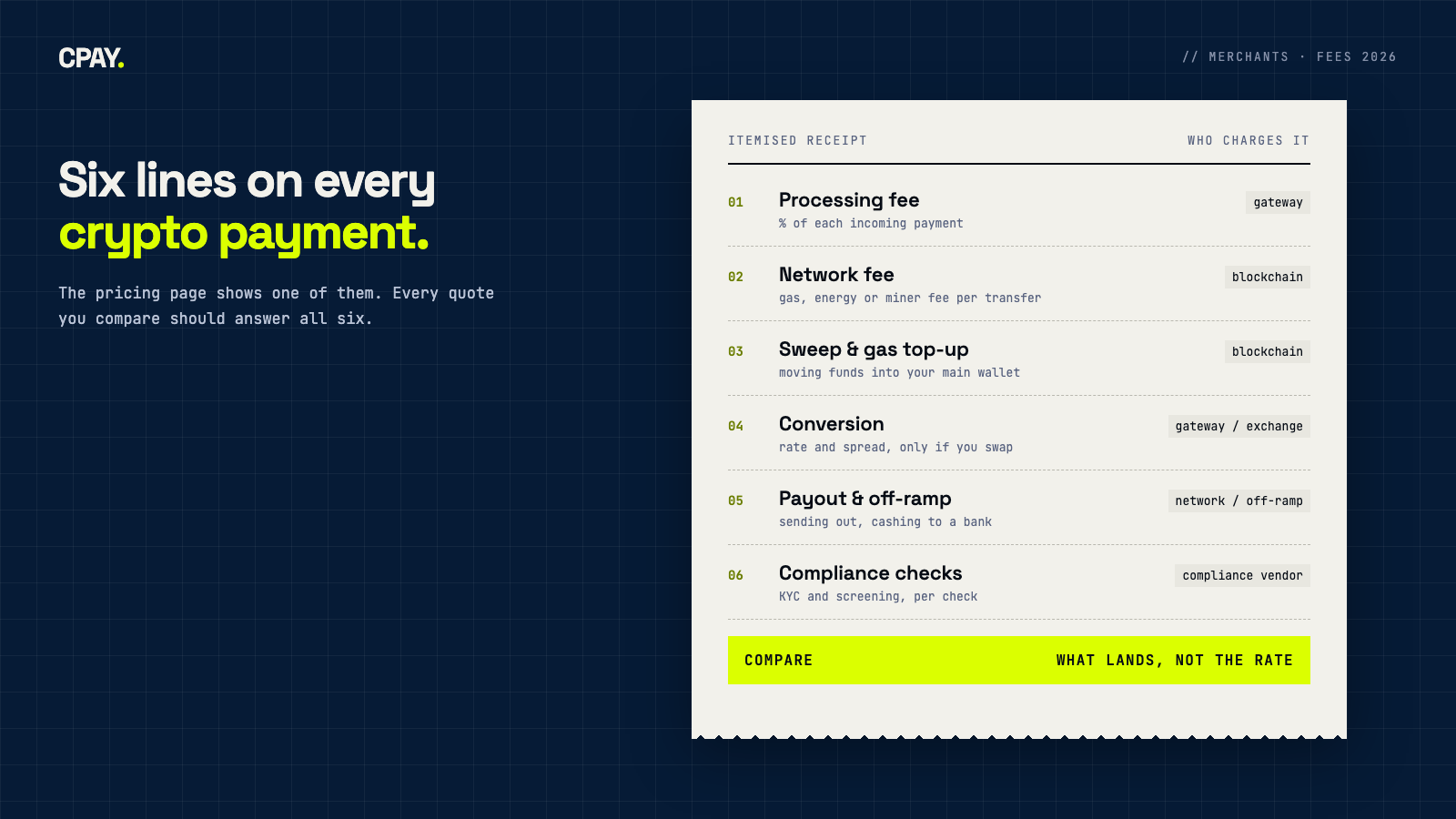
Every crypto payment a business receives can carry up to six costs. Not every line applies to every merchant, but every quote you compare should answer all six:
- Processing fee: the gateway's percentage.
- Network fee: what the blockchain charges to move the funds.
- Sweep and gas top-up: the on-chain cost of consolidating payments into your main wallet.
- Conversion: the rate and spread when you swap into a stablecoin or another asset.
- Payout and off-ramp: moving funds out, and turning them into bank money if you need to.
- Compliance checks: KYC and transaction screening, where your business needs them.
Compare the money that lands, not the percentage on the pricing page. (A rule of thumb, not a quote.)
Line 1: The processing fee
This is the number on the pricing page: a percentage of each incoming payment, sometimes with a fixed amount per transaction on top. It's the easiest line to compare and the one most marketing focuses on.
Three questions turn a headline rate into a usable number:
- What does it apply to? Incoming payments only, or payouts and internal transfers too?
- Is there a fixed part? A per-transaction fixed fee hurts small tickets far more than a percentage does.
- Are there setup fees or monthly minimums? A minimum turns a low rate into a high one in a quiet month.
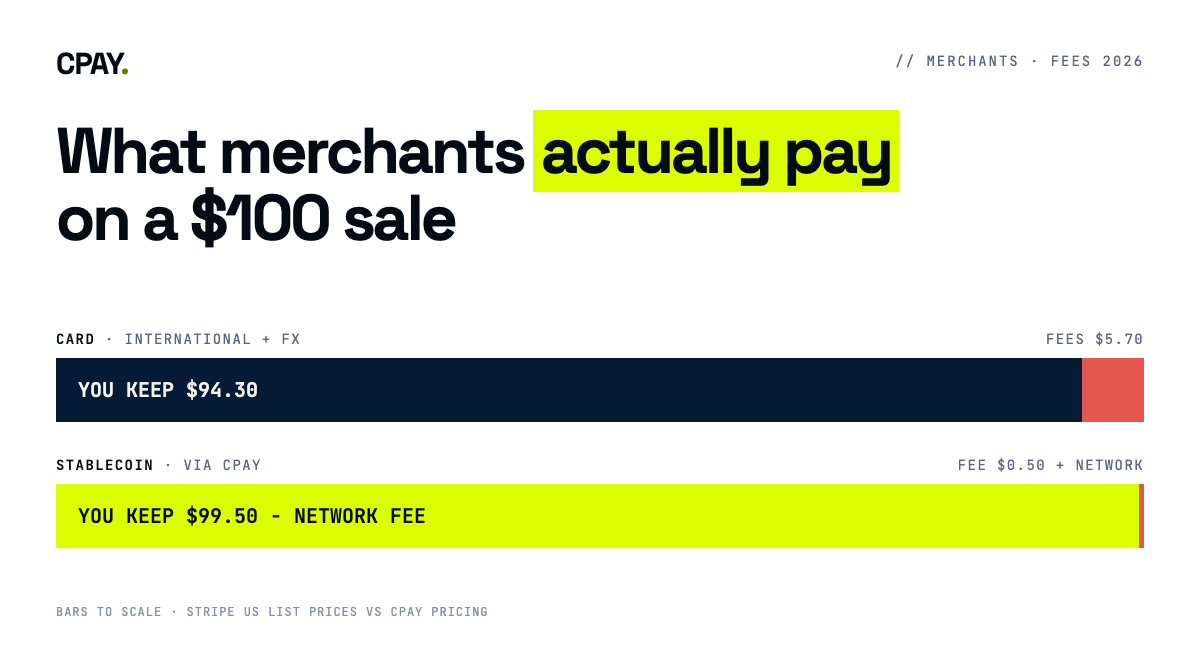
For reference, card processing at Stripe's standard US rate is 2.9% plus 30¢ per domestic card payment, with an extra 1.5% for international cards and 1% when currency conversion is needed. Stripe lists stablecoin payments at 1.5% on the same page.
Line 2: The network fee
Every on-chain transfer pays the network, not the gateway. On Ethereum, the fee is the gas used multiplied by the base fee plus a priority tip. A plain ETH transfer uses 21,000 gas; a token transfer uses more because it runs a smart contract. On TRON, transactions consume bandwidth and energy. A token transfer needs energy, and if the account doesn't hold enough, TRX is burned to cover the rest.
Two things matter more than the exact number:
- Who pays it. When the customer sends funds, they normally pay the network fee for their own transfer. What happens on later transfers is a setting you should know about.
- Which network. The same stablecoin can cost cents to move on one network and much more on another when it's busy. Our blockchain comparison covers the trade-off.
Line 3: Sweeps and gas top-ups, the quiet line
Many gateways give each customer or invoice its own deposit address, then move ("sweep") the funds into the merchant's main wallet. That second hop is another on-chain transaction with another network fee.
Tokens add a twist. To move USDT out of a deposit address, that address needs a little of the network's native coin (ETH, TRX and so on) for gas. In CPAY, for example, the account wallet sends that gas to the client wallet before the token can move on. It's a small amount per payment, but it's real, and on thousands of payments it adds up.
Who pays the miner fee on the sweep? In CPAY, the account decides whether the customer or the business pays the miner fee when funds move from a client wallet to the account wallet. If the customer pays, their credited balance reflects the deduction. If you pay, it's part of your cost of acceptance. Either choice is fine, as long as you made it deliberately.
Line 4: Conversion and spread
If you accept volatile coins but want to hold stablecoins, something has to convert them. That conversion has a price, either as an explicit fee or as a spread between the rate you get and the market rate. Look for:
- The rate source and when it's locked: at invoice, at payment or at settlement.
- An explicit fee or a spread. Either can be fair; a spread you can't see is harder to compare.
- Whether you need conversion at all. If most customers pay in USDT or USDC, converting only the remainder keeps this line small.
Line 5: Payouts and the off-ramp
Moving funds out of the gateway is another transfer. Some providers add a payout fee on top of the network fee; some charge the network fee only. If you pay suppliers or staff in stablecoins, that's the end of the line.
If you need bank money, there's one more step: an exchange or off-ramp partner that converts stablecoins to fiat and wires them. Its fees and spreads are separate from the gateway's and vary by provider, currency and volume, so get them quoted in writing. For mass payments, our mass payouts guide shows how batching changes the maths.
Line 6: Compliance checks
Regulated businesses pay for identity verification and transaction screening, usually per check. These are real costs of accepting payments, even if they're billed separately. Count them per customer or per transaction so they sit on the same receipt as everything else. Where screening fits in the flow is covered in our sanctions screening guide.
Side by side: Card vs. stablecoin on the same sale
Here is a $100 sale and a $10,000 B2B invoice, using Stripe's published US card pricing and CPAY's published 0.5% rate. Network fees depend on network and timing, so they're shown as a line to fill in rather than a number.
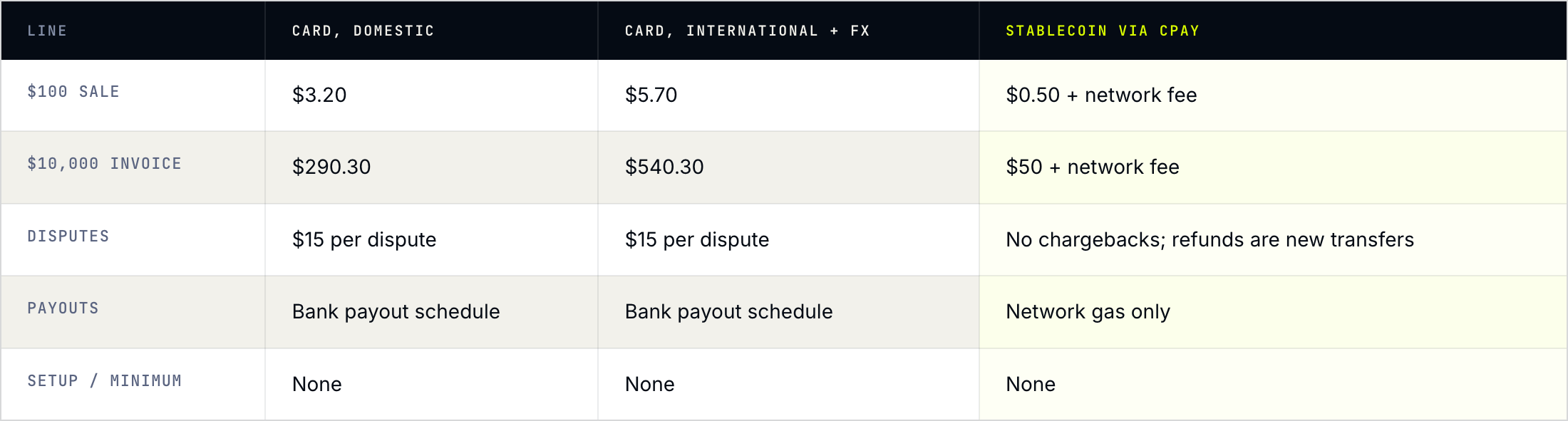
Card figures use 2.9% + 30¢, plus 1.5% for international cards and 1% for conversion. The stablecoin column excludes conversion and off-ramp costs, which only apply if you swap or cash out. Crypto payments are final, so there's no chargeback fee, but a refund is a new transfer with its own network fee; see how refunds work on-chain.
Do the maths: Your effective rate in five lines of code
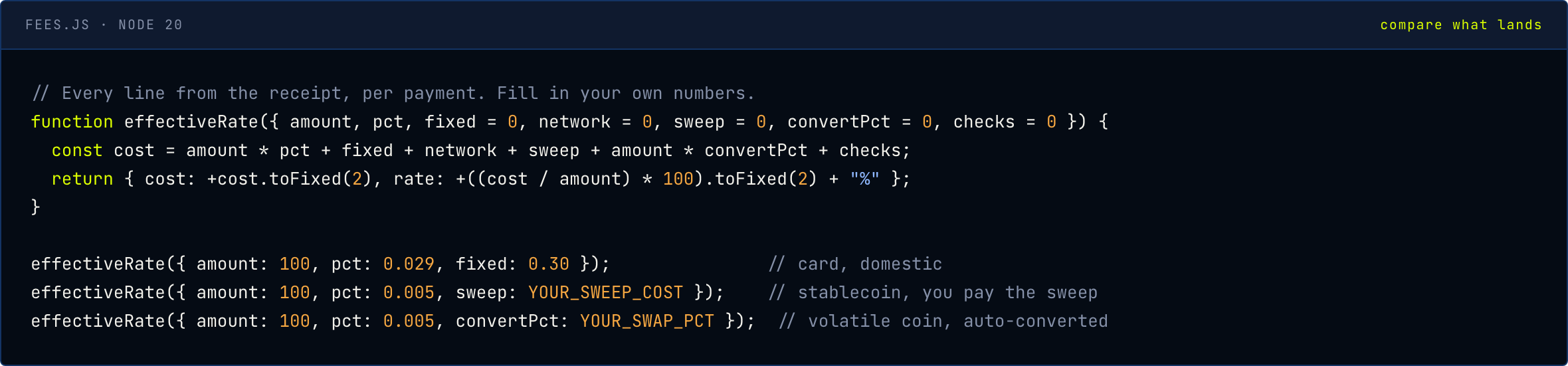
The only number worth comparing is the effective rate: total cost divided by the amount received. Put your own volumes and fees into a model like this and run it for every quote you're considering.
Before you sign: Seven questions for any gateway quote
- What exactly does the percentage apply to: incoming payments, payouts, internal transfers?
- Is there a fixed fee per transaction, a setup fee or a monthly minimum?
- Who pays the network fee on each hop, and can I change it?
- How are token sweeps funded, and what does that cost per payment?
- What rate and spread apply to conversion, and when is the rate locked?
- What does a payout cost on top of the network fee?
- Are KYC and screening billed separately, and at what price per check?
In CPAY: What the receipt looks like here
- Processing: a flat 0.5% on incoming payments and processed wallet transactions, with no setup fee and no monthly minimum.
- Payouts: outgoing transfers cost the on-chain network fee only, with no CPAY markup.
- Miner fee on sweeps: you choose whether the customer or the business pays it.
- Platforms and white label: account owners can set their own account fee on client deposits and withdrawals, which turns payment acceptance into a revenue line.
- Compliance: KYC and AML are priced per check, with no subscription.
- Volume: high-volume and enterprise pricing is quoted individually, and a cashback programme returns part of the fees as USDT.
FAQ — Common follow-ups
Are crypto payments always cheaper than cards?
Usually on the processing line, and especially on large or cross-border tickets. The full picture depends on network fees, sweeps, conversion and whether you need to cash out to a bank. Run the effective-rate maths with your own numbers.
Who pays the network fee when a customer pays?
The customer pays the fee for their own transfer. Fees on later transfers, such as sweeping funds into your main wallet, depend on your gateway and its settings.
Do stablecoin payments have chargebacks?
No. A confirmed on-chain transfer is final. Refunds are handled as new transfers under your own refund policy, and each one carries a network fee.
What does it cost to turn stablecoins into bank money?
It depends on the exchange or off-ramp partner, the currency and your volume. Ask for the fee and the spread in writing, and compare against keeping part of your balance in stablecoins for supplier payments.
Which network is cheapest for payments?
Fees change with network load, so there's no permanent answer. TRON, Base and Polygon are usually low-cost for stablecoin transfers; Ethereum costs more but suits large transfers. Offer the networks your customers already use.
Want 0.5% on incoming payments and network gas only on payouts? See CPAY pricing or book a call.
Sources: Stripe — Pricing (US), ethereum.org — Gas and fees, TRON Developers — Resource model, CPAY Docs — Autosign, CPAY Docs — Supported networks & fees, CPAY — Pricing. Prices as published at the time of writing; check current pricing pages before you decide.