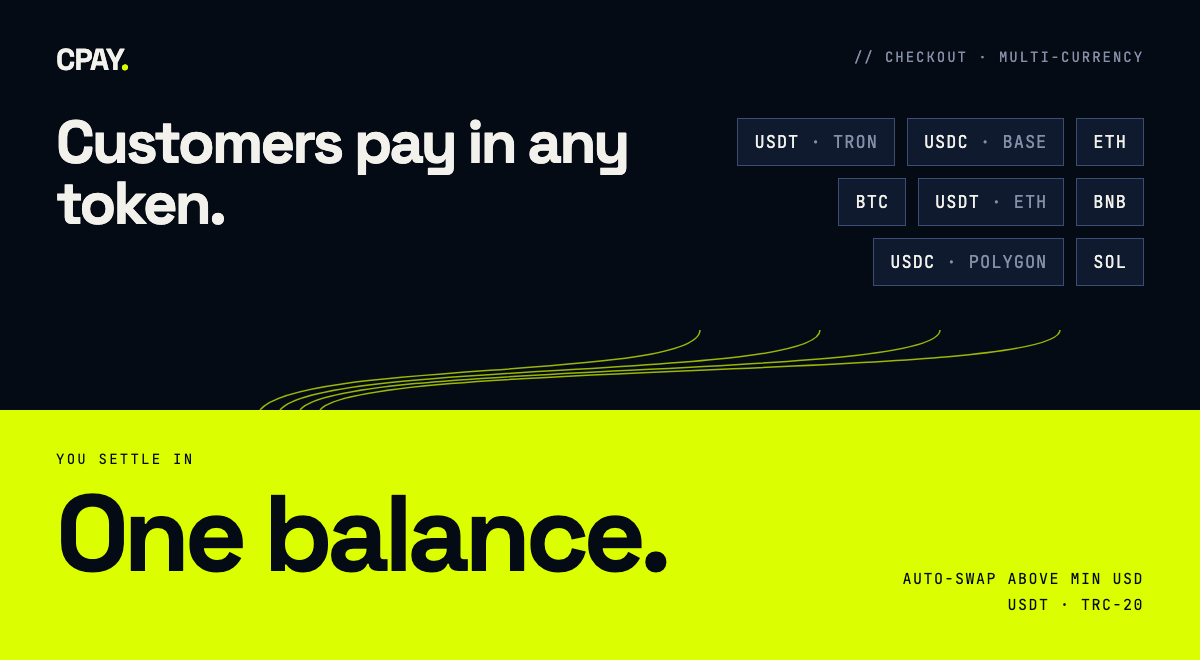
Your customers don't hold one currency. One pays in USDT on TRON, another holds USDC on Base, a third only has ETH, and a fourth wants to pay in BTC. Your finance team, meanwhile, wants one balance to reconcile, report and pay suppliers from. A multi-currency checkout sits between those two needs. It accepts what the customer has and settles into what the business wants. This guide covers both sides of the counter: what the customer sees, what happens to the money afterwards, and the settings that decide whether the setup stays simple.
The problem: Why one currency is never enough
A checkout that accepts a single token on a single network turns away everyone who holds something else. The customer has to swap or bridge first, which costs time and fees, and many simply leave.
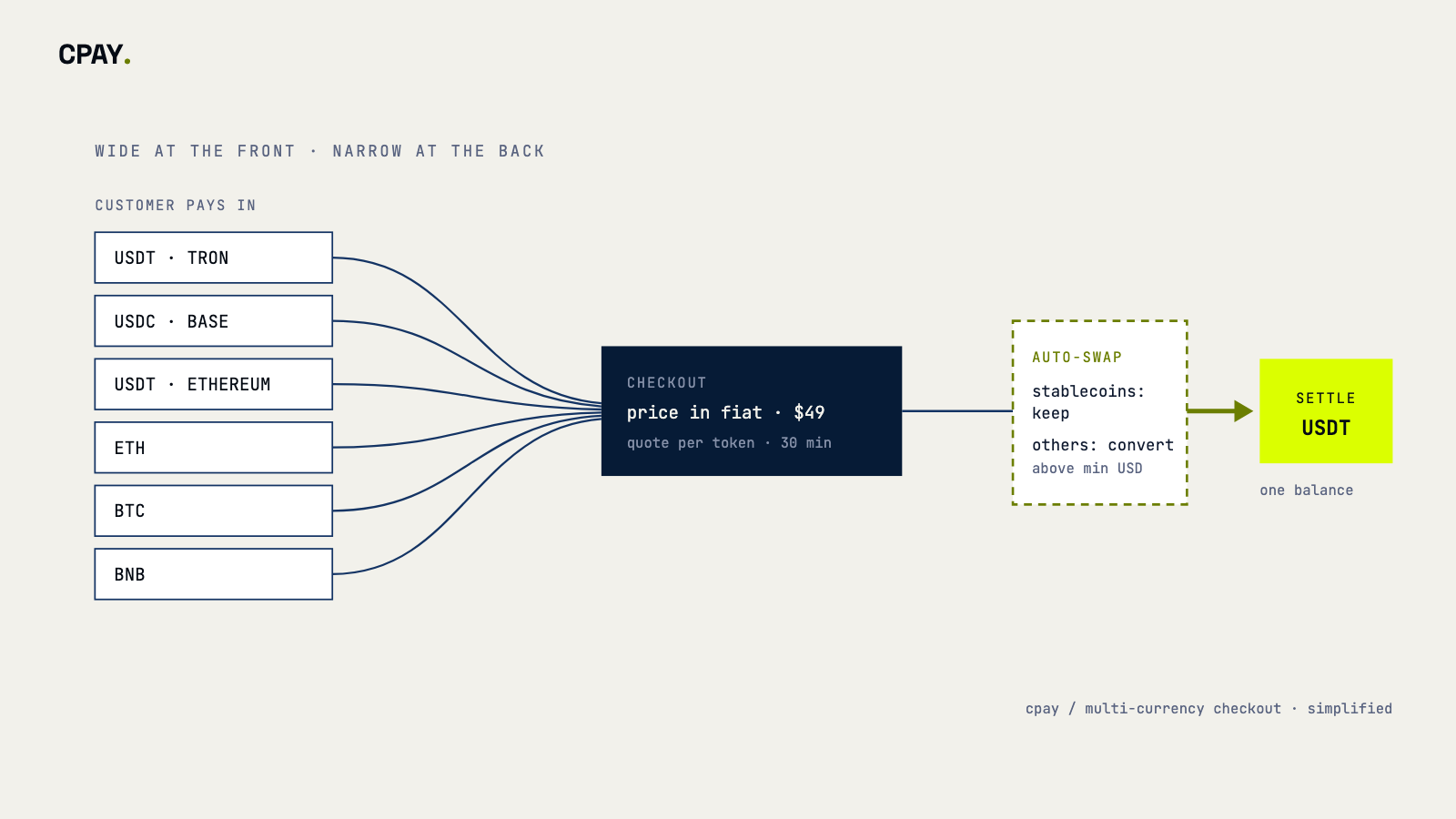
The opposite extreme causes a different problem. Accept twenty tokens and keep them all, and your treasury becomes a portfolio: twenty balances moving in price, twenty lines to reconcile and twenty decisions about when to sell. The goal is to keep the front of the checkout wide and the back narrow.
Wide at the front, narrow at the back: accept what customers hold, settle into what finance needs. (A rule of thumb, not a quote.)
Side 1 — the customer: What a good multi-currency checkout shows
- A price in fiat. The product costs $49 or €45. The checkout converts that into each accepted token, so the customer sees how much ETH, BTC or USDT to send.
- A short, clear payment window. Crypto prices move, so the quote is valid for a fixed time. When it expires, the customer gets a fresh quote rather than a stale one.
- One address per token, labelled by network. Each option shows the token and network together, with an address and QR code that belong to that payment only.
- A visible status. The customer sees the payment move from waiting to detected to confirmed, so nobody sends twice "just in case".
The network label is the detail that prevents most support tickets. USDT exists on several networks, and the same 0x address format works on all EVM chains. Our network comparison explains why the token and network must always appear together.
Side 2 — the merchant: What happens to the money after "paid"
Once a payment confirms, the business decides what to do with it. There are three common settlement policies:
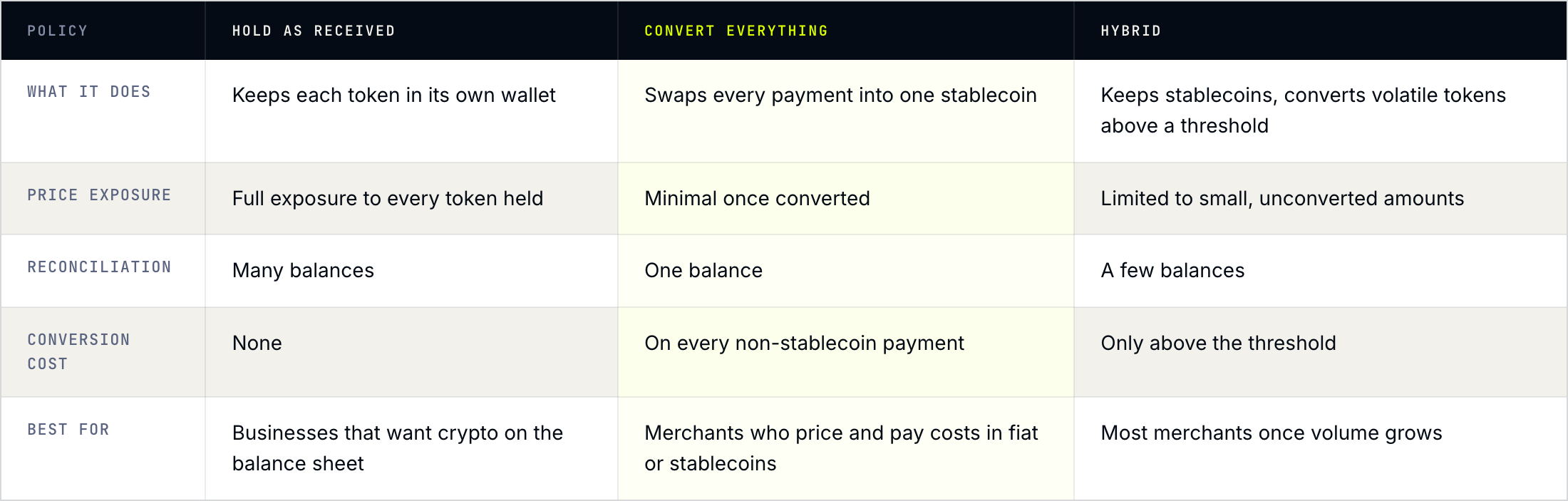
For most merchants, "settle in one" means a stablecoin such as USDT or USDC, because it keeps the balance close to the fiat price the product was sold at. From there, funds can pay suppliers, staff or partners directly, or go to an off-ramp. Our instant settlement guide covers the treasury side in more depth.
Where it gets tricky: Three things to design on purpose
1. Quotes and volatility
The crypto amount is calculated when the customer starts paying. If the payment arrives after the window closes, the price may have moved. Keep the window short enough to limit that risk and long enough for a customer to open a wallet and confirm. Decide in advance what happens to late payments: credit at the original quote, re-quote, or refund.
2. Wrong amounts
Customers sometimes send slightly less, slightly more, or the right amount in two transfers. Exchange withdrawals that deduct their own fee are a common cause. Set a rule for each case before launch; our guide to failed and underpaid transactions walks through the options.
3. Conversion rate and timing
Converting into your settlement currency has a price: the rate you get and, for some providers, a fixed or floating rate type. A fixed rate is predictable but may be slightly worse; a floating rate follows the market until the swap completes. Converting small payments one by one can also cost more than converting in batches above a minimum amount.
Accepting tokens nobody asked for. Every extra token adds a wallet to monitor, a conversion route to maintain and a line in reconciliation. Start with the tokens your customers already use, measure demand, and add more only when the data says so.
The menu: Which tokens to offer first
- Core: USDT and USDC on the two or three networks your customers use most. These cover the bulk of payments with no price risk.
- Majors: BTC and ETH for customers who hold them and prefer not to swap first.
- Regional or community tokens: only where a clear group of customers asks for them, and always with automatic conversion.
Set it up: A settlement rule in plain fields
Most of the policy fits in a handful of fields per incoming currency: what arrives, what you want, the minimum amount worth converting, and which wallets the funds move between.

In CPAY: Multi-currency in, one currency out
- Choose what to accept. Each checkout (sale, donation or cart) has a list of payment methods: the currencies you accept. Sale prices are set in fiat, and the widget shows the amount in the chosen cryptocurrency.
- One address per currency. A separate client wallet is created for each currency, with its own QR code. The charge moves from New to Pending to Done, and the payment window can be set to 10, 30 or 60 minutes.
- Partial payments. Customers can pay a sale in part, so split transfers don't break the flow.
- Settle in one with auto-swap. Rules define the currency you send, the currency you get, a minimum amount in USD, and the sender and destination wallets. The swap runs automatically once funds arrive.
- Rate choice. Through the swap API you can request fixed or floating rates and compare offers by rate or duration.
- Pricing: a flat 0.5% on incoming payments, with no setup fee or monthly minimum.
Auto-swap needs auto-signing on the wallet, because the system signs the conversion transaction itself.
FAQ — Common follow-ups
Does the customer pay more for paying in a different token?
The customer pays the fiat price converted into their token at the quoted rate, plus their own network fee. Any conversion into your settlement currency happens afterwards, on your side.
Should we convert stablecoins too?
Usually there is no need. USDT and USDC already track the dollar. Some merchants convert one into the other to keep a single balance; weigh that convenience against the conversion cost.
What if a customer pays after the window closes?
The funds still arrive on-chain. Decide in your policy whether to honour the original quote, ask for the difference or refund, and apply that rule consistently.
How many tokens should we accept at launch?
Start with USDT and USDC on your customers' main networks, plus BTC and ETH if your audience holds them. Add others only when customers ask for them and volume justifies the extra wallet and conversion route.
Can we show prices in local currencies?
Yes. Price the product in the fiat currency you sell in; the checkout calculates the crypto amount from it. That keeps your price list stable while customers pay in whatever they hold.
Want to accept any token and settle in one balance? Book a call or read the CPAY auto-swap docs.
Sources: CPAY Docs — Checkouts, CPAY Docs — Donation and sale, CPAY Docs — Selling a product or service, CPAY Docs — Auto-swap, CPAY Docs — Using API for swap, CPAY Docs — Autosign, CPAY — Pricing.