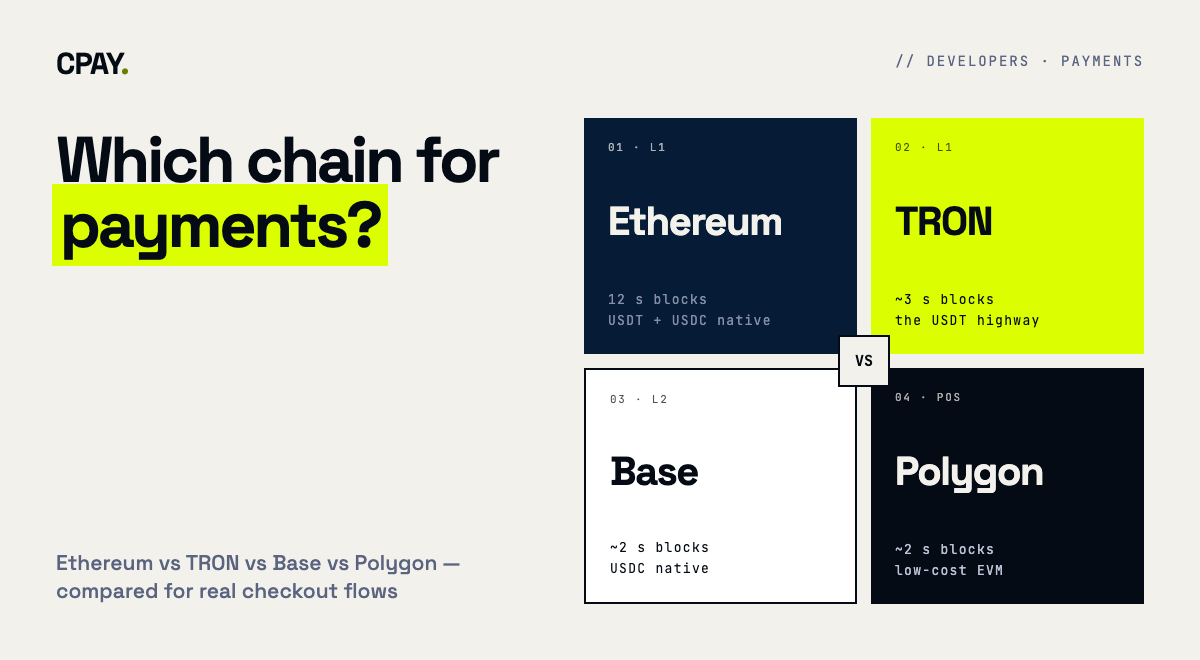
"Which blockchain should we accept payments on?" sounds like an engineering question. In practice it's a customer question with an engineering tail. The right network is the one your payers already hold stablecoins on, at a cost that fits your ticket size, with a settlement path that suits where your money goes next. This guide compares the four networks merchants ask about most — Ethereum, TRON, Base and Polygon — on exactly those terms, and ends with a short decision path you can apply in an afternoon.
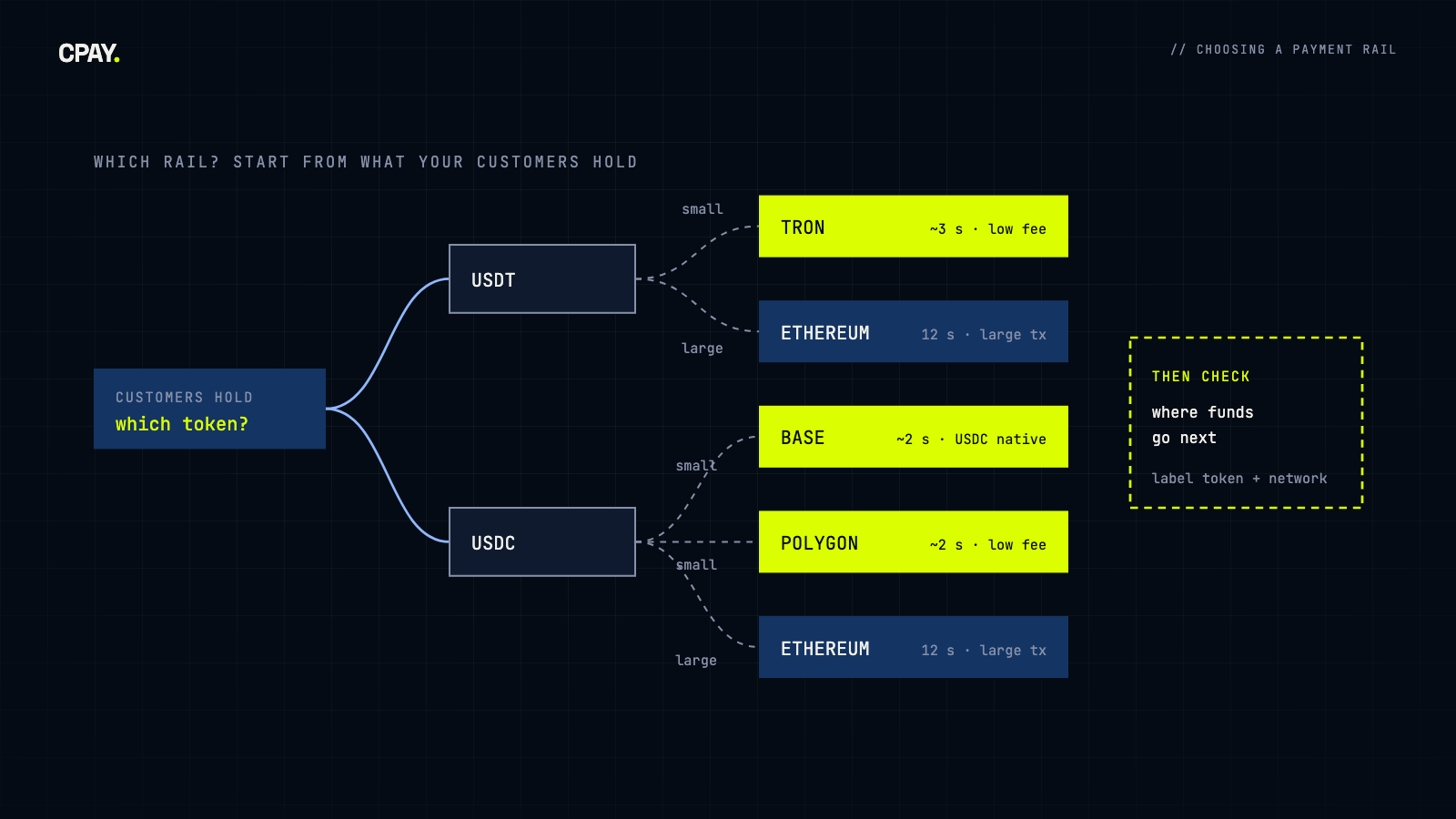
Pick the rail your customers already use. USDT-heavy customers tend to sit on TRON and Ethereum. USDC-heavy customers tend to sit on Base, Polygon and Ethereum. Large B2B transfers are comfortable on Ethereum; small retail payments fit the low-fee networks. Most businesses end up offering two or three rails, clearly labelled.
Step 1 — four questions: What actually decides the network
- Where do your payers hold funds today? A customer who keeps USDT on TRON will pay on TRON. Asking them to bridge first adds a step most people skip by leaving.
- Which stablecoin? USDT and USDC are available on different sets of networks, and their footprint differs by region and customer type.
- What's the typical ticket? On a $50,000 invoice, the network fee is noise. On a $15 order, it decides whether the payment makes sense at all.
- Where does the money go next? Treasury, exchange, payroll, a supplier on another chain — the cheapest rail in is only cheap if the rail out works too.
Network 1 — Ethereum: The settlement layer
Ethereum is where both major dollar stablecoins are issued natively and where the deepest liquidity, the most institutional counterparties and the longest operating history sit. Blocks are produced in fixed 12-second slots, and transactions become final once two checkpoints a few minutes apart are confirmed by the network. Fees are paid in ETH and rise with demand, which makes Ethereum excellent for large transfers and expensive for small ones.
Pick it when: tickets are large, counterparties are institutional, or funds will sit in Ethereum-based treasury and DeFi positions. Watch for: fee spikes during busy periods, and the friction they add to small retail payments.
Network 2 — TRON: The USDT highway
TRON produces a block about every three seconds and has become one of the most used networks for USDT transfers, especially for retail and cross-border payments. Fees work differently from Ethereum: transactions consume network resources — bandwidth and energy — which an account obtains by staking TRX, or pays for by burning TRX when it has none. For a payment business, that turns fee management into resource management.
One detail matters for stablecoin planning. Circle stopped minting USDC on TRON in February 2024 and has since wound down support for it, so treat TRON as a USDT network.
Pick it when: your customers pay in USDT, tickets are small to mid-size, and speed matters. Watch for: energy and bandwidth management on high volumes, and customers looking for USDC on TRON.
The best payment network is the one your customer can pay on in one tap. (A rule of thumb, not a quote.)
Network 3 — Base: The USDC-native layer 2
Base is an Ethereum layer 2 built on the OP Stack and incubated by Coinbase. Blocks arrive about every two seconds, fees are low, and USDC is issued on Base natively by Circle — a natural fit for USDC payments and for customers who already use Coinbase products. Transfers within Base settle quickly; moving funds from Base back to Ethereum through the standard bridge is a different matter, with a seven-day challenge period before the withdrawal can be finalised on Ethereum.
Pick it when: you price in USDC, tickets are small, and customers are Coinbase-adjacent or consumer-facing. Watch for: the seven-day path to Ethereum for treasury moves — plan to off-ramp or rebalance through venues that support Base directly.
Network 4 — Polygon: The low-cost EVM workhorse
Polygon PoS is an EVM-compatible chain with its own validator set, blocks about every two seconds and low fees, paid in its native token POL (formerly MATIC). Native USDC is issued on Polygon PoS by Circle, alongside an older bridged version known as USDC.e — two different tokens with different contracts. Accept the one you intend to hold, and say so on the payment page.
Pick it when: you want low fees with familiar Ethereum tooling, and your customers hold USDC or USDT on Polygon. Watch for: USDC versus USDC.e confusion, and the MATIC-to-POL naming in older wallets and documentation.
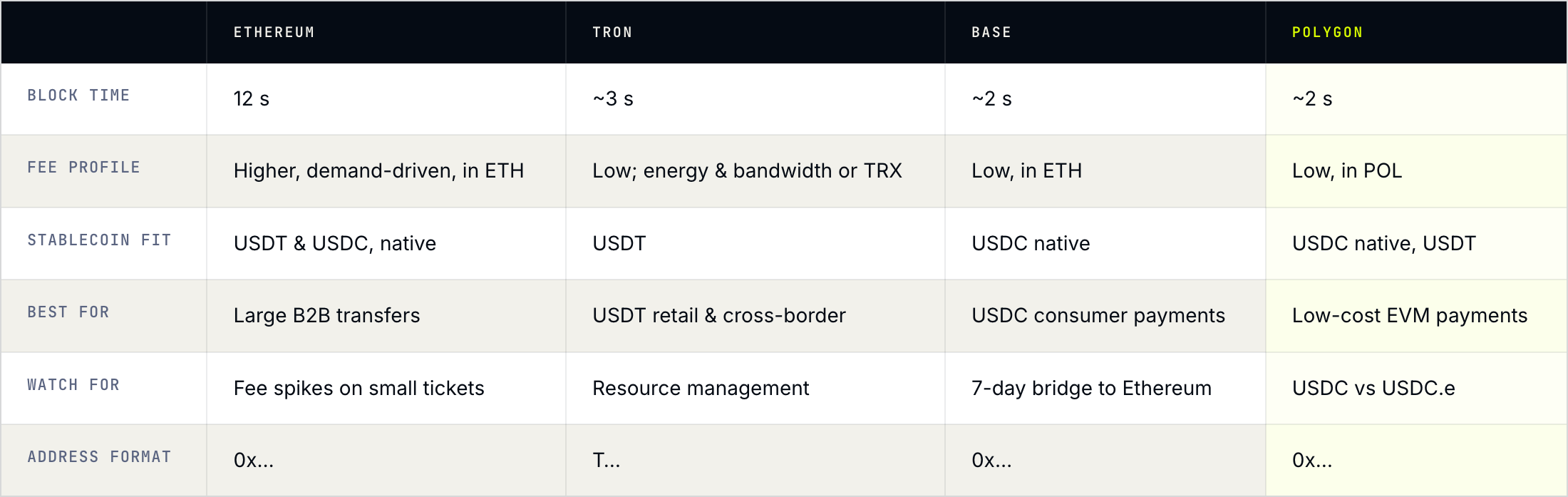
At a glance: Four networks, side by side
The quiet risk: Same address, different network
The last row of that table hides the most common support ticket in crypto payments. Ethereum, Base and Polygon all use the same 0x address format, so an address valid on one is valid on all three — and a payment sent on the wrong one still arrives, just somewhere your checkout isn't watching. Address validation catches a mistyped address; only clear labelling catches the wrong network. That's why every payment option should carry the token and the network in the same line.
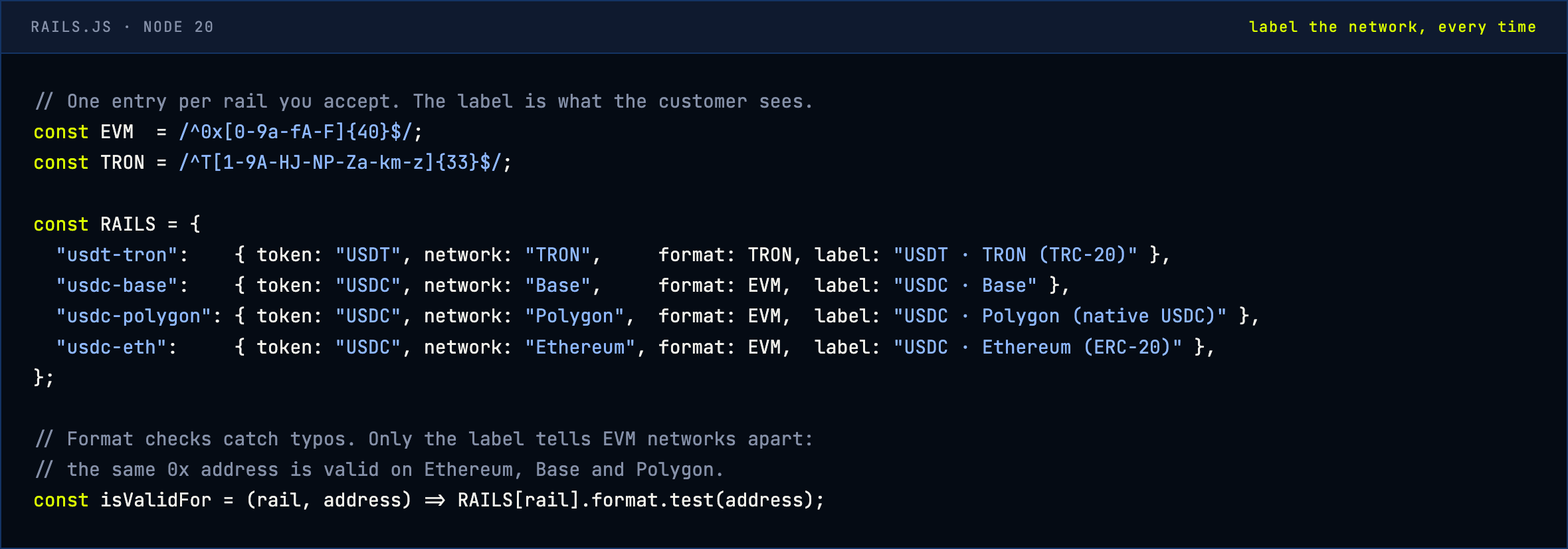
In CPAY: Offer several rails from one integration
CPAY supports USDT and USDC on all four networks covered here — Ethereum, TRON, Polygon and Base — alongside BNB Chain, Optimism, Arbitrum, Solana, TON and others, so adding a rail is a configuration choice rather than a new integration. The network fee (miner fee) is set by the blockchain itself and is separate from CPAY's commission, and the account decides whether the customer or the business covers it when funds move from a client wallet to the account wallet. For the stablecoin side of the decision, our USDT/USDC checkout guide covers the payment flow end to end.
Step 2 — decide: A decision path in five lines
- Start with your payers: survey or check past requests — which token, which network?
- USDT customers: TRON first, Ethereum for large tickets.
- USDC customers: Base or Polygon for small tickets, Ethereum for large ones.
- Check the exit: confirm your off-ramp, exchange or treasury accepts deposits on each rail you add.
- Launch with two or three rails, label each one with token and network, and add more when customers ask.
FAQ — Common follow-ups
Which blockchain is cheapest for payments?
TRON, Base and Polygon all have low per-transfer costs compared with Ethereum, and the exact figures move with network demand and, on TRON, with how resources are provisioned. For small payments, any of the three works; pick the one your customers already hold funds on.
Should we accept USDT or USDC?
Both, if you can — on the networks where each is strongest. USDT covers TRON and Ethereum users; USDC covers Base, Polygon and Ethereum users. Offering one token on one network is a fine pilot; most businesses add the second within months.
How fast is settlement on each network?
Blocks arrive every 12 seconds on Ethereum, about every three on TRON and about every two on Base and Polygon. How many confirmations you wait for before crediting an order is your call; larger amounts justify a longer wait.
What happens when a customer pays on the wrong network?
On EVM networks the funds land at the same address on the other chain. Whether they can be recovered depends on whether your wallet can access that address on that network — often it can, at the cost of a manual recovery. Clear labels on the payment page prevent most of these cases.
Can we add networks later?
Yes. Start with the rails your customers use most, measure, and add others as requests come in. With a multi-network gateway, a new rail is a configuration change on the same integration.
Want to accept stablecoins on several networks from one integration? Book a call or read the CPAY docs.
Sources: ethereum.org — Proof-of-stake, TRON Developers — Resource model, Circle — USDC on TRON, Circle — Native USDC on Polygon PoS, Base Docs — Bridging and withdrawals, CPAY Docs — General concepts. Network fees and finality change over time; check current figures before you decide.