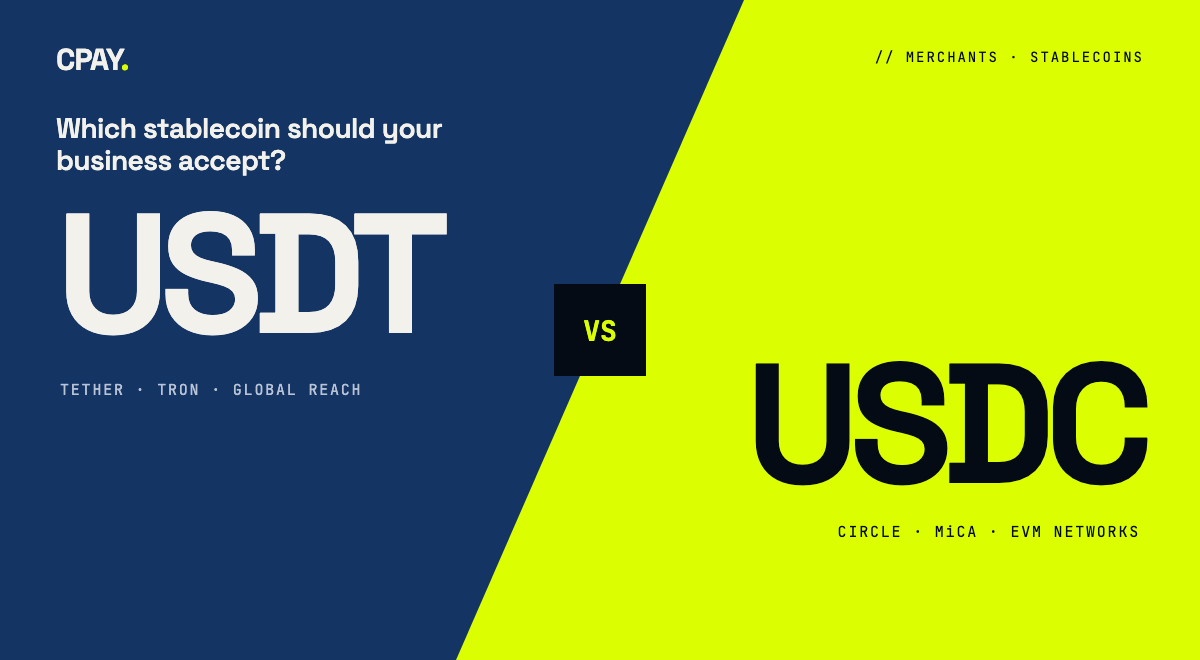
USDT and USDC both aim to be worth one US dollar, and both move on public blockchains in minutes. For a business choosing what to accept, they are not interchangeable. They differ in who issues them, how their reserves are reported, how regulators treat them in the EU, and which networks and regions your customers use them on. This guide compares the two on the points that matter to a merchant, then turns the comparison into a decision you can make in an afternoon.
The short answer: Accept both, settle into one
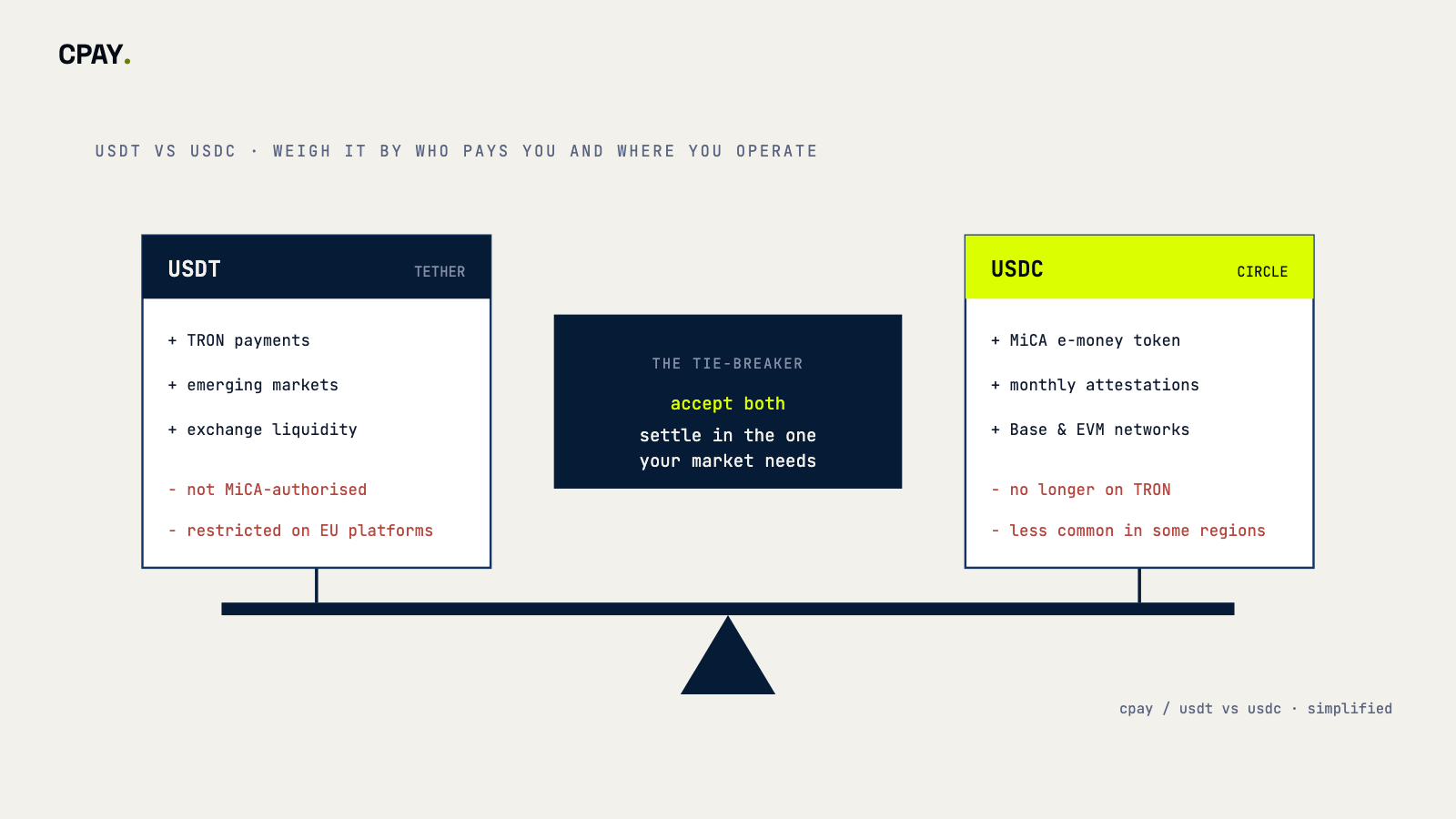
For most merchants the practical answer is to accept both and decide separately which one you hold. Customers pay with whatever they already have; your treasury keeps the stablecoin that fits your jurisdiction, banking partners and suppliers. The rest of this guide helps you pick that settlement coin.
Let customers choose the coin they pay with. Let your regulator and your suppliers choose the coin you hold. (A rule of thumb, not a quote.)
Side by side: The facts that differ

Issuer and reserves
Tether states that USDT is backed by its reserves and publishes reserve reports on its transparency page. Circle reported in its 2025 SEC filing that most USDC reserves sit in the Circle Reserve Fund, a government money market fund managed by BlackRock, with the remainder held as cash at banks, and that it publishes monthly assurance on the reserves from a Big Four accounting firm.
Regulation in the EU
Under MiCA, the EU rules for stablecoin issuers have applied since 30 June 2024. Circle announced on 1 July 2024 that its French entity had obtained an e-money licence, making USDC a MiCA-compliant e-money token in the EU. In January 2025, ESMA asked crypto-asset service providers to align their services for non-compliant stablecoins with MiCA, with a transition period running to the end of Q1 2025. Several large exchanges restricted USDT for EU users during that window.
Networks
Both coins run on many networks, but not the same set. USDT is heavily used on TRON. Circle discontinued USDC on TRON, so USDC payments normally arrive on Ethereum, Base, Polygon, Arbitrum, Solana and other networks. Our network comparison covers fees and finality per network.
The decision: Five questions that settle it
- Where are your customers? Customers in emerging markets and on exchanges often hold USDT; EU and US business customers increasingly hold USDC.
- Where is your business regulated? An EU-regulated business will find USDC far easier to hold, report and bank.
- Where does the money go next? If you pay suppliers or staff in stablecoins, hold what they accept. If you off-ramp to a bank, hold what your off-ramp partner supports best.
- Which networks do your payers use? TRON users mean USDT; Base and many EVM-native users mean USDC.
- What does your risk policy say about issuers? Some treasury policies cap exposure to any single issuer. Holding both, with a target split, is a valid answer.
In practice: Four merchant profiles
- EU SaaS selling to EU businesses: accept both, settle in USDC.
- Global retail or iGaming with many emerging-market customers: accept USDT on TRON plus USDC on one or two EVM networks; settle in whichever your payouts and off-ramp use.
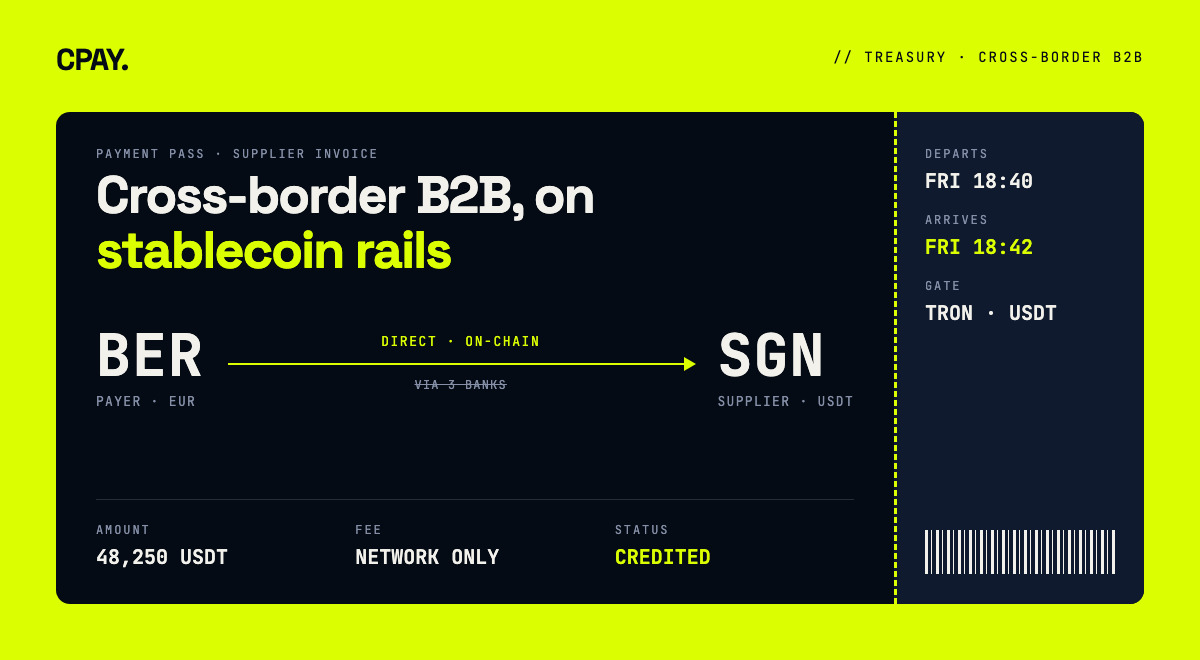
- B2B company paying suppliers in Asia or Latin America: ask suppliers which coin and network they hold; often USDT on TRON. Hold enough of it for each payment run.
- US marketplace paying sellers: accept both, settle in USDC unless sellers ask for USDT.
Labelling the coin but not the network. "Pay in USDC" is not enough. A customer who sends USDC on the wrong network, or USDT where USDC was expected, creates a support case. Show the token and network together on every payment option.
Set it up: Accepted coins vs. settlement coin
Treat the two decisions as separate settings: what you accept at checkout, and what you hold afterwards. Our guide to multi-currency checkout covers the conversion side.
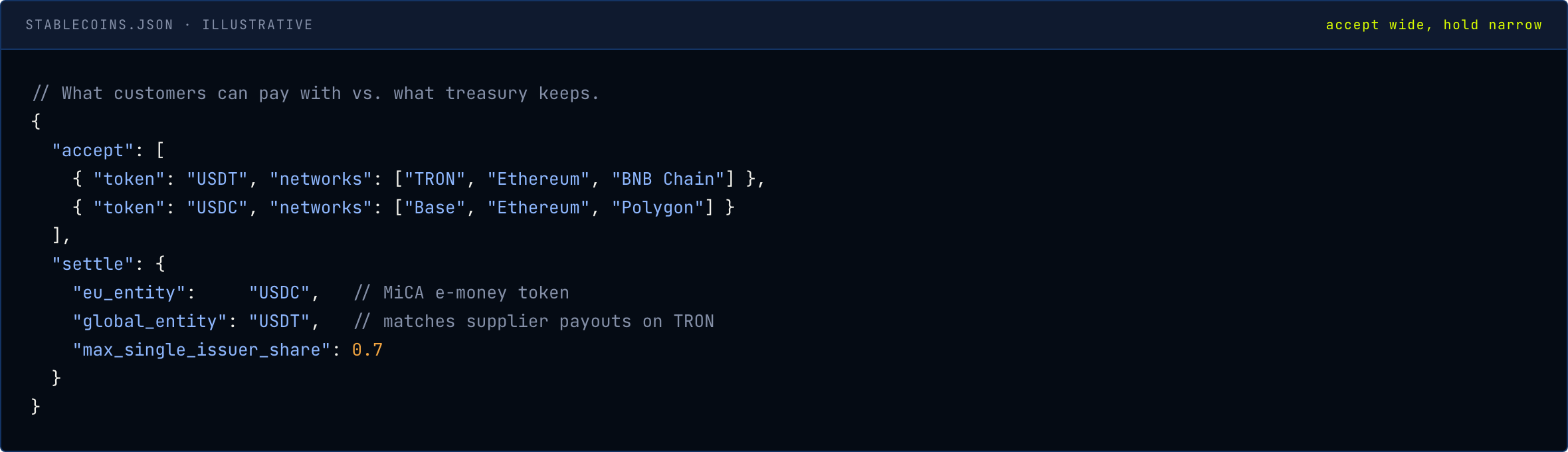
In CPAY: Both coins, one integration
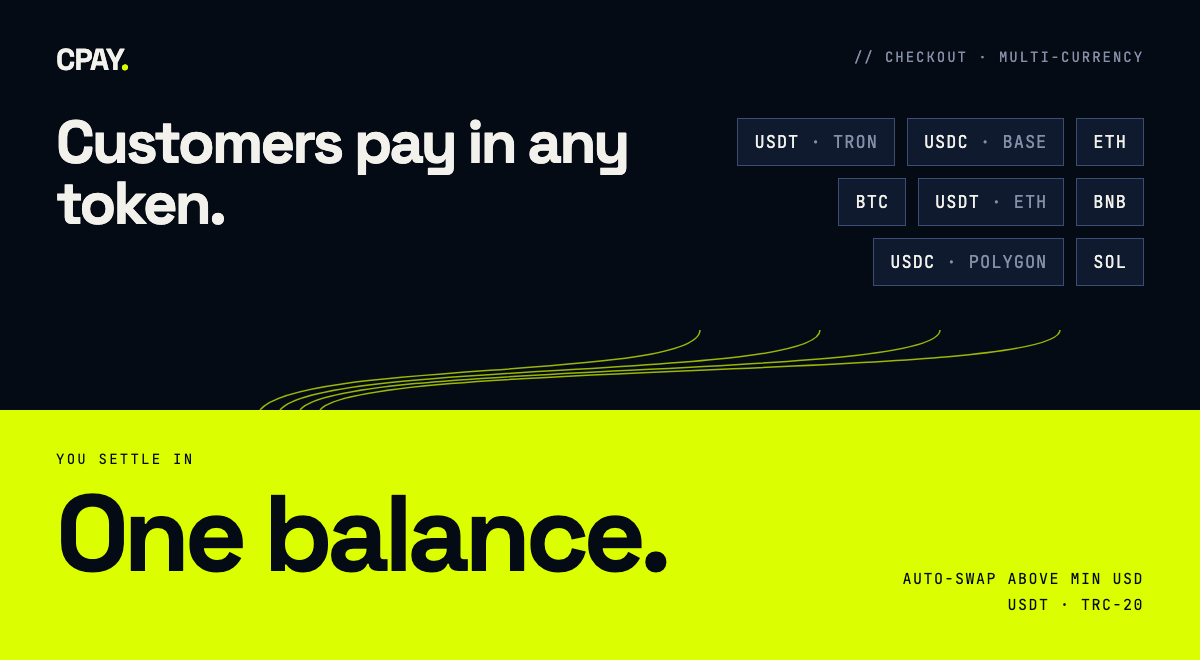
- Both stablecoins on many networks. CPAY supports USDT and USDC across networks including Ethereum, BNB Chain, Polygon, Arbitrum, Optimism and Base, plus USDT on TRON and TON.
- Settle into the coin you choose. Auto-swap rules convert incoming currencies into your settlement coin above a minimum amount you set.
- Pricing: a flat 0.5% on incoming payments, network gas only on payouts, no setup fee or monthly minimum.
FAQ — Common follow-ups
Is USDC safer than USDT?
They carry different risk profiles: different issuers, reserve compositions, reporting and regulatory status. Read each issuer's latest reserve reports and set a treasury policy on how much you hold of each, rather than relying on a single label.
Can an EU business accept USDT?
MiCA restricts what EU crypto-asset service providers can offer for non-compliant stablecoins. Whether and how an EU business can accept or hold USDT depends on its setup and providers, so confirm with your legal adviser. Many EU businesses accept USDC only, or convert USDT on arrival.
Are USDT and USDC always worth exactly $1?
Both are designed to track the dollar, and market prices usually sit very close to $1, but small deviations can happen, especially in stressed markets. Converting promptly and keeping balances proportionate to your needs limits that exposure.
Which is cheaper to receive?
The token rarely decides the fee; the network does. A USDT payment on TRON and a USDC payment on Base can both be cheap, while either on Ethereum costs more at busy times.
Can we switch our settlement coin later?
Yes. Settlement is a treasury setting, not a customer-facing change. Update your conversion rules and keep accepting both at checkout.
Want to accept USDT and USDC and settle in the one your treasury holds? Book a call or check supported networks.
Sources: Tether — Transparency, Circle — Form S-1 (SEC, 2025), Circle — MiCA compliance announcement, ESMA — Statement on non-MiCA compliant ARTs and EMTs, Cointelegraph — USDT delistings in Europe, Circle — USDC on TRON discontinued, CPAY Docs — Supported networks, CPAY — Pricing. This article is general information, not legal or investment advice.