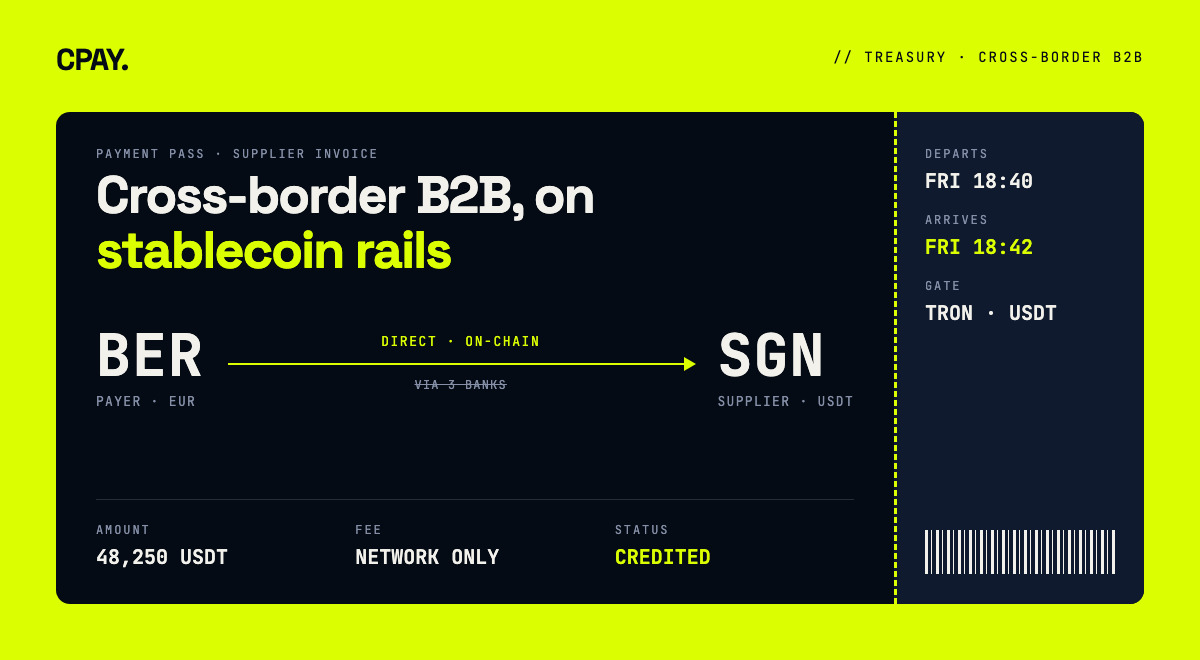
A supplier invoice crosses a border and something strange happens. The amount leaves your account on Monday, passes through banks you never chose, loses a few fees along the way, and lands on Wednesday, or Thursday if a holiday sits in the middle. Nobody can tell you the final amount in advance. That's why finance teams paying suppliers, contractors and subsidiaries abroad are adding a second route: stablecoins on a public blockchain, settled in minutes, any day of the week. This guide compares the two routes leg by leg and shows where the new one fits.
Route A: How a cross-border wire actually travels
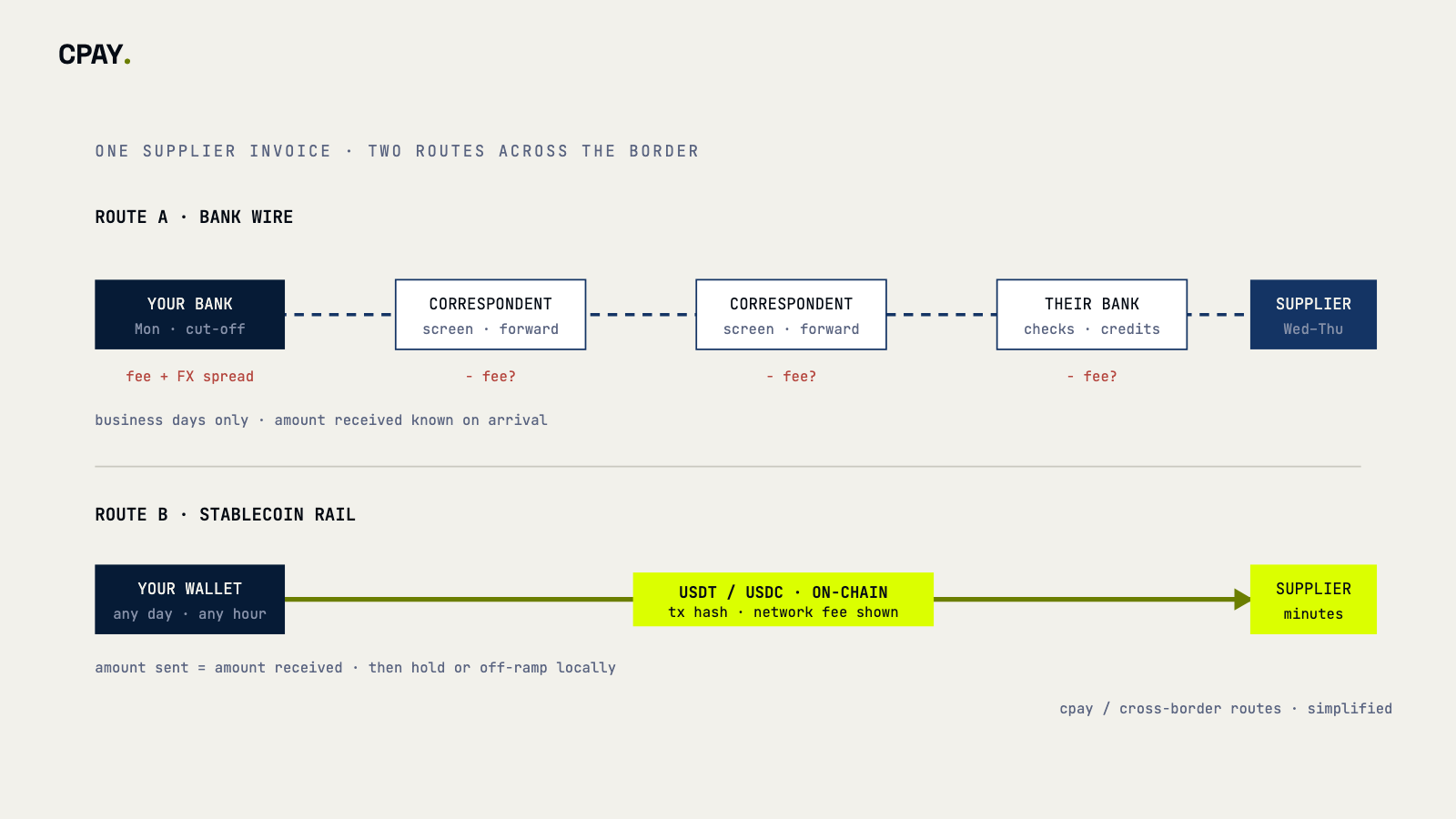
A cross-border bank payment rarely goes straight from your bank to your supplier's. Unless the two banks have a direct relationship, the payment hops through one or more correspondent banks that hold accounts for each other. Each hop can add a fee, a compliance check, a cut-off time and, if currencies change, an FX spread.
Those routes are getting thinner. BIS data shows the number of active correspondent banks worldwide fell by about 22% between 2011 and 2019, with steeper declines in emerging markets and small island economies. Fewer correspondents can mean longer chains or fewer options in exactly the corridors where many suppliers sit.
- Your bank debits you, applies its fee and FX rate, and sends the instruction before its cut-off.
- One or more correspondents receive, screen and forward it, sometimes deducting their own fee from the amount.
- The beneficiary bank receives the funds, runs its own checks and credits the supplier, often the next business day.
The friction: Four things finance teams complain about
- Cost: sending fees, intermediary deductions and an FX spread that's rarely shown as a separate number.
- Speed: cut-off times, time zones, weekends and public holidays in two or three countries.
- Predictability: the supplier receives less than the invoice, and someone has to chase the difference.
- Access: some corridors have few correspondents left, and payments there are slower or harder to get through.
1% and one hour, by end-2027. The G20 target for retail cross-border payments, which explicitly includes B2B, is an average cost of no more than 1% and funds available within one hour for 75% of payments by end-2027. In October 2025 the FSB said satisfactory global improvements were unlikely to be achieved on that timetable, even though wholesale payment speed had improved.
Route B: How a stablecoin payment travels
On a stablecoin rail, the payer sends USDT or USDC from its wallet straight to the supplier's wallet on a public blockchain. There are no intermediary banks between the two wallets, no cut-off times and no weekends. The transfer settles when the network confirms it, typically in seconds to minutes depending on the network.
- Fund: hold stablecoins for payables, or convert from fiat through an on-ramp before the payment run.
- Send: one on-chain transfer per supplier, or a batch for many, each with a transaction hash both sides can see.
- Receive: the supplier keeps the stablecoins for its own payments or converts them locally through an off-ramp.
The amount sent is the amount received, minus a network fee you can see before you send. The transaction hash doubles as a payment reference that both finance teams can check independently.
Move the money at internet speed. Keep the paperwork at bank standard. (A rule of thumb, not a quote.)
Side by side: Route A vs. Route B
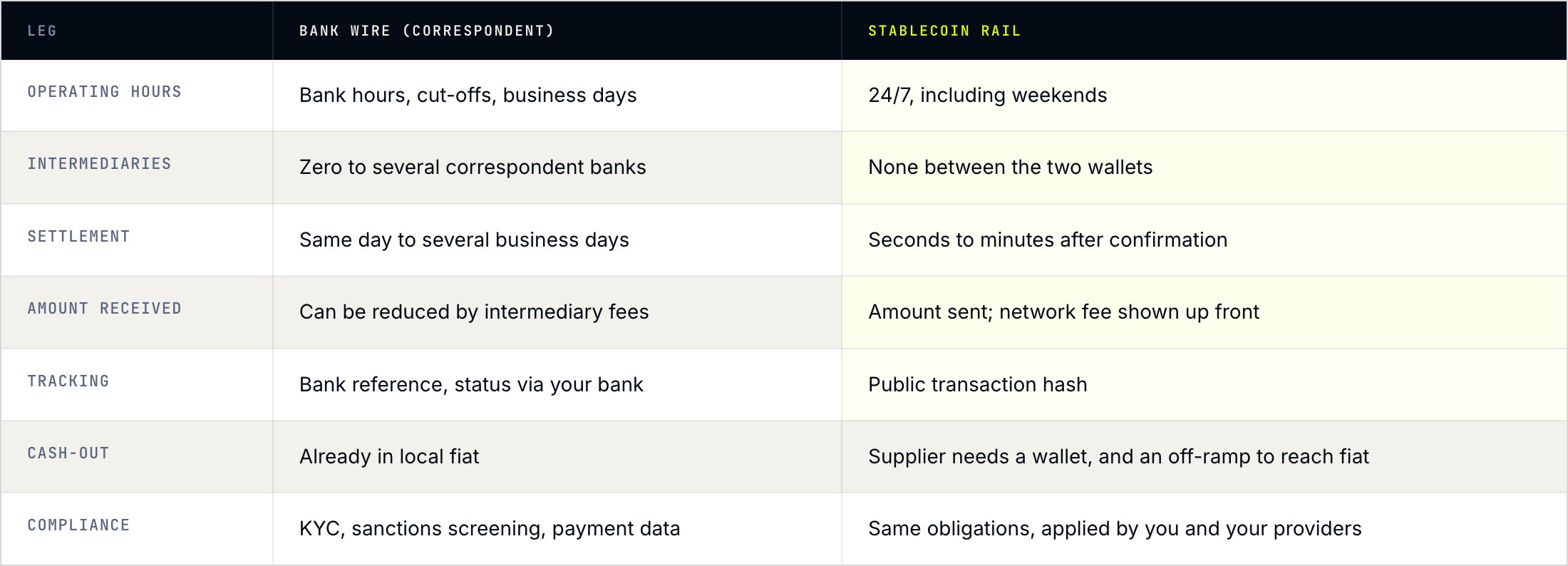
The last two rows matter as much as the first five. A stablecoin rail only works if the supplier can use or convert what it receives, and compliance obligations travel with the payment whichever route it takes.
Know who you're paying. Supplier due diligence, sanctions screening and record-keeping still apply. Verify the supplier and its wallet address before the first payment, and screen counterparties as you would on any rail. Our guides to KYC & AML and sanctions screening cover the details.
Where it fits: Four payment runs that move first
- Suppliers in hard-to-reach corridors. Where wires are slow or expensive and the supplier already uses stablecoins.
- Contractors and agencies abroad. Many small, recurring payments where fixed wire fees hurt most. See our mass payouts guide.
- Intercompany treasury. Moving working capital between your own entities on a Friday evening without waiting for Monday.
- Marketplace and platform payouts. Paying sellers in many countries from one balance.
Bank rails remain the better choice when a counterparty contractually requires fiat into a named bank account, or when no reliable off-ramp exists on the receiving side. Most companies end up running both routes and picking per supplier.
The rulebook: Regulation is catching up
Two frameworks have made stablecoins easier for finance and compliance teams to sign off on:
- EU: under MiCA, the rules for issuers of asset-referenced and e-money tokens, the categories that cover stablecoins, have applied since 30 June 2024.
- US: the GENIUS Act, a federal framework for payment stablecoins, was signed into law on 18 July 2025 as Public Law 119-27.
Rules differ by jurisdiction and keep evolving, so confirm the position for your entities and your suppliers' countries with counsel before you scale.
Start small: A 30-day pilot
- Pick one corridor and one to three suppliers who already hold or accept USDT or USDC.
- Agree the network and token in writing, together with the supplier's verified wallet address. Our network comparison helps here.
- Send a small test transfer and have the supplier confirm receipt before the real invoice.
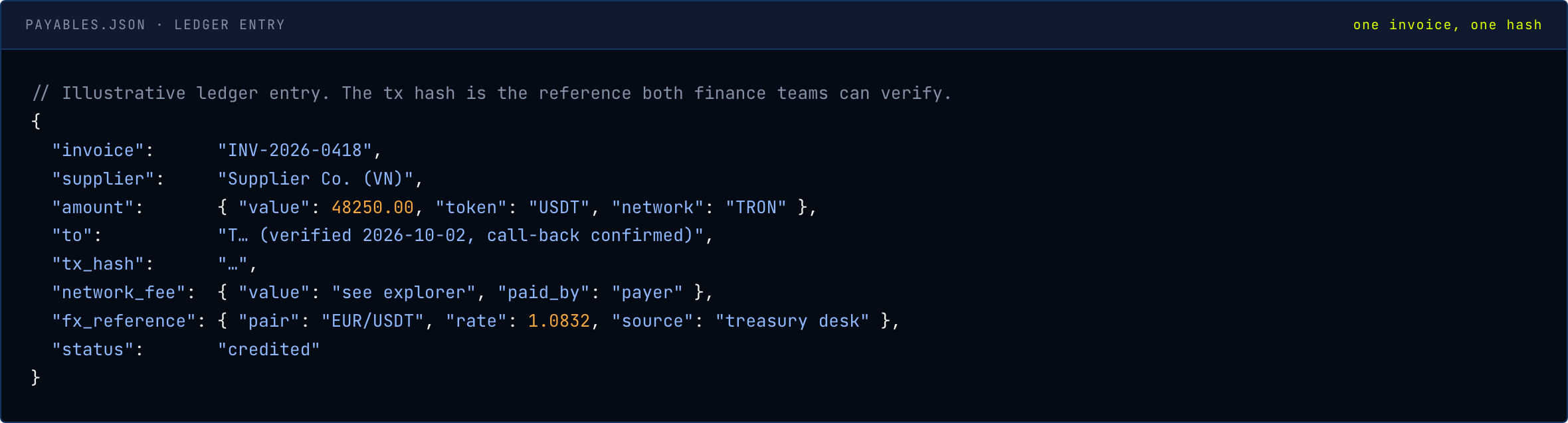
- Record every payment against its invoice with the transaction hash, network, amount and exchange rate used.
- Compare after 30 days: total cost, days-to-credit and time spent chasing payments, against the same suppliers on wires.
In CPAY: Running the stablecoin route
- Non-custodial wallets for holding and sending stablecoins on the networks your suppliers use, with saved, verified addresses in the address book.
- Batch payouts: multisend pays many recipients in one operation, useful for contractor and marketplace runs.
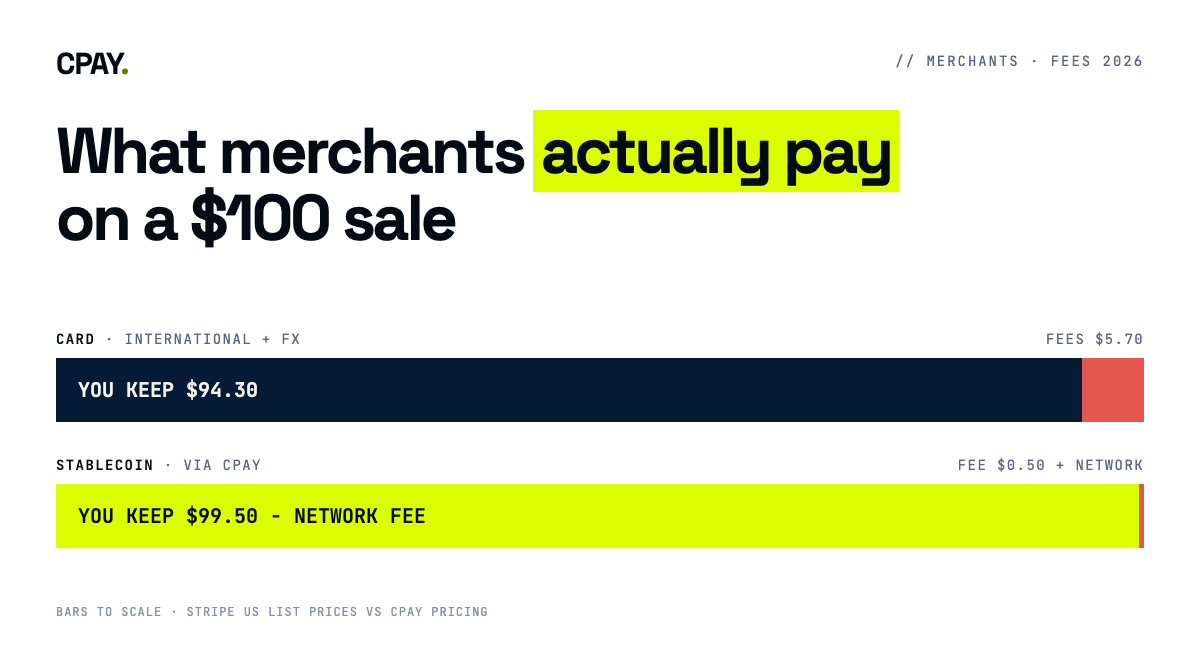
- Pricing: outgoing transfers cost the network fee only, incoming payments are a flat 0.5%, with no setup fee or monthly minimum.
- Compliance: KYC and AML checks are available pay-per-check, so supplier onboarding and screening sit in the same place.
FAQ — Common follow-ups
Is paying suppliers in stablecoins legal?
In many jurisdictions, yes, and frameworks such as MiCA in the EU and the GENIUS Act in the US now set rules for stablecoin issuers. Rules differ by country and change over time, so confirm the position for your entities and your suppliers' jurisdictions.
How do we account for a stablecoin payment?
Record each payment against its invoice with the transaction hash, token, network, amount and the exchange rate you used. Agree the accounting treatment with your auditors before the pilot, not after.
What if the supplier needs local currency?
The supplier converts through a local exchange or off-ramp. If that isn't available or affordable in their country, keep that supplier on bank rails.
Which stablecoin and network should we use?
The ones your supplier already uses. USDT on TRON and USDC on Ethereum, Base or Polygon are common; agree the exact token and network in writing so funds never go to the wrong chain.
Can a stablecoin payment be reversed?
No. A confirmed transfer is final, which is why address verification and a test transfer come before the first real payment. Corrections are made with a new transfer.
Ready to pay suppliers abroad in minutes, any day of the week? Book a call or read the CPAY docs.
Sources: BIS / CPMI — Correspondent banking data, FSB — G20 targets for cross-border payments, FSB — October 2025 progress statement, EBA — ARTs and EMTs under MiCA, GovInfo — Public Law 119-27 (GENIUS Act), CPAY Docs — Multisend, CPAY — Pricing. This article is general information, not legal or tax advice.