What is a crypto payment gateway? How it works in 2026
The crypto equivalent of a card processor — but built on public blockchains. Here is what a crypto payment gateway is, how the payment flow actually works end to end, and what separates a modern 2026 gateway from a basic one.
If you sell online, you already understand a payment gateway: it is the layer that takes a customer's money and gets it into your account. A crypto payment gateway does the same job on public blockchains — it lets a business accept, verify, and settle cryptocurrency payments without dealing with blockchain complexity directly. This guide explains what it is, how the flow works step by step, and what to look for in 2026.
01 — What a crypto payment gateway actually is
A crypto payment gateway is the infrastructure that connects a business to blockchains so it can get paid in crypto. It creates payment requests, detects incoming transactions, confirms them, tells your system what happened, settles the funds, and lets you pay out — all through a simple API or plugin, so your team never has to write blockchain code.
It is easy to confuse three things, so it is worth separating them clearly:
- A wallet stores keys and holds funds. It is where money sits.
- An exchange trades one asset for another. It is where money is converted.
- A payment gateway orchestrates getting paid: request, detect, confirm, notify, settle, pay out. It is the process around the money.
The closest analogy is a traditional processor like the ones behind card checkouts. The job is identical — accept a payment and settle it to the merchant — but the rails are different. Instead of card networks and banks, a crypto gateway runs on blockchains, which changes the economics (lower, more predictable fees), the speed (minutes, not days), and the risk profile (no chargebacks, on-chain verifiability).
The reason a dedicated gateway exists at all is that accepting crypto directly is deceptively hard. There are dozens of networks, each with its own confirmation rules, fee tokens, and quirks. Payments can arrive short, arrive late, or land on the wrong chain. Exchange rates move between the moment a price is shown and the moment funds clear. Compliance obligations apply the same way they do to any money movement. Building and maintaining all of that in-house is a serious, ongoing engineering commitment that has nothing to do with your actual product. A gateway exists so you can treat "accept crypto" as a feature you switch on — not as a second business you have to run.
02 — How a crypto payment gateway works, step by step
The whole point of a gateway is to turn a messy on-chain reality into a clean, predictable flow. Here is what actually happens when a customer pays.
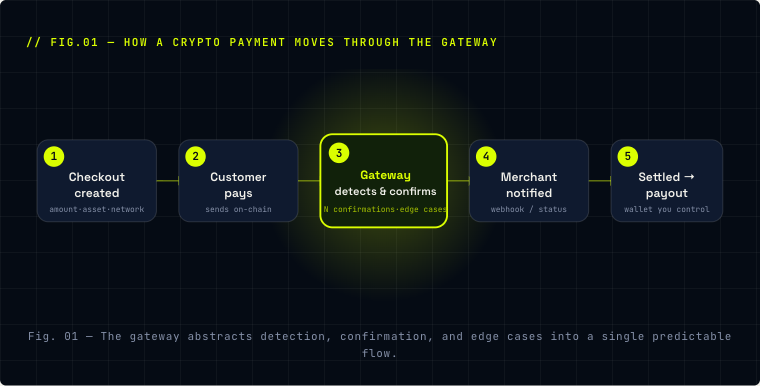
- Checkout created. Your system asks the gateway — via API, a hosted checkout link, or a plugin — for a payment of a given amount, asset, and network. The gateway returns a payment address and a checkout (often with a QR code).
- Customer pays. The customer sends the crypto from their own wallet to that address on the chosen network. Nothing about your infrastructure touches the blockchain directly.
- The gateway detects and confirms. The gateway's indexers watch the chain and see the incoming transaction within seconds, then wait for the required number of block confirmations before treating it as final. This is also where the hard parts live — underpayments, overpayments, late transfers, and wrong-network deposits are all handled here.
- Your system is notified. A webhook (callback) tells your backend the payment status — paid, pending, or failed — so an order can be fulfilled or a service unlocked automatically, without anyone checking a block explorer.
- Settlement and payout. The funds are credited to your balance. In a non-custodial gateway they land in a wallet you control, ready to withdraw, auto-forward, or use for your own payouts.
You can plug into this flow in three ways, depending on how much control you want. A hosted checkout is the fastest — the gateway hosts the payment page and you just redirect to it. A direct API integration gives you full control over the experience and is what most product teams build against. And a ready-made plugin for platforms like Shopify or WooCommerce gets a store live with almost no code. All three drive the same underlying flow.
One detail is worth understanding because it defines the whole model: confirmations. A blockchain transaction is not final the instant it appears — it becomes progressively harder to reverse as more blocks build on top of it. The gateway's confirmation policy (how many blocks to wait, per network and per amount) is what turns "a transaction showed up" into "this payment is safe to act on." Too few confirmations is risky; too many is needlessly slow. Getting that balance right, per chain, is a large part of what you are actually paying a gateway to do.
From the customer's side it feels like any modern checkout. From your side, weeks of blockchain engineering are replaced by a few API calls.
03 — Custodial vs non-custodial gateways
The single most important difference between gateways is who holds the funds. It shapes your risk, your control, and your compliance exposure.
- Custodial — the gateway holds incoming funds in its own pooled wallets and then settles to you. Convenient, sometimes with an easier fiat off-ramp, but you carry counterparty risk: your money sits behind someone else's keys.
- Non-custodial — the keys stay with you. The gateway orchestrates detection, confirmation, and settlement, but never takes possession of your funds. There is no shared pool to breach, and every transaction is verifiable on-chain.
For businesses that care about control and want to avoid the failure modes that have sunk custodial platforms, non-custodial has become the default expectation in 2026.
What this means for security and compliance
Custody and compliance are two different questions, and a good gateway answers both. On the security side, a non-custodial model removes the single biggest target — a pooled wallet holding everyone's funds — and, in modern systems, protects keys with MPC or multisig rather than a lone private key. On the compliance side, accepting crypto does not exempt a business from the rules that govern any money movement: identity checks (KYC), anti-money-laundering screening (AML), and, increasingly, Travel Rule data exchange between providers. A capable gateway builds these in so you can stay compliant without assembling a separate stack — a point we return to in the buyer's guide below.
04 — What a modern gateway handles for you
A basic gateway takes a payment. A modern one absorbs the entire operational surface of crypto so you do not have to. Expect it to handle:
- Multichain and multi-asset — many networks and 100+ assets, including stablecoins, from one integration.
- Address generation and detection — a payment address per checkout and real-time monitoring across chains.
- Confirmation policy and edge cases — under- and overpayments, late or wrong-network transfers, and expiry, all resolved predictably.
- Dynamic network fees — gas calculated at send time so you neither overpay nor stall during congestion.
- Webhooks and idempotency — reliable notifications your system can trust, even through restarts.
- Reporting and reconciliation — clean records that match your accounting.
- Payouts and multisend — send funds out, in bulk when needed.
- Compliance — KYC, AML, and Travel Rule support where required.
Complexity in, simplicity out. A good gateway turns the entire messy reality of blockchains — networks, confirmations, fees, edge cases, compliance — into a single API and a predictable settlement. That abstraction is the product.
05 — Fees and settlement
Crypto gateway pricing is usually simpler than card pricing. You typically pay a transaction fee — often below 1%, for example a flat 0.5% — plus the underlying network (gas) fee. There is no interchange, no monthly card scheme complexity, and no chargeback risk, because on-chain settlement is final.
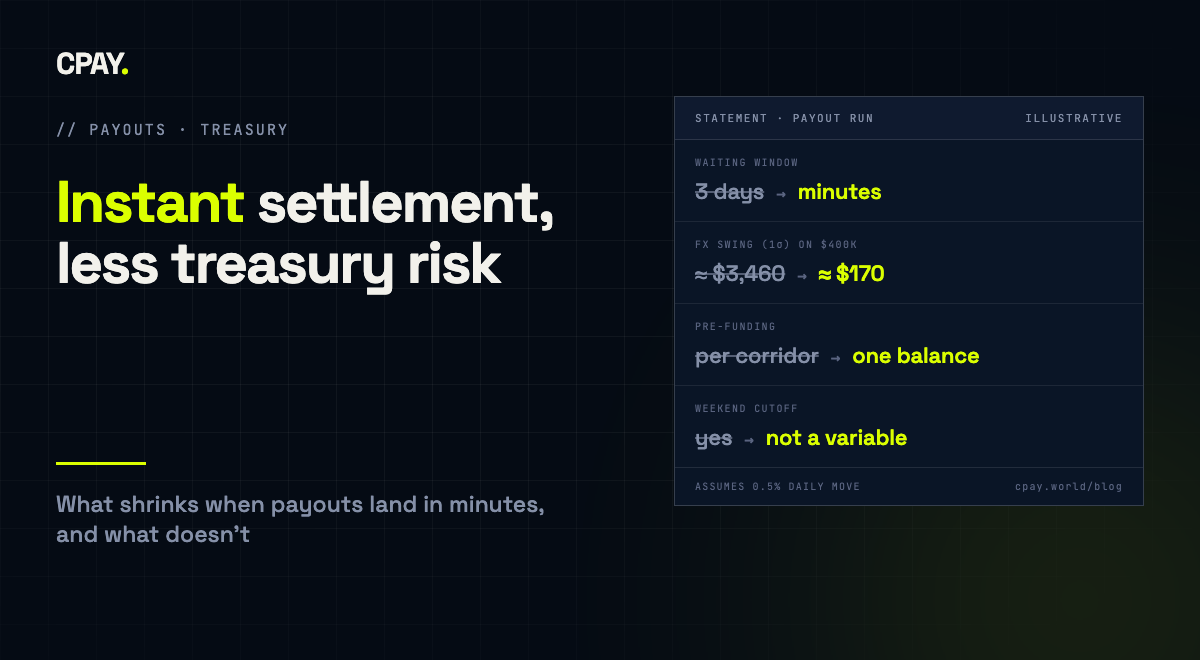
Speed is the other advantage. Card payments often settle in two business days; a crypto payment settles in minutes. With stablecoins such as USDT and USDC, that fast settlement comes without price volatility — you receive dollar-pegged value that is easy to reconcile and use. For a business, faster and more predictable settlement is not a cosmetic win; it is working capital freed up on every transaction.
How it compares to a traditional card gateway
Put the two side by side and the differences are consistent:
- Fees — card rails stack interchange, scheme, and processor fees, often 2–3% or more; a crypto gateway typically charges a single flat fee below 1%, plus the network gas cost.
- Chargebacks — cards allow reversals and "friendly fraud" weeks or months later; on-chain settlement is final, so chargebacks simply do not exist.
- Settlement — cards settle in days (T+2); crypto settles in minutes (T+0).
- Reach — cards depend on issuing banks and geography; crypto works anywhere with an internet connection.
- Transparency — card flows are largely opaque to the merchant; every crypto transaction is verifiable on a public ledger.
None of this makes crypto a universal replacement — cards still win on mainstream consumer familiarity, and most businesses run both. But for cross-border, high-fee, or chargeback-prone operations, the gateway economics are hard to argue with.
"A payment gateway's job is to make the hard part invisible. In crypto, the hard part is everything between 'customer sent it' and 'we can trust it' — and that is exactly what the gateway owns."
06 — What to look for in a crypto payment gateway in 2026
Not all gateways are equal. If you are choosing one this year, hold it against this baseline:
- Non-custodial option — keys and funds stay with you.
- Stablecoin support — USDT and USDC at minimum, to remove volatility.
- Multichain coverage and low, dynamic fees — pay the cheapest viable route.
- A real API and reliable webhooks — with sandbox and clear docs.
- Robust edge-case handling — under/overpayments, wrong-network, expiry.
- Compliance built in — KYC, AML, and Travel Rule where you operate.
- Payouts and multisend — so money flows out as easily as in.
- Transparent, flat pricing — no hidden spreads.
- White-label option — if you want to run the experience under your own brand.
07 — Who uses crypto payment gateways
The pattern is the same across very different businesses: they want faster settlement, lower fees, no chargebacks, and global reach. That includes eCommerce and marketplaces, iGaming and betting, forex and trading platforms, SaaS and subscriptions, online education, money exchanges and fintechs, and B2B flows where cross-border invoices and payouts are slow and expensive on traditional rails.
08 — Where CPAY fits
CPAY is a non-custodial crypto payment gateway and wallet infrastructure: accept 100+ assets across multiple networks at a flat sub-1% fee, with stablecoin support, an open API and hosted checkout, reliable webhooks, payouts and multisend, KYC/AML, and a white-label option — while the keys stay with you. It is the payment layer described above, ready to integrate, without the custody trade-off.
09 — FAQ
Is a crypto payment gateway the same as a crypto wallet?
No. A wallet stores keys and holds funds; a gateway orchestrates payments — checkouts, detection, confirmation, notifications, settlement, and payouts. A non-custodial gateway uses wallets you control, but the gateway is the payment layer around them.
How long does a crypto payment take to confirm?
Usually seconds to a few minutes. The gateway detects the transaction almost immediately, then waits for the required block confirmations, which vary by network and amount. Faster chains and stablecoin transfers confirm in seconds.
What does a crypto payment gateway cost?
Typically a transaction fee — often below 1%, for example a flat 0.5% — plus the network (gas) fee. That compares favorably to card rails, which add interchange, processor fees, and chargeback exposure.
Do I have to hold crypto to use one?
Not necessarily. With stablecoins like USDT and USDC you accept and settle in dollar-pegged value, avoiding volatility. With a non-custodial gateway, funds stay in wallets you control from the moment they settle.
What happens if a customer underpays or sends on the wrong network?
A capable gateway detects these edge cases and reports them through its status and webhook system — an underpayment is flagged (often with the option to request the difference), an overpayment is credited, and wrong-network or late transfers are surfaced rather than silently lost. Handling these predictably is a core part of what separates a robust gateway from a basic one.
Is accepting crypto payments compliant?
Yes, when the right controls are in place. Crypto payments are subject to the same money-movement rules as any other, so a gateway should support KYC identity checks, AML screening, and Travel Rule data exchange where required. The exact obligations depend on your jurisdiction and business type.
Conclusion
A crypto payment gateway is not a wallet, an exchange, or a mystery. It is the same idea as any payment processor — accept money and settle it — implemented on rails that are faster, cheaper, and final. Understand the flow, insist on non-custodial control, and the rest is just integration.