Wallet-as-a-Service explained: build vs. buy for crypto wallet infrastructure
Every product that touches crypto eventually asks the same question: do we build our own wallet infrastructure, or do we plug in someone else's? The answer is rarely about coding ability. It's about what you actually want to become a specialist in.
Adding crypto capability to a product sounds like a feature decision. In practice, it is an infrastructure decision, and it forks early: build the wallet layer yourself, or buy it as a service. Both are legitimate. But they commit a business to very different things, and the difference is easy to underestimate until a team is six months into a "simple" wallet feature.
01 — What Wallet-as-a-Service actually is
Wallet-as-a-Service (WaaS) is infrastructure that lets a business embed crypto wallets into its own product — one wallet per user, per merchant, or per agent — without operating the underlying key management, blockchain connectivity, and security systems itself. It is delivered as an API: create a wallet, check a balance, prepare a transaction, and the provider handles what happens underneath.
The critical variable is custody. A custodial WaaS holds the keys itself, which reintroduces the honeypot risk this blog has covered before — the provider becomes a single point of failure for every wallet it manages. A non-custodial WaaS is architected so the business (or its end users) control the keys throughout, while the provider supplies the infrastructure — key generation, transaction construction, blockchain monitoring, recovery — around them. That distinction matters more than almost anything else in this decision, because it determines whether "buying" wallet infrastructure means renting convenience or handing over control.
02 — What building actually requires
"We'll just build our own wallet" is a sentence that undersells the work behind it. A production-grade wallet system touches nearly every hard problem in crypto infrastructure at once:
- Key management — generating, storing, and using private keys securely, typically via MPC or HSM-backed signing, with no single point where a full key exists unprotected.
- Multi-chain support — each network has its own node requirements, confirmation rules, and quirks; supporting more than one chain multiplies the surface area.
- Security architecture — threat modeling, penetration testing, and an ongoing security review process, because a wallet system is a permanent target.
- Compliance — KYC, AML, and Travel Rule obligations that apply the moment real funds move through the system.
- Monitoring and incident response — detecting anomalies, responding to failed transactions, and operating on-call coverage for a system that never sleeps.
- Recovery infrastructure — a real answer for lost devices and compromised accounts, not an afterthought bolted on later.
None of this is exotic engineering — it is well-understood, solvable work. But it is a lot of it, and it does not stop after launch. It becomes a permanent line item: security reviews, key rotations, new-chain support, and audits, indefinitely.
03 — What buying actually gets you
A WaaS provider has already built and hardened that stack, and exposes it through an API. Integrating one typically looks like:
- Calling an endpoint to create a wallet for a user, merchant, or agent.
- Reading balances and transaction history through the same API.
- Preparing and submitting transactions, with the provider handling network specifics.
- Getting security, compliance, and multi-chain support as part of the platform, not as a project you own.
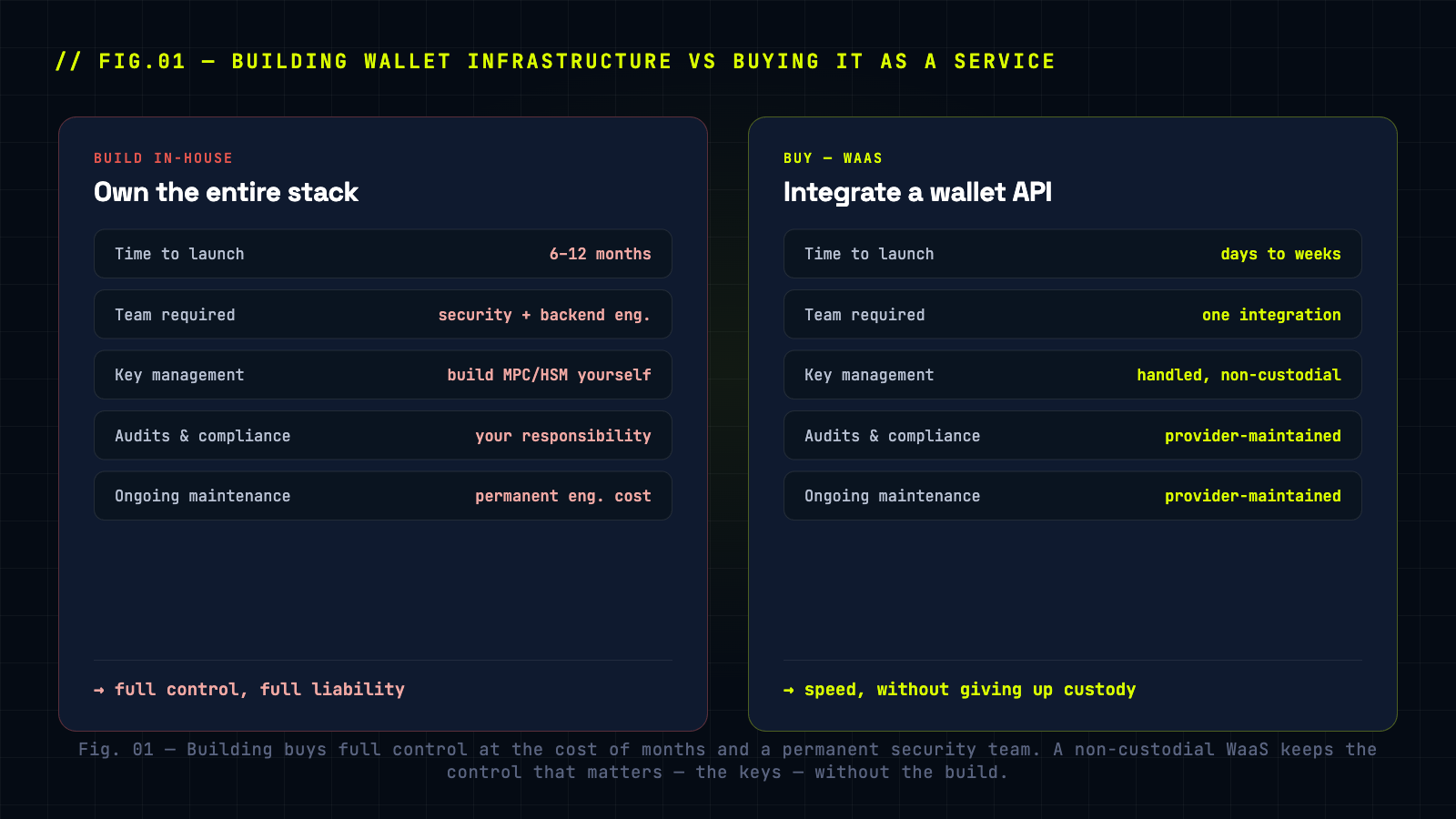
The difference in the figure is not "buy is universally better." It is that build and buy trade different things, and the trade only makes sense once you are specific about which side of it you actually want to be on.
04 — The real cost comparison
The sticker price of "build" looks like zero — no vendor invoice, no per-transaction fee. That is the illusion. The true cost of building shows up as engineering time diverted from the actual product, a security incident that erases months of savings in a single afternoon, an audit bill that arrives before launch, and a permanent slice of headcount that never goes back to building features.
Buying has a visible cost — a subscription or a per-transaction fee — and that visibility is often mistaken for being the more expensive option. It rarely is, once the hidden costs of building are counted honestly. The realistic comparison is not "free vs paid." It is hidden, deferred, and larger costs (build) vs. transparent, immediate, smaller costs (buy).
"Nobody budgets for the security incident. That's exactly why it's the real cost of building your own wallet infrastructure — not the one on the project plan, but the one that shows up later and costs more than the plan did."
05 — When building actually makes sense
Buying is the right default for most teams, but building is not automatically wrong. It tends to make sense when a business has genuinely unusual requirements a general-purpose provider will not build for it, expects wallet infrastructure to become a core, differentiating part of its product rather than a supporting feature, is already operating at a scale where the economics of an ongoing security team make sense against transaction volume, or needs control so specific — a bespoke custody model, an unusual compliance regime — that no vendor's roadmap will ever match it.
These are real conditions, and some businesses meet them. Most do not — and it is worth being honest that "we want full control" is a preference, not automatically a requirement that justifies the cost.
06 — When buying makes sense
For the majority of teams, the calculus is more straightforward: crypto wallets are a feature of the product, not the product itself. Buying makes sense when speed to market matters, when the team's expertise and headcount belong in the actual product rather than in wallet security, when the security and compliance burden of self-custody-grade infrastructure is disproportionate to what the business needs, or when the volume does not yet justify a dedicated security team.
The honest reframe: choosing to buy is not a shortcut around building it properly. It is choosing not to become a wallet-security company in order to stay focused on the company you actually set out to build.
07 — What to look for in a WaaS provider
Not all WaaS offerings are equal, and the wrong choice reintroduces exactly the risks buying was supposed to avoid. Before committing, check for:
- Non-custodial architecture — keys stay with you or your users, not pooled behind the provider.
- Modern key security — MPC or multisig, not a single key sitting on one server.
- Multi-chain and multi-asset support matched to what your product actually needs.
- Compliance built in — KYC, AML, and Travel Rule support where your business requires it.
- Real recovery options — seedless or social recovery, not "email support if something breaks."
- A genuine API and documentation — sandbox environment, clear docs, and reliable webhooks, so integration is measured in days, not months.
- Transparent pricing — a clear fee model, not one that reintroduces hidden costs on the buy side too.
08 — Where CPAY fits
CPAY's Wallet-as-a-Service is built around the buy decision done right: non-custodial wallets secured with MPC, deployable per user, merchant, or agent through an open API, with multi-chain support, built-in KYC/AML, and seedless recovery options. The engineering-months a build would cost are already spent — on infrastructure that keeps the keys with you, not with CPAY. You get the speed of buying without trading away the control that matters.
09 — FAQ
Is Wallet-as-a-Service always custodial?
No — this is the single most important distinction to check. A non-custodial WaaS gives the business or its users control of the keys; a custodial one holds them on the provider's side, reintroducing single-point-of-failure risk.
How long does building wallet infrastructure actually take?
For a production-grade, audited system, typically six to twelve months for an initial version, plus ongoing engineering indefinitely afterward for maintenance, security, and new-chain support.
Is buying more expensive than building?
Usually not, once the hidden costs of building — security incidents, audits, permanent headcount, and delayed launches — are counted. Buying has a visible price; building has a larger, deferred one.
When should a business build instead of buy?
When it has genuinely unusual requirements, expects wallet infrastructure to be a core differentiator, already operates at a scale that justifies a dedicated security team, or needs a custody model no vendor supports.
What's the biggest mistake teams make in this decision?
Treating "we want control" as automatically justifying a build, without weighing it against the real, ongoing cost — and without checking whether a non-custodial WaaS could have given them that same control through an API instead.
Conclusion
Build vs. buy for wallet infrastructure is not a question of engineering capability — most teams could build it, eventually. It is a question of what you want to spend the next year of engineering time becoming expert in: your product, or wallet security. A non-custodial WaaS resolves the tension that used to force a compromise between the two: it delivers the speed of buying without asking you to give up the control that non-custodial design was always meant to protect.