For thirty years one HTTP status code sat unused: 402 Payment Required. In 2026 it is suddenly everywhere — because software finally needs it. Here is what x402 is, how the flow works, and where adoption actually stands.
Every developer has seen 404 Not Found and 200 OK. Almost no one has seen 402 Payment Required — it was reserved in the earliest HTTP specs and left unused for decades. x402 is the standard that finally puts it to work: a way for a server to say "pay me" and for software to pay, in stablecoins, inside the same web request. It exists because the web now has a new kind of customer — the AI agent.
01 — What x402 actually is
x402 is an open payment protocol that uses the HTTP 402 status code to let software pay for a resource inline — no account, no API key, no subscription set up in advance. Created by Coinbase and Cloudflare and stewarded through the x402 Foundation, it turns a long-dormant status code into a real payment rail for machines.
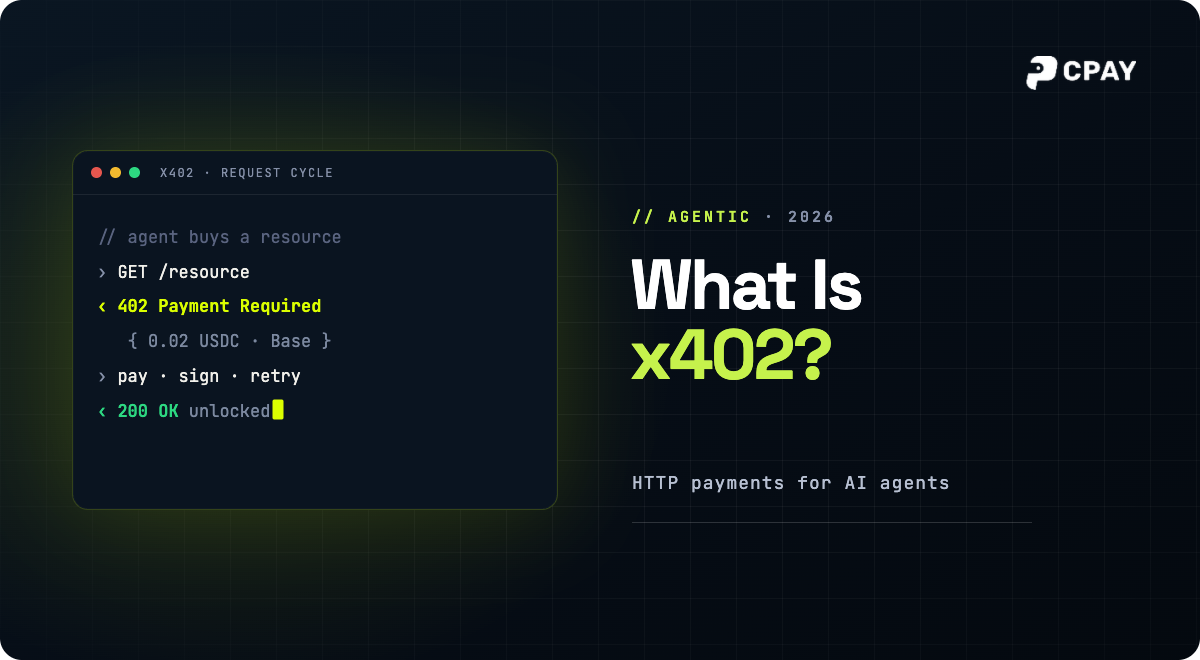
The mechanics are deliberately boring, which is the point. When a client requests something that costs money, the server answers with 402 and machine-readable payment terms. The client pays, then repeats the request with proof. That is the entire idea — and because it lives in HTTP, any software that already speaks the web can speak payments too.
A few properties define it:
- Pay-per-request — price is declared and paid per call, not per plan.
- Stablecoin settlement — payments clear on-chain, predominantly in USDC, so value is dollar-pegged and predictable.
- No accounts or keys by default — a paying agent does not need to be onboarded first.
- Zero protocol fees — you pay the resource price and network gas, not a cut to x402 itself.
- Chain-agnostic — it runs across networks, with Base and Solana leading on low fees and fast finality.
It is worth saying what x402 is not: it is not a coin, not a blockchain, and not a wallet. It is a thin standard layered on top of HTTP and existing stablecoin rails.
02 — How an x402 payment works
The whole exchange is a short, programmatic loop between a client — often an AI agent — and a server offering a paid resource.
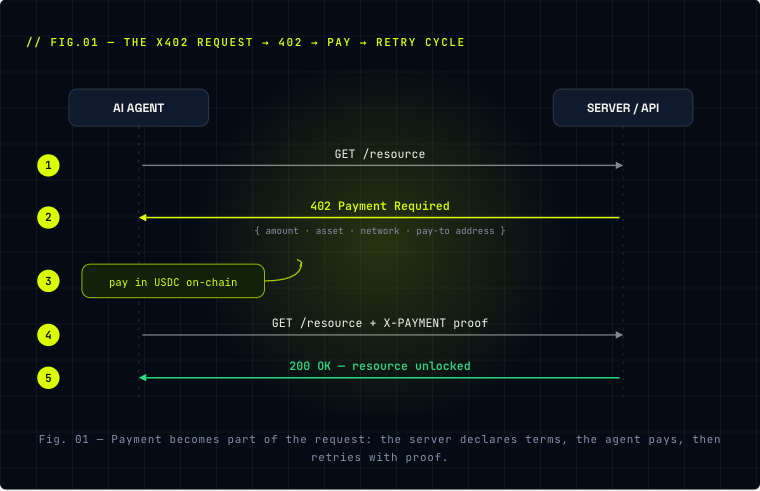
- The agent requests a paid resource — a normal HTTP call to an API, dataset, or endpoint.
- The server responds 402 Payment Required — with machine-readable terms: how much, which stablecoin, which network, and where to pay.
- The agent pays — it signs a stablecoin payment on-chain, usually with the help of a facilitator that handles verification and settlement.
- The agent retries the request — the same call, now carrying proof of payment in a header.
- The server verifies and returns the resource — a clean
200 OK, no accounts and no human checkout anywhere in the loop.
The elegance is that payment stops being a separate system bolted onto the side of the product. It becomes a status code — one more thing HTTP already knows how to express.
03 — Why HTTP payments matter for AI agents
To see why this suddenly matters, look at who is doing the buying. Software is becoming autonomous — AI agents call APIs, buy data, pay for inference, rent compute, and use tools, constantly and in tiny increments. That behavior breaks every assumption built into human payment systems.
Human rails assume a relationship set up before the transaction: an account, a signup form, an API key, a monthly plan, a card on file. An autonomous agent that discovers a useful API mid-task cannot pause to fill in a signup flow, wait for a key, or negotiate a subscription tier. It needs to pay in the same motion it already uses — an HTTP request — and move on.
x402 fits that shape exactly. Payment is discovered and completed inside the request loop, with no pre-provisioned account. And because settlement happens in stablecoins on low-fee chains, micropayments finally become economic: charging a fraction of a cent per API call is viable in a way card rails, with their fixed minimums, never allowed.
A concrete example makes it tangible. Imagine a research agent working through a task that suddenly needs one specific dataset behind a paywall. With traditional access it would simply stall — there is no account, no key, and no human standing by to approve a signup. Under x402, it requests the data, receives a 402 quoting a two-cent price, pays in USDC, retries with proof, and continues — all in well under a second and with nobody in the loop. Multiply that by thousands of agents making millions of such calls a day, and you get a payment pattern that did not meaningfully exist a few years ago.
From accounts to requests. Traditional monetization asks "who are you, and what plan are you on?" x402 asks only "did you pay for this request?" For machines that appear, transact once, and vanish, that is the difference between possible and impossible.
04 — What x402 replaces — and what it doesn't
For machine consumers, x402 quietly replaces a stack of friction: API-key issuance, manual onboarding, plan negotiation, and invoicing. Instead of provisioning access ahead of time, a provider simply prices each resource and gets paid per call. Pay-per-use stops being a billing project and becomes the default.
It does not replace everything, and honest positioning matters here. x402 is not built for human checkout, large recurring B2B contracts, or relationships where trust and terms are negotiated up front. It is built for machine-to-machine, usage-based, small-value flows — the long tail of automated purchases that traditional rails were never designed to serve.
05 — What sits around the protocol
x402 is intentionally thin, so a working setup leans on a few supporting pieces:
- A facilitator — a service that verifies payments and settles them on-chain, so a server offering resources does not have to run blockchain infrastructure itself.
- A settlement asset — predominantly USDC, chosen for stability and liquidity; dollar-pegged value keeps per-request pricing predictable.
- Networks — Base and Solana lead on cost and speed, though the protocol is chain-agnostic by design.
- An agent wallet — the paying agent needs a funded wallet and controls around it: spending limits, allowlisted counterparties, and an audit trail. Autonomous spending only works safely inside a policy.
That last point is easy to overlook and expensive to get wrong. The moment software can pay on its own, "who can spend how much, to whom" becomes a security question — the same governance a business applies to any wallet, now applied to an agent.
Verification matters as much as spending. A server accepting x402 has to confirm that a payment is real, final, and matches the quoted terms before it releases the resource — precisely the job a facilitator abstracts away. Get it wrong in one direction and you hand out resources for free; get it wrong in the other and you block customers who genuinely paid. Doing both reliably, at machine speed, is the unglamorous engineering that turns a clever status code into a dependable rail.
06 — Where x402 actually stands in 2026
The traction is real and the backing is heavy. By early 2026, x402 had processed well over 100 million transactions on Base alone and tens of millions more on Solana, with hundreds of millions of dollars in annualized volume and zero protocol fees. Coinbase and Cloudflare drive the standard; Cloudflare ships a monetization gateway around it; Visa added support through its Trusted Agent Protocol, Stripe through its Agent Commerce Protocol, and AWS through managed agent-payment capabilities. That is an unusually strong set of names for a two-year-old standard.
But it is worth staying grounded. Reporting through early 2026 also noted that real micropayment demand has not fully arrived — a meaningful share of volume is experimental or agent-to-agent rather than mature commercial use. The rails and the standard are maturing faster than the market that will eventually run on them.
Strong rails, early demand. x402 is not a saturated market you are late to — it is a settling standard with serious infrastructure and a demand curve still climbing. For builders, that is the good time to understand it: being early here is cheap, and being ready when agent volume grows is the whole point.
07 — What x402 means in practice
Which side of x402 you are on shapes what you should do about it.
If you sell APIs, data, or compute, x402 is a new revenue surface: you can monetize per request — including from agents you never onboarded and will never meet. Machine consumers become payers instead of a support burden.
If your product runs agents that consume paid services, the priority flips to control: those agents need wallets with spending limits, allowlists, and a full audit trail, so autonomous payments stay inside the rules you set. Either way, the missing piece is the same — payment and wallet infrastructure that speaks stablecoins and enforces policy.
There is also a timing argument. Payment standards tend to consolidate — the web does not keep five competing ways to do the same thing for very long. With Coinbase, Cloudflare, Visa, Stripe, and AWS already aligned around x402, the businesses that make their APIs and wallets speak it early are positioning for the moment agent-driven demand becomes ordinary rather than experimental. Retrofitting a payment layer after that shift is always more expensive than building for it before.
"The web finally has a native way for one piece of software to say 'pay me' to another. x402 didn't invent the idea — it just made payment a header."
08 — Where CPAY fits
An x402 flow needs something underneath it on the money side: stablecoin rails, wallets the business controls, and policy that keeps agent spending in bounds. That is exactly the layer CPAY builds. As part of its move toward agentic and machine payments, CPAY provides non-custodial wallet and stablecoin payment infrastructure — USDC and USDT support, spending limits, approvals, and audit logs, all through an open API, with the keys staying with the business. Agents can transact within a policy you define, rather than with open access to funds.
09 — FAQ
Is x402 a cryptocurrency?
No. x402 is an open payment protocol, not a coin or a blockchain. It uses the HTTP 402 status code so a server can request payment and a client can pay programmatically, settling in stablecoins on existing chains.
Do I need crypto to use x402?
Payments settle in stablecoins, primarily USDC, so a paying agent needs a funded wallet. The value is dollar-pegged, which keeps pricing predictable and makes tiny per-request payments economic.
Does x402 cost anything?
The protocol itself charges zero fees. You pay the network gas cost and the stablecoin amount for the resource. A facilitator service may charge for verification and settlement convenience.
Is it only for AI agents?
Agents and API monetization are the primary use cases, but any software can use x402 — bots, automated workflows, or backend services that need to pay for a resource without a human in the loop.
Is x402 widely adopted yet?
It is growing quickly and backed by Coinbase, Cloudflare, Visa, Stripe, and AWS, with over a hundred million transactions on Base by early 2026. But demand is still early — the rails and standard are maturing faster than mainstream commercial use.
Conclusion
The web spent thirty years with a payment status code it never used, because there was no customer who needed it. Now there is. x402 will not replace human checkout, but for the machine economy — agents buying data, inference, and tools by the request — it turns payment from a blocker into a header. The businesses that win will be the ones whose payment and wallet infrastructure is ready when the agents show up.