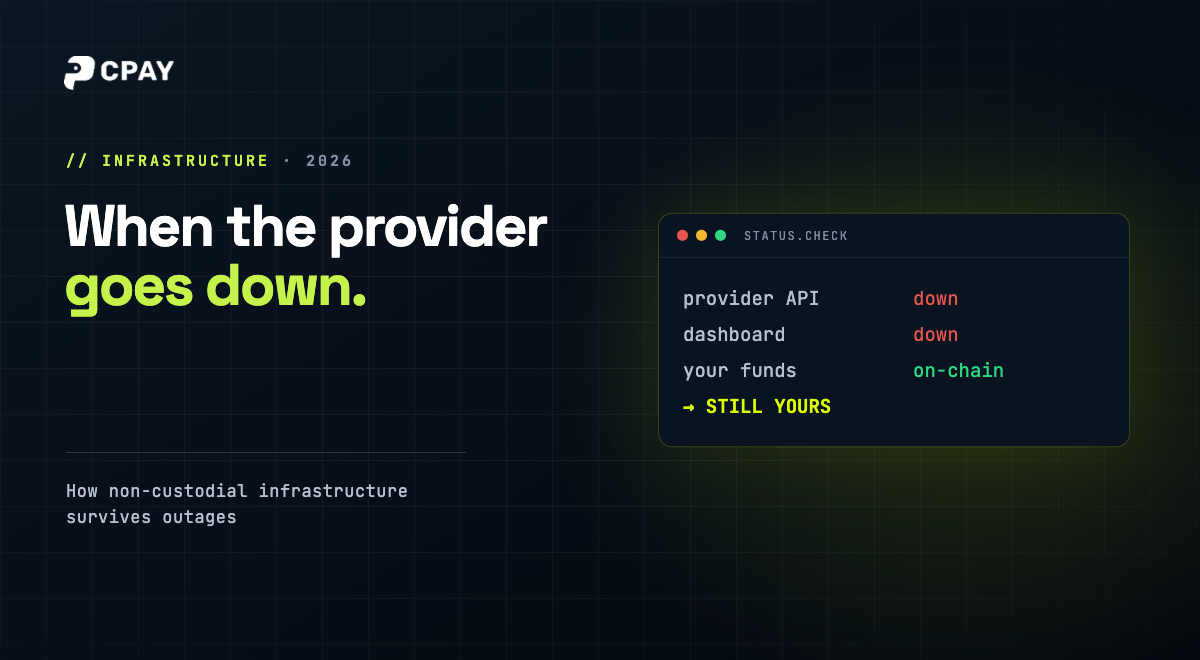
Disaster resilience: how non-custodial infrastructure survives provider outages
Every provider goes down eventually. The real question is not whether your payment infrastructure has an outage — it's what happens to your money when it does.
Cloud regions fail. Databases corrupt. A bad deploy takes an API offline; a DDoS knocks out a dashboard for an afternoon. This is not a knock on any particular vendor — it is the normal weather of running software at scale. What separates resilient infrastructure from fragile infrastructure is not the promise that nothing ever breaks. It is the blast radius when something does. And for money, the blast radius is decided almost entirely by one thing: who holds custody.
01 — Outages are inevitable
No provider has one hundred percent uptime, and anyone who claims otherwise is selling something. Over a long enough horizon, every payment platform will have a region go dark, a service degrade, or a maintenance window run long. Treating outages as a rare anomaly is how teams end up unprepared for a routine event.
The mature question is therefore not "how do we guarantee this never happens?" but "when it happens, what still works, and what stops?" For a payment platform, the most important part of that answer is what happens to the funds — because an outage that only degrades a dashboard is an inconvenience, while an outage that traps money is a crisis.
02 — The custodial single point of failure
In a custodial model, the provider holds customer funds in its own pooled wallets. The provider's systems are not just the interface to the money — they are the path to it. When those systems go down, so does access.
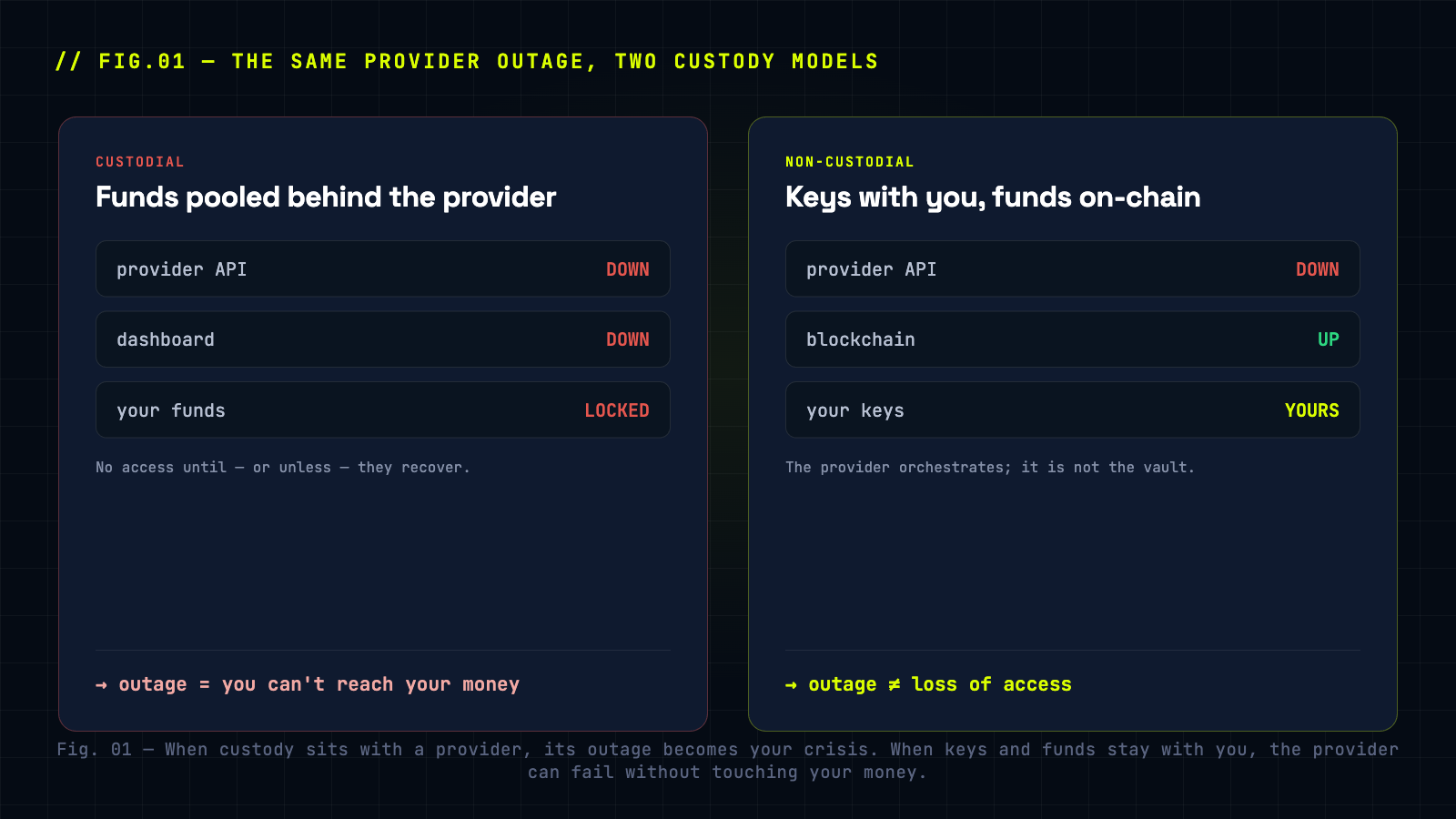
That is the trap. Because custody sits with the provider, its outage becomes your outage. You cannot withdraw, because withdrawals run through the systems that are down. You cannot verify your balance independently, because the ledger lives inside the provider. And if the outage is not a two-hour blip but something worse — a prolonged failure, an insolvency, a regulatory freeze — the funds can be inaccessible for weeks, or not returned at all. The provider's worst day becomes your worst day, and you have no lever to pull.
03 — Why non-custodial survives
Non-custodial infrastructure breaks that dependency at the root. The keys stay with you, and the funds sit on a public blockchain rather than in a provider's pooled wallet. The provider is an orchestration layer — it creates checkouts, watches the chain, sends notifications, and prepares operations — but it is not the vault.
That distinction is everything during an outage. If the provider's API and dashboard go dark, the blockchain does not care: it keeps producing blocks, and your funds keep sitting exactly where they were, controlled by keys the provider never held. You can still verify your balance on any block explorer, and you can still move funds with your keys, because neither of those depends on the provider being online. The provider can fail without your money failing with it.
04 — What stays up, and what degrades
Being honest about resilience means being precise. A provider outage in a non-custodial system does not make everything keep working — it makes the important things keep working while the conveniences degrade.
- What stays up: the blockchain, your funds, and your ability to access and move them with your keys. Custody is never in question.
- What may degrade: the dashboard, the creation of new checkouts, real-time webhooks, and reporting — the provider-hosted conveniences that resume when the provider does.
The difference is categorical, not cosmetic. In the custodial model, an outage threatens the one thing that must never be threatened — access to funds. In the non-custodial model, an outage can only ever touch the layer above custody, and it degrades gracefully rather than locking you out.
05 — Layers of resilience
Non-custodial custody is the foundation of resilience, but a serious platform builds more on top of it. Good infrastructure assumes its own components will fail and is designed to keep degrading gracefully rather than falling over:
- Redundancy across regions and providers, so a single cloud or data-center failure does not take everything down.
- Independent, redundant chain indexers, so payment detection survives the loss of any one node or data source.
- Self-custody as the ultimate backstop — because even in the extreme case where the provider is entirely unavailable, the user still holds the keys and the funds are still on-chain.
That last layer is the one custodial systems can never have. You can add all the redundancy you want on top of a pooled wallet, but the wallet itself remains a single point of failure. Non-custodial design removes it.
06 — Beyond outages: insolvency, seizure, shutdown
A temporary outage is the mild version of the problem. The same property that protects you during a two-hour blip protects you against the events that actually destroy businesses.
- Insolvency. If a custodian goes bankrupt, your funds become part of its estate. With non-custodial infrastructure, there is nothing to claim — the funds were never the provider's to lose.
- Seizure or freeze. A regulator or court can freeze a custodian's accounts, taking your operational funds offline alongside everyone else's. Funds you hold yourself, on-chain, are not the provider's to freeze.
- The provider simply disappears. Vendors get acquired, pivot, or shut down. In a custodial world that is an emergency; in a non-custodial world it is an inconvenience, because your funds and keys were never in their hands.
Resilience, in other words, is not only about uptime. It is about ensuring that no single company's fate can become your loss.
07 — What to look for
If disaster resilience matters to you — and for anyone moving real volume, it should — these are the properties worth insisting on:
- Non-custodial by default — keys and funds stay with you, not in a pooled provider wallet.
- On-chain verifiability — you can confirm balances and transactions independently, without the provider.
- Graceful degradation — an outage degrades conveniences (dashboard, new checkouts) without ever touching custody.
- No shared honeypot — funds are isolated, not concentrated behind one set of keys.
- Redundant architecture — multi-region, redundant indexers, no single component that takes everything down.
Notice that most of this flows from the first point. Get custody right, and resilience follows; get it wrong, and no amount of uptime engineering can fully protect the money.
08 — Where CPAY fits
CPAY is non-custodial by design, which makes disaster resilience a property of the architecture rather than a promise on a status page. Funds settle to wallets the client controls, on public blockchains, verifiable on-chain at any time. CPAY's role is orchestration — checkouts, monitoring, payouts, reporting through an open API — and if that layer ever degrades, the funds beneath it are unaffected, because CPAY never holds them. The worst outage CPAY could have still cannot lock you out of your own money.
09 — FAQ
If the provider goes down, can I still access my funds?
In a non-custodial system, yes. Your keys control the funds and the funds live on-chain, so neither depends on the provider being online. You can verify balances on a block explorer and move funds with your keys regardless of the provider's status.
Doesn't non-custodial just move the risk to me?
It moves control to you, which is the point. The provider can no longer lose or freeze your funds. The responsibility that comes with it — key management — is handled by modern wallet infrastructure (MPC, policies, recovery) rather than a single fragile secret.
What actually stops working during an outage?
Provider-hosted conveniences can degrade: the dashboard, creating new checkouts, real-time webhooks, and reporting. Custody and access to existing funds do not, because they do not run on the provider's servers.
How does this protect against provider insolvency or seizure?
Because the provider never holds your funds, there is nothing for a bankruptcy estate to claim or a regulator to freeze. Your funds are on-chain and controlled by your keys, independent of the provider's corporate fate.
Conclusion
Every provider has a bad day eventually. What decides whether that bad day becomes yours is a single architectural choice: who holds the money. Custodial systems make their outage your outage, because your funds live behind their doors. Non-custodial infrastructure keeps custody with you, so the provider can fail — degrade, go dark, even disappear — while your funds stay exactly where they are, on-chain and under your control. That is not a feature you appreciate on a normal day. It is the one you are grateful for on the worst one.