Wallet recovery without seed phrases: MPC and social recovery UX
The 12-word seed phrase is the worst user experience in crypto — and the single biggest cause of lost funds. Here is how MPC and social recovery replace it, and what the recovery flow actually looks like.
Ask anyone why they bounced off a crypto wallet, and the answer is usually the same: the app told them to write down twelve random words, store them somewhere safe forever, and warned that if they lost them, their money was gone with no recourse. That is not a security feature people love. It is a barrier — and in 2026, the wallets winning mainstream users are the ones removing it.
01 — The seed phrase problem
A seed phrase is a human-readable version of a wallet's private key: lose it or leak it, and the outcome is total. That single design choice creates two failure modes that pull in opposite directions.
- Lose it and you lose everything. No password reset, no support line, no recovery. A misplaced piece of paper or a wiped device can permanently destroy real money.
- Leak it and you lose everything. Anyone who sees those words controls the funds, which makes seed phrases a magnet for phishing, fake "wallet support," and malware.
On top of that, they are simply bad onboarding. Asking a first-time user to safeguard an irreplaceable secret before they have done anything is a conversion killer, and it is why so many people abandon self-custody at the very first screen. The seed phrase asks ordinary users to be their own bank's vault, security team, and disaster-recovery plan all at once — a job most people neither want nor are equipped to do.
02 — What "recovery without seed phrases" means
Removing the seed phrase does not mean giving up self-custody or handing the keys to a company. It means replacing "one secret string the user must guard forever" with a recovery model that has no single point of failure and feels like signing back into a normal app.
Two approaches dominate, and they are often combined:
- MPC — the key is split into shares held in different places, so there is no single secret to lose.
- Social recovery — trusted guardians can help the user restore access, so losing a device is not fatal.
03 — MPC recovery
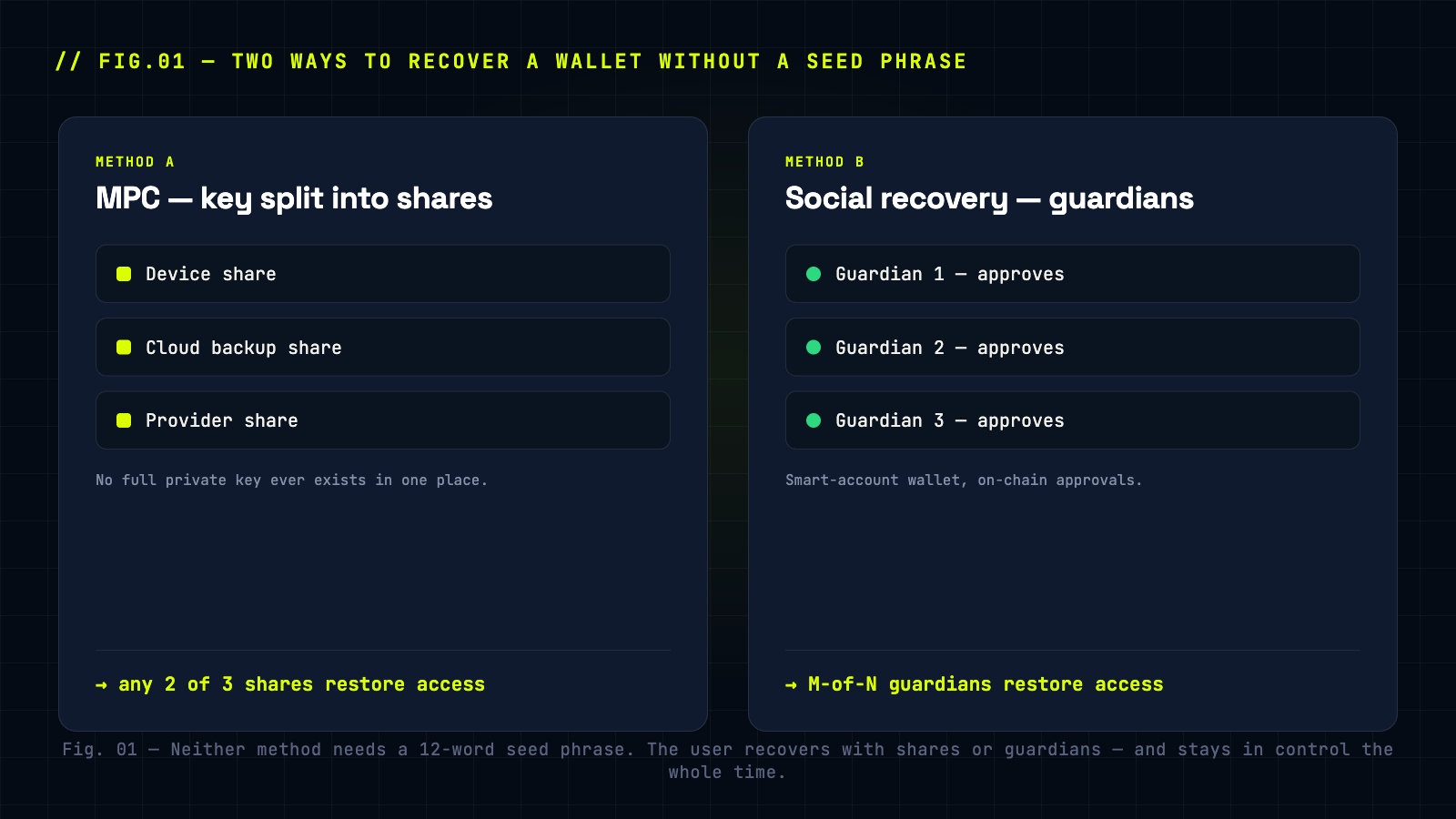
In multi-party computation (MPC), the private key is never created as one whole object. Instead it is split into shares, each stored in a different location — for example, one on the user's device, one in an encrypted cloud backup, and one held by the provider. Signing a transaction is done collaboratively across the shares; a complete key is never assembled anywhere.
For recovery, this changes everything. Because the key is a threshold of shares — say, any two of three — the user does not need to protect one fragile secret. If they lose their phone, the remaining shares plus a new device reconstruct access. There is nothing to write down and nothing that, alone, can be stolen.
The UX is the payoff: onboarding becomes "sign in and you're set," and recovery becomes "prove it's you and restore." MPC is also chain-agnostic and invisible on-chain — it works the same across networks and does not require any special smart contract, which makes it a natural fit for wallets embedded inside products.
04 — Social recovery
Social recovery takes a different route, usually built on smart-account wallets. Instead of splitting a key, the user designates a set of guardians — trusted people, their own secondary devices, or an institution. Normal usage needs none of them; guardians only matter when something goes wrong.
If the user loses access, recovery is a matter of guardians approving the restoration: once a required number of them (M-of-N) confirm, the wallet is reassigned to the user's new device. No single guardian can move the funds or hijack the wallet, and the user never depended on a phrase.
Because it is smart-account based, social recovery lives on-chain and is typically tied to EVM networks. Its strength is human intuition: "a few people I trust can help me get back in" is a mental model everyone already understands from the rest of their digital life.
05 — MPC vs social recovery
These are not rivals so much as complementary tools, and many modern wallets use both. The trade-offs are worth knowing:
- MPC — no full key ever exists, chain-agnostic, no smart contract required, and the recovery logic is off-chain. Great for embedded, cross-chain wallets and the smoothest possible sign-in.
- Social recovery — enforced on-chain by a smart account, highly intuitive, and resilient to a lost device through people you trust. Best where an account-abstraction wallet and human guardians fit the product.
A common pattern is to use MPC for the everyday key management — seamless login and signing — and social recovery as the backstop when a user genuinely loses their access path. The user gets convenience day-to-day and a human safety net for the worst case.
06 — The UX that actually works
The whole point is that recovery should feel ordinary. In a well-built seedless wallet, the flow looks like this:
- Onboarding: the user signs in with a passkey, email, or social login. A device share and an encrypted backup share are created behind the scenes. There are no words to write down.
- Everyday use: signing happens with a tap or a biometric prompt — the shares combine silently.
- Recovery: on a new device, the user re-authenticates and restores from their backup share, or triggers guardian approvals. Access comes back in minutes.
Crucially, none of this asks the user to understand cryptography. It borrows the patterns people already trust — passkeys, cloud backup, "ask a trusted contact" — and applies them to a wallet. That is what turns self-custody from a specialist tool into something a normal person can use without fear of one mistake wiping them out.
07 — Security considerations
Seedless does not mean careless, and it is fair to be precise about what changes.
- Is it still non-custodial? Yes — as long as the user controls the threshold. If a full key never exists and the provider holds only a minority share that cannot move funds alone, the user remains in control. The test is simple: can any party other than the user reconstruct access on their own? The answer must be no.
- Guardian collusion. Social recovery is only as safe as the guardian set and the threshold. Requiring several independent guardians makes collusion hard; too few or too cozy a set weakens it.
- Backup trust. A cloud backup share must be encrypted so the cloud provider cannot use it, and paired with strong authentication so an attacker cannot simply request a reset.
- Authentication is the new front door. With no phrase to steal, attackers target the login. Passkeys, device binding, and step-up verification for recovery are what keep that door shut.
Done right, seedless recovery is not a weaker model than a seed phrase — it is a stronger one, because it removes the single point of failure that made phrases so dangerous in the first place.
08 — Where CPAY fits
For any product embedding wallets — a marketplace, a game, a fintech app — asking end users to manage seed phrases is a conversion problem and a support liability. CPAY's non-custodial wallet infrastructure (WaaS) is built for seedless onboarding and recovery: MPC-based key management and recovery options that let your users sign in and restore access without ever handling twelve words, while the keys stay outside CPAY's control. You ship a wallet that feels like a normal account, and your users keep true self-custody underneath it.
09 — FAQ
Is a seedless wallet still non-custodial?
Yes, when the user controls the threshold. If no full private key ever exists and no single other party can reconstruct access, the user remains in control — that is the definition of non-custodial.
What is the difference between MPC and social recovery?
MPC splits the key into shares so there is no single secret; recovery re-combines a threshold of shares. Social recovery uses trusted guardians who approve restoring a smart-account wallet. MPC is chain-agnostic and off-chain; social recovery is on-chain and smart-account based. They are often used together.
What happens if I lose my device?
With MPC, the remaining shares plus a new device restore access. With social recovery, your guardians approve reassigning the wallet to a new device. Either way, a lost device is no longer a lost wallet.
Can the provider access my funds?
No, in a correctly designed system. The provider holds at most a minority share that cannot move funds on its own, so it can help you recover but never spend for you.
Do I still need to back anything up?
There is no phrase to write down, but you do rely on your authentication (passkey/login), your encrypted cloud backup, and your guardian set. Keeping those in order is the modern equivalent — far more forgiving than a single slip of paper.
Conclusion
The seed phrase made self-custody safe for experts and terrifying for everyone else. It turned one mistake into a permanent loss, and it stopped countless people at the first screen. MPC and social recovery fix the root problem: they remove the single point of failure and replace it with recovery flows people already understand. For users, that means self-custody without the fear. For products, it means wallets that onboard like a normal app — and that is what finally makes owning your own keys feel less like a risk and more like a right.