How to Accept Crypto Payments on a Website
Online businesses today face a structural friction problem.
Card payments come with chargebacks, processing fees, settlement delays, and cross-border limitations. International customers face declined transactions. High-risk industries deal with frozen accounts. Even standard eCommerce businesses wait days for settlement while managing FX conversion and intermediary costs.
At the same time, customers already hold digital assets. Stablecoins circulate globally. Wallet adoption continues to grow. The demand exists — but many websites still struggle with one question:
How do you accept crypto payments properly, without creating accounting chaos or compliance risk?
The solution is not publishing a wallet address on your homepage. That approach creates reconciliation issues, price volatility exposure, and operational inefficiencies. What websites need is infrastructure — not improvisation.
What Proper Crypto Integration Looks Like
Accepting crypto on a website in 2026 means implementing a structured payment flow:
A customer selects “Pay with Crypto.”
The system calculates the real-time exchange rate.
A unique wallet address or QR code is generated.
The rate is locked for a defined time window.
Blockchain confirmations are monitored automatically.
The order status updates once the payment is validated.
Behind the interface, several processes happen simultaneously: address generation, network monitoring, confirmation validation, and transaction matching to internal accounting records. Without automation, this quickly becomes unmanageable at scale.
That is why most businesses use a crypto payment gateway.
Providers such as Coinbase Commerce or BitPay offer hosted solutions that connect to Shopify, WooCommerce, Magento, or custom-built websites. They handle the technical layer while allowing merchants to receive funds in crypto or convert instantly to fiat.
However, as transaction volume grows or regulatory requirements increase, websites often require deeper infrastructure. This is where API-driven solutions such as CPAY become relevant.
CPAY provides non-custodial architecture, stablecoin routing, compliance integrations, and automated reconciliation tools designed for businesses that treat crypto payments as part of their financial stack — not just an additional checkout option. Instead of operating as a standalone widget, the system integrates directly into treasury, accounting, and risk monitoring workflows.
Choosing the Right Assets
Most websites begin with stablecoins such as USDT or USDC. Stablecoins reduce volatility exposure and simplify revenue reporting because values are denominated in fiat equivalents.
Bitcoin and Ethereum can also be offered, especially if the target audience actively holds these assets. The key operational question is whether the business plans to hold digital assets or convert them immediately.
Automatic conversion reduces balance sheet volatility. Holding stablecoins can improve cross-border settlement speed and supplier payments.
Compliance and Operational Control
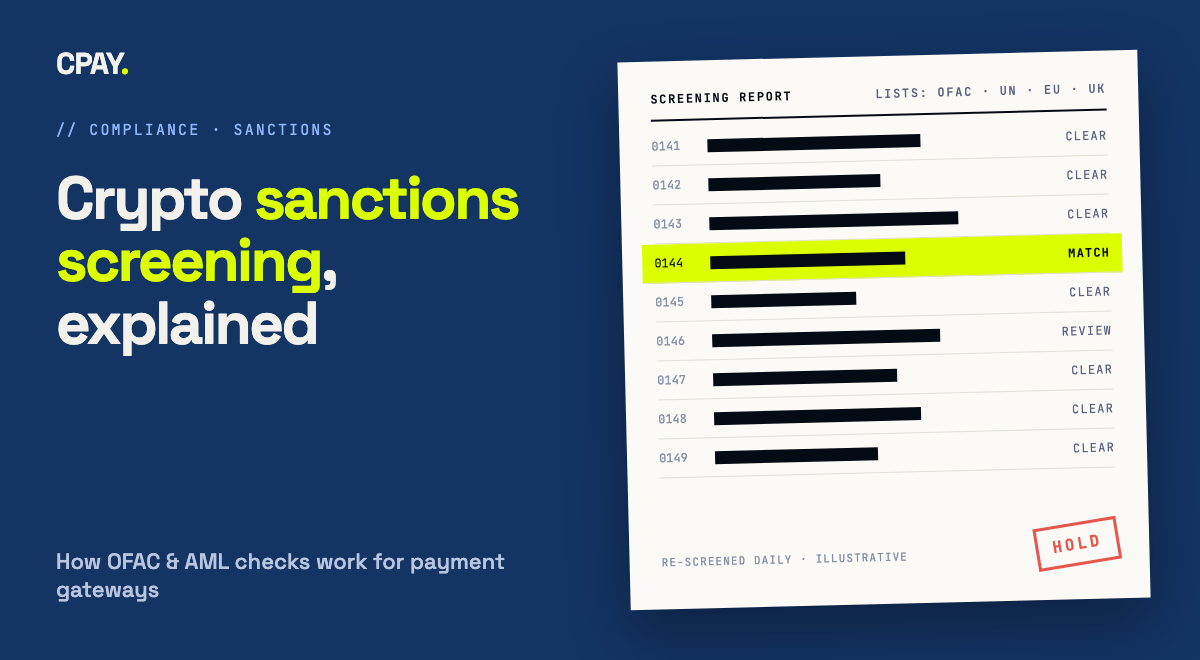
Accepting crypto payments does not remove regulatory responsibility. Depending on jurisdiction and industry, websites may need transaction monitoring, sanctions screening, and structured reporting.
Infrastructure providers increasingly integrate blockchain analytics and AML tools directly into the payment layer. This reduces manual compliance overhead and aligns digital asset payments with existing financial controls.
Accounting and Reconciliation
One of the most underestimated aspects of crypto integration is accounting alignment.
Each blockchain transaction must map to:
- An invoice or order ID
- A fiat equivalent at time of settlement
- A transaction hash for audit trails
Without automated reconciliation, finance teams face reporting discrepancies. Modern gateways export structured transaction data or integrate via API with ERP systems to maintain clean financial records.
Why This Matters Now
Crypto payments are no longer experimental branding for tech-forward startups. They are becoming a practical solution for:
- Cross-border eCommerce
- SaaS subscriptions
- Digital services
- Marketplaces
- High-risk verticals with card processing constraints
When implemented correctly, crypto payments reduce intermediary dependency, accelerate settlement, and expand global accessibility.
The difference lies in architecture.
Websites that treat crypto as infrastructure — supported by scalable gateways and API-driven systems like CPAY — build a payment stack that aligns with how digital value already moves.
The opportunity is not about replacing existing rails.
It is about adding a more efficient one.