Removing Liquidity Friction in Cross-Chain Payments
Liquidity should never be the reason a withdrawal fails.
Networks should not matter to users.
And platforms should not spend their time manually moving funds between blockchains.
This is exactly the problem CPAY set out to solve with its new partnership with Rhino.fi.
By integrating Rhino.fi liquidity and swap infrastructure, CPAY takes another step toward building a payments layer where cross-chain complexity disappears.
Why Cross-Chain Liquidity Is Still Broken
Most custodial crypto platforms face the same structural issue.
Users want to withdraw assets on a specific network.
Platforms hold liquidity on another.
To avoid failed withdrawals, teams are forced to:
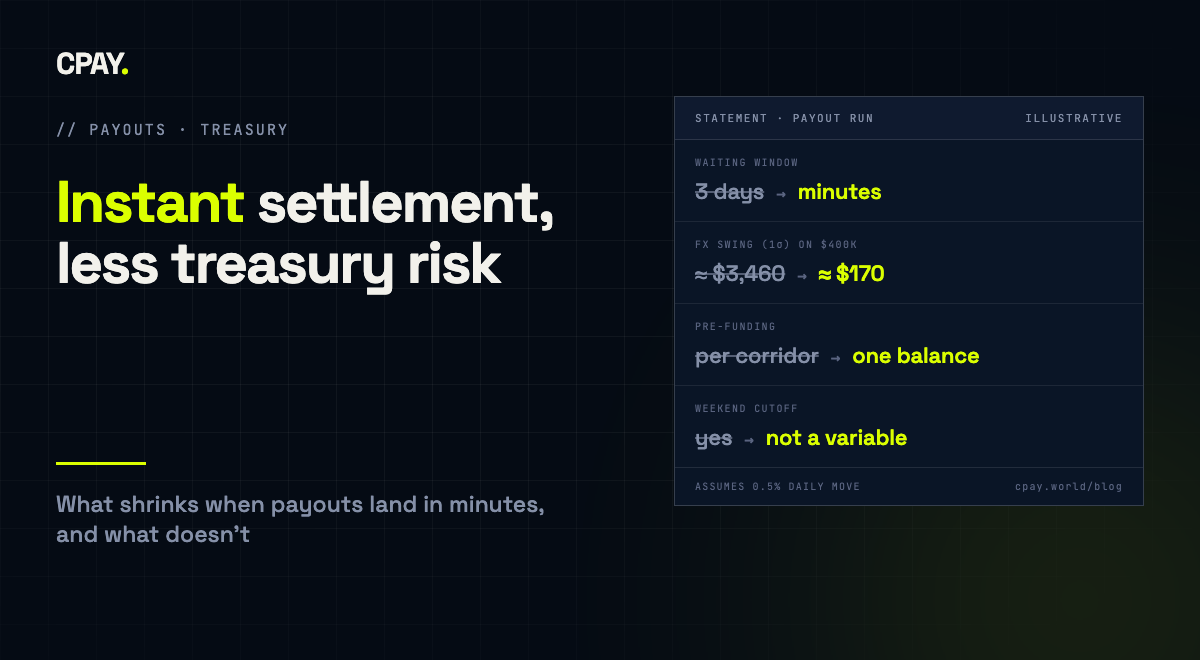
- Pre-fund wallets across multiple blockchains
- Manually rebalance liquidity
- Delay withdrawals when balances are insufficient
This approach does not scale. It locks capital, increases operational risk, and creates friction exactly where users expect speed.
CPAY’s integration with Rhino.fi directly addresses this bottleneck.
About Rhino.fi
Rhino.fi is built around a simple idea: liquidity should move freely between blockchains.
Rhino.fi aggregates liquidity across multiple networks and executes cross-chain swaps and bridges as a single flow. Instead of forcing users or platforms to think in terms of chains, bridges, and wrapped assets, Rhino.fi focuses on outcomes — delivering the right asset on the right network.
This makes Rhino.fi a natural infrastructure partner for CPAY’s multi-chain payment architecture.
How CPAY Uses Rhino.fi
The integration is not an external add-on.
Rhino.fi bridge is now part of CPAY’s core infrastructure.
Cross-Chain Swaps Inside CPAY Products
On CPAY products and partner white-label platforms, users can now make swaps using Rhino.fi liquidity directly inside the CPAY environment.
From the user’s perspective, nothing changes:
- Select the asset
- Choose the network
- Confirm the swap
Behind the scenes, CPAY routes the transaction through Rhino.fi to access optimal cross-chain liquidity and execute the swap efficiently.
No external DeFi interfaces. No manual bridging. No added complexity.
Automated Withdrawals Without Liquidity Gaps
The real impact of this partnership becomes clear at the withdrawal layer.
Example:
A user requests a withdrawal of USDT on Tron.
The platform wallet currently holds USDT on BSC.
In a traditional setup, this would mean a delay or a failed transaction.
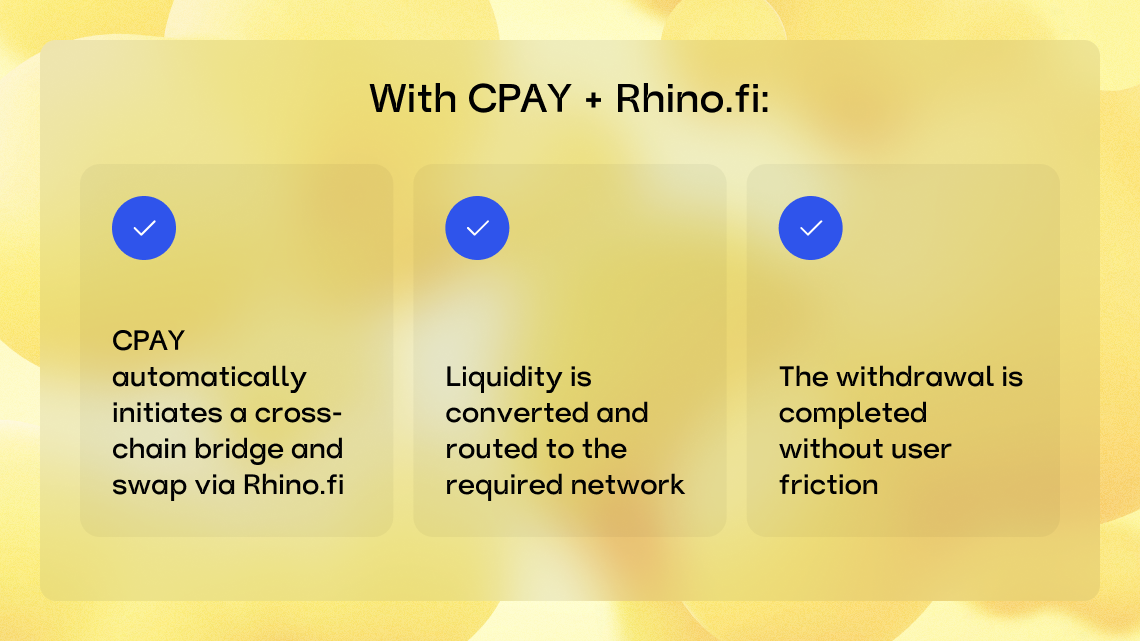
All of this happens automatically, in real time.
What This Unlocks for CPAY Partners
For custodial platforms running on CPAY white labels, this changes how liquidity is managed entirely.
Instead of maintaining isolated balances per network, partners gain:
- Dynamic, on-demand cross-chain liquidity
- Fewer blocked withdrawals
- Reduced treasury overhead
- Faster and more predictable user payouts
Liquidity becomes flexible, not fixed.
Building Infrastructure That Scales
The CPAY <> Rhino.fi partnership is not about adding another integration.
It is about removing a structural limitation that has existed in crypto payments for years.
By combining CPAY’s payment and white-label infrastructure with Rhino.fi’s cross-chain liquidity engine, platforms can operate in a multi-chain environment without inheriting its complexity.
That is how scalable crypto payments should work.