Accepting crypto payments used to mean managing wallets, tracking transactions manually, and dealing with multiple blockchain networks.
In 2026, businesses expect something much simpler.
They want a checkout that works, an API their developers can integrate, and settlement directly to their own wallets.
That's exactly what crypto payment infrastructure is designed to provide.
With CPAY, businesses can accept payments in 100+ assets across 8 networks with a flat 0.5% processing fee and non-custodial settlement. Whether you're running a Shopify store, SaaS platform, forex brokerage, iGaming operation, or marketplace, the integration process looks much closer to a modern payment gateway than a traditional crypto wallet setup.
Start with the checkout
For many businesses, a hosted checkout is the fastest way to launch crypto payments.
Instead of building payment flows from scratch, merchants create an invoice or payment request through CPAY and direct customers to a payment page.
The customer chooses an asset, sends the payment, and receives confirmation once the transaction is completed.
Behind the scenes, CPAY handles:
- payment address generation;
- network detection;
- transaction monitoring;
- payment confirmation;
- status updates.
The merchant receives the payment directly to their designated wallet without managing infrastructure internally.
This approach works particularly well for:
- Shopify stores;
- WooCommerce stores;
- digital products;
- SaaS subscriptions;
- online services.
For many companies, crypto payments can be live within a single development sprint.
When you need more control, use the API
Hosted checkout works for many businesses.
Others need crypto payments to become part of their own product.
A forex broker may want crypto deposits directly inside a client cabinet.
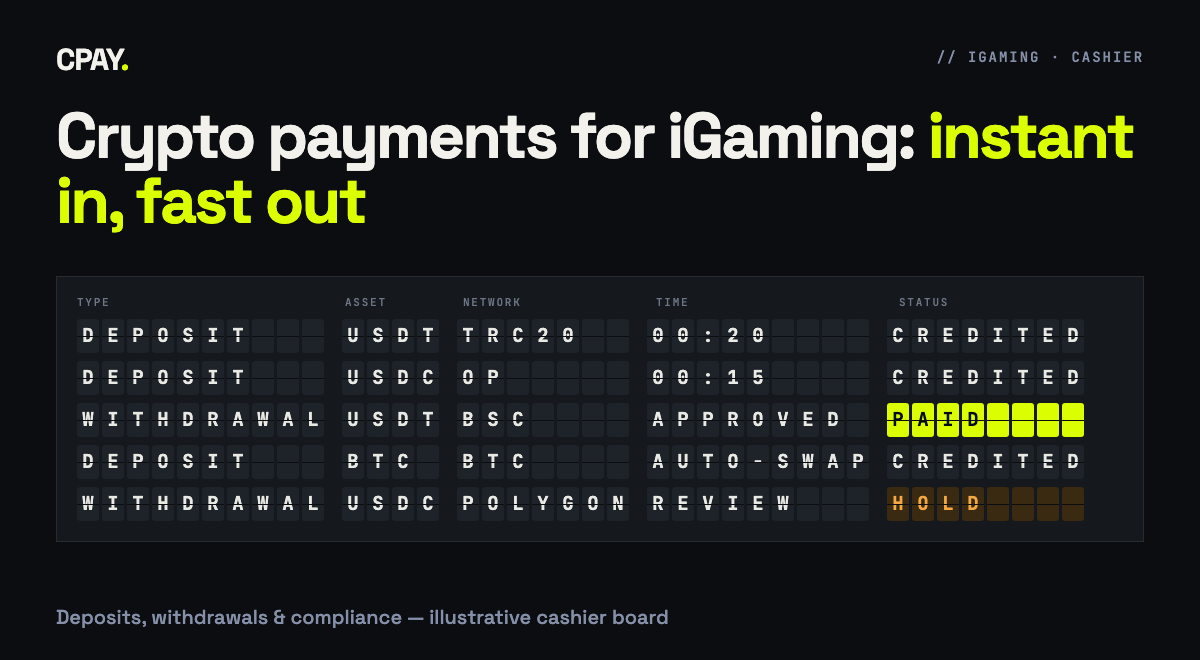
An iGaming platform may need instant deposits linked to player accounts.
A marketplace may need custom payout logic.
That's where the CPAY API comes in.
Instead of redirecting customers to an external page, businesses can create, monitor, and reconcile payments directly from their own platform.
A typical integration includes:
- payment creation;
- invoice management;
- transaction status tracking;
- webhook notifications;
- payout automation.
From the user's perspective, the payment experience remains entirely within the merchant's product.
Stablecoins are becoming the default payment method
A few years ago, most crypto payment discussions focused on Bitcoin.
Today, stablecoins drive a significant share of payment activity.
Businesses increasingly prefer USDT and USDC because pricing remains predictable from invoice creation to settlement.
A $500 invoice remains a $500 invoice.
There is no need to account for market volatility between payment initiation and payment confirmation.
Stablecoins are particularly useful for:
- international eCommerce;
- SaaS subscriptions;
- B2B invoices;
- affiliate payouts;
- contractor payments;
- customer withdrawals.
For global businesses, stablecoins often function as a faster alternative to traditional international transfers.
One integration, multiple networks
Customers hold assets across different ecosystems.
Some prefer Ethereum.
Others use Polygon, BNB Chain, Base, or alternative networks.
Supporting every network separately creates unnecessary operational complexity.
CPAY allows businesses to support multiple blockchain networks through a single payment infrastructure layer.
The customer chooses how they want to pay.
The merchant receives a unified payment experience.
This becomes increasingly important as stablecoin activity spreads across multiple ecosystems and transaction costs vary between networks.
Non-custodial by design
One of the first questions businesses should ask when evaluating a crypto payment provider is simple:
Who controls the funds?
Some providers collect payments into wallets they control and settle funds later.
CPAY follows a non-custodial model.
Payments can be settled directly to merchant-controlled wallets, giving businesses full control over their assets.
This model reduces counterparty risk while simplifying treasury operations for companies that already manage digital assets internally.
Beyond payments: payouts, subscriptions, and automation
Accepting crypto is often the first step.
Many businesses quickly move toward additional workflows.
Examples include:
Customer payouts
Forex brokers, trading platforms, and iGaming operators often need to process withdrawals as efficiently as deposits.
Stablecoin payouts can reduce delays associated with traditional banking infrastructure.
Subscription billing
SaaS businesses increasingly explore recurring crypto billing for international customers who prefer digital assets.
Mass payouts
Affiliate programs, creator platforms, marketplaces, and global teams frequently process payments to hundreds of recipients.
Automated payout infrastructure helps remove manual operational work.
The same payment infrastructure that powers checkout flows can also support these operational use cases.
Which businesses benefit the most?
While crypto payments can work for almost any online business, adoption is particularly strong among companies serving international audiences.
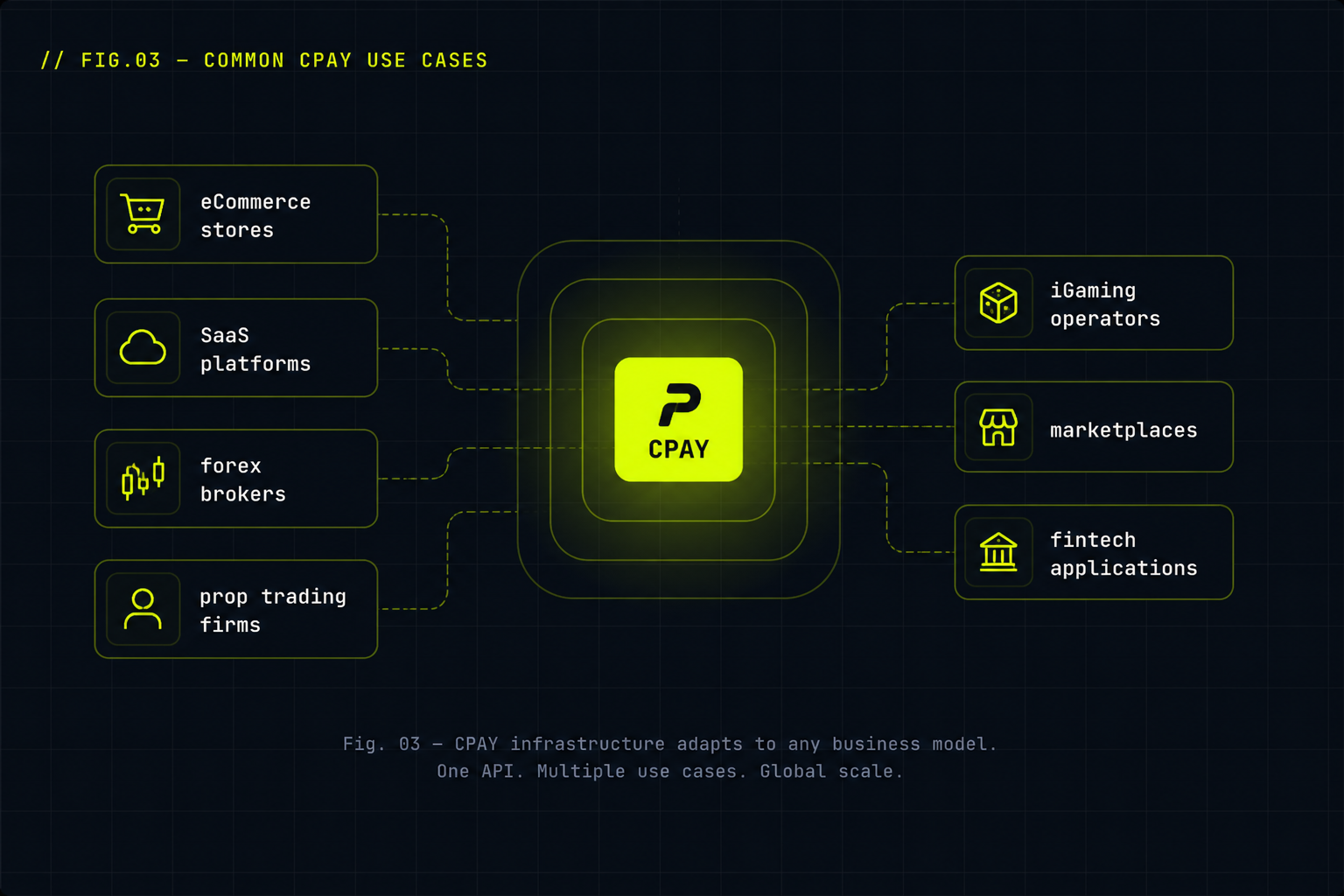
These businesses often face the same challenge: customers are global, while traditional payment systems remain fragmented by country, bank, and payment processor.
Crypto payments provide another way to move value across borders without adding additional banking complexity.
Final thoughts
The discussion around crypto payments has shifted.
The question is no longer whether customers are willing to pay with digital assets.
Many already do.
The focus now is infrastructure.
Businesses need checkout flows that convert, APIs that developers can integrate, stablecoin support that customers expect, and settlement models that fit existing operations.
With CPAY, merchants can launch hosted checkouts, integrate payment APIs, support stablecoins across multiple networks, and receive funds through a non-custodial payment infrastructure built for modern internet businesses.