AI agents are quickly moving beyond content generation and research.
They are booking meetings, managing workflows, analyzing data, interacting with APIs, and making operational decisions. The next logical step is handling economic actions.
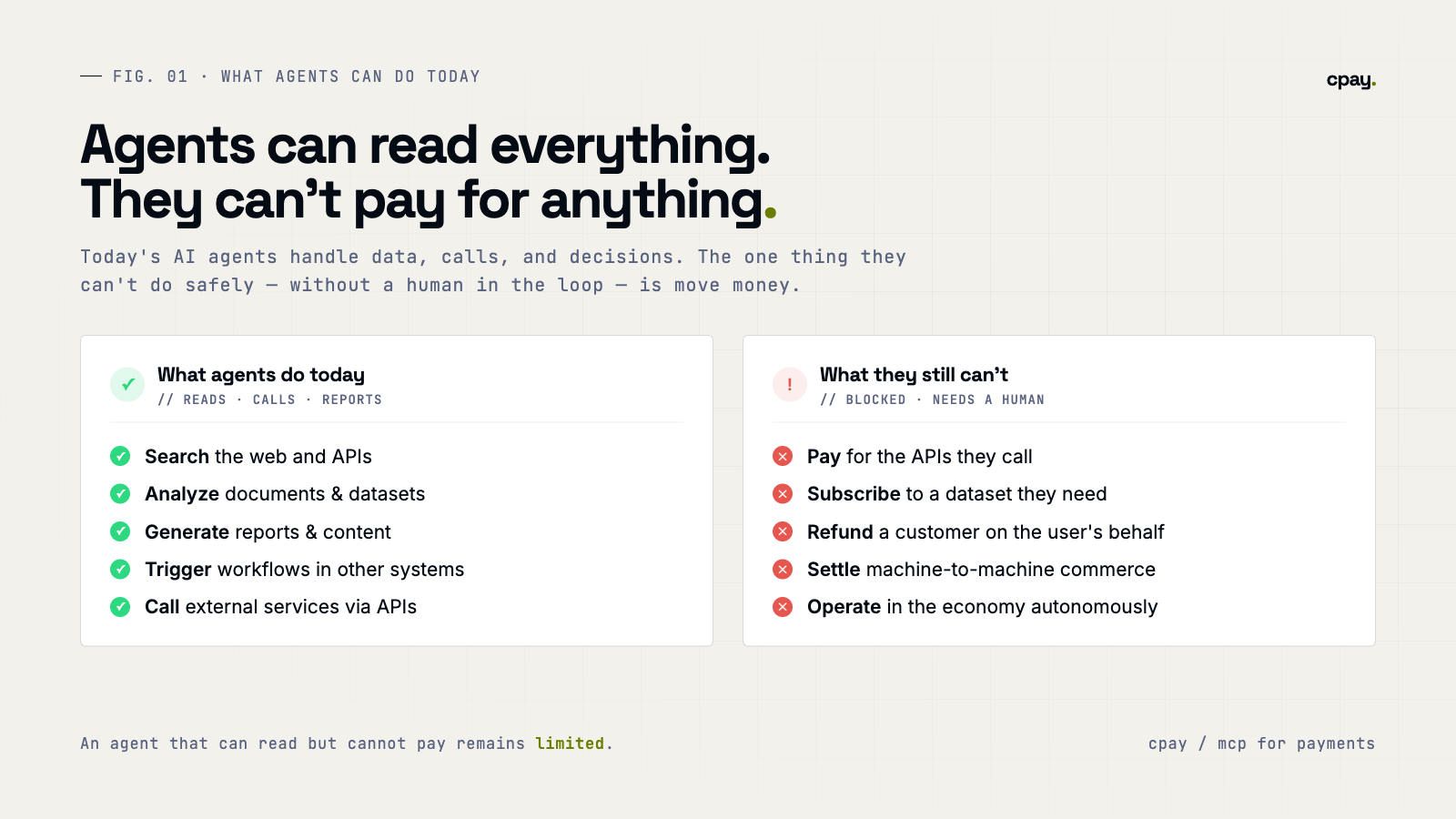
An agent that can read information but cannot pay for services remains limited. As more software becomes API-driven and usage-based, AI systems need a secure way to interact with payment infrastructure.
This is where MCP enters the picture.
What is MCP?
Model Context Protocol (MCP) is an emerging standard that allows AI models to interact with external tools through a structured interface.
Instead of building a custom integration for every service, developers expose capabilities through MCP-compatible endpoints.
For an AI agent, this means:
- Accessing external systems
- Retrieving data
- Executing predefined actions
- Working across multiple providers through a consistent interface
The concept is similar to how APIs standardized communication between applications. MCP aims to standardize communication between AI systems and external tools.
The missing layer: payments
Many AI agents can already:
- Search information
- Analyze documents
- Generate reports
- Trigger workflows
- Call APIs
Very few can handle payments safely.
Traditional payment systems were designed for humans. They assume manual approvals, banking interfaces, and user-driven interactions.
AI agents operate differently.
They require:
- Programmatic access
- Machine-readable responses
- Permission controls
- Automated execution
- Auditable decision trails
Without dedicated payment infrastructure, agents become dependent on human intervention for every financial action.
That creates a bottleneck.
Why AI agents need payment infrastructure
Consider a simple workflow.
An AI-powered research assistant needs access to:
- Market data APIs
- Premium datasets
- Verification services
- Monitoring tools
Each service charges separately.
Today the workflow usually looks like this:
- Human subscribes.
- Human manages billing.
- Human updates payment methods.
- Human resolves failed transactions.
As the number of agents grows, this approach becomes difficult to scale.
The future looks different.
Agents will purchase resources dynamically based on task requirements, usage limits, and predefined policies.
To support that model, payments must become programmable.
How MCP changes the model
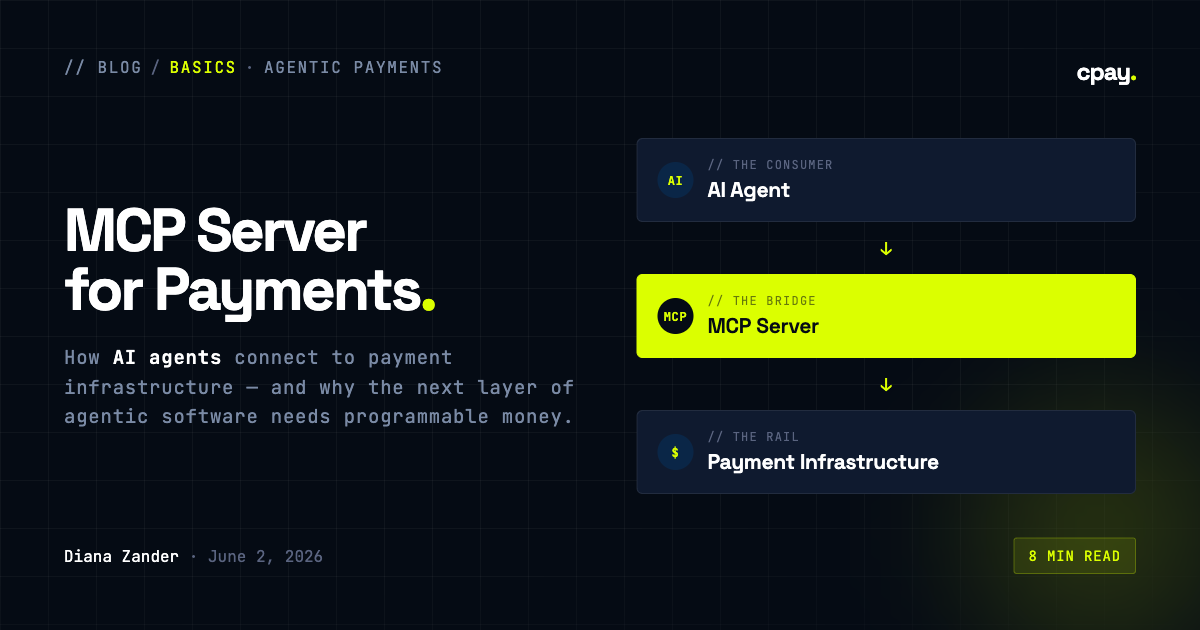
An MCP server can expose payment functionality as a set of controlled tools.
Instead of interacting with banking interfaces or wallets directly, an AI agent can request actions through standardized MCP endpoints.
Examples include:
- Checking balances
- Viewing transaction history
- Generating payment requests
- Creating invoices
- Monitoring settlement status
- Preparing payout batches
- Requesting approval for larger transactions
The MCP server becomes the bridge between the AI layer and the payment layer.
This separation improves security and governance.
The agent receives only the permissions it needs.
MCP server for payments
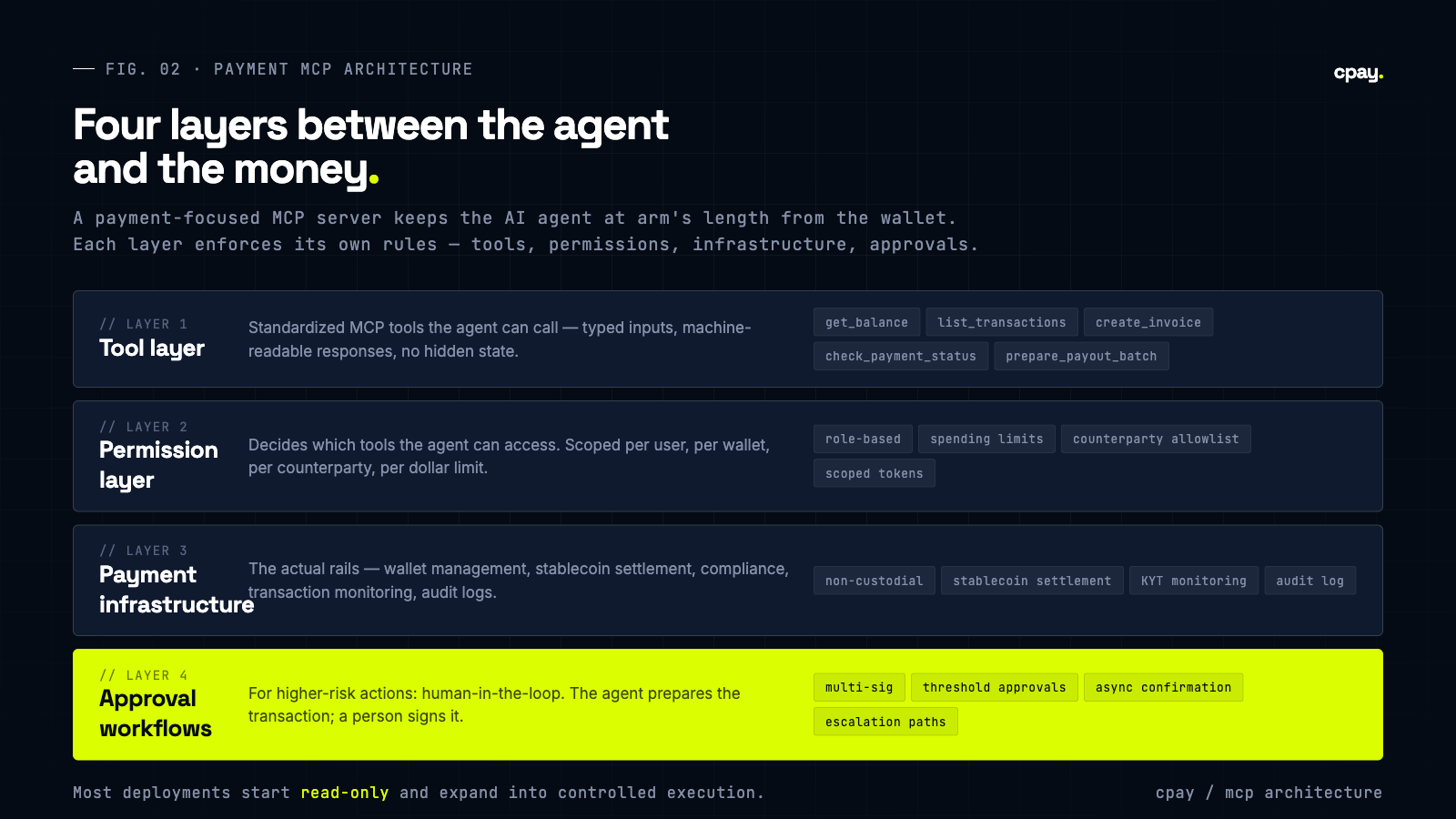
A payment-focused MCP server allows external AI systems to interact with payment infrastructure without direct access to sensitive wallet operations.
The architecture typically includes:
Tool layer
Standardized MCP tools exposed to AI agents.
Examples:
- get_balance
- list_transactions
- create_invoice
- check_payment_status
- prepare_payout_batch
Permission layer
Controls which tools an agent can access.
Permissions can be scoped by:
- User
- Organization
- Wallet
- Transaction limits
- Approved counterparties
Payment infrastructure
The underlying system responsible for:
- Wallet management
- Stablecoin settlement
- Compliance checks
- Transaction monitoring
- Audit logging
Approval workflows
Higher-risk actions can require human approval before execution.
This creates a practical balance between automation and control.
Why stablecoins fit agentic payments
Stablecoins solve several challenges that traditional payment rails struggle with.
They provide:
- Global availability
- Near-instant settlement
- API-friendly infrastructure
- Predictable transaction costs
- 24/7 operation
For AI agents, these characteristics are particularly important.
An autonomous system operating across time zones cannot wait for banking hours.
Machine-to-machine transactions require infrastructure that is always available.
Stablecoins provide that foundation.
Security considerations
Allowing AI systems to interact with payment infrastructure introduces new risks.
The solution is not unlimited autonomy.
The solution is controlled autonomy.
A production-ready payment MCP server should support:
- Role-based permissions
- Spending limits
- Counterparty allowlists
- Multi-step approvals
- Transaction monitoring
- Full audit logs
- Human escalation paths
Most deployments will start with read-only capabilities before expanding into controlled payment execution.
This mirrors how enterprise software adoption typically evolves.
MCP and machine-to-machine commerce
The long-term opportunity extends beyond AI assistants.
Software systems increasingly buy services from other software systems.
Examples include:
- Agents purchasing API access
- Automated infrastructure provisioning
- Dynamic data acquisition
- Usage-based software consumption
- Autonomous service marketplaces
These interactions require a financial layer designed for machines.
MCP provides a standardized way for agents to communicate.
Payment infrastructure provides a standardized way for value to move.
Together, they create the foundation for machine-to-machine commerce.
What comes next
Most organizations are still experimenting with AI agents.
The first phase focuses on productivity.
The second phase focuses on decision-making.
The third phase introduces economic actions.
As AI systems gain the ability to purchase services, manage budgets, and execute transactions within predefined rules, payment infrastructure becomes a core component of the stack.
The companies building agentic systems will need more than wallets and APIs.
They will need infrastructure designed specifically for AI-driven financial operations.
MCP servers are emerging as one of the key layers that can make that possible.