Self-custody security for business: protecting non-custodial crypto funds in 2026
When a business holds crypto, the most important security decision happens before any firewall: who holds the keys.
Lede. The biggest crypto losses of the last few years were not clever exploits or broken cryptography. They were custody failures — billions of dollars gone because someone else held the keys. As more businesses move treasury, payouts, and customer balances on-chain, the question is no longer "is crypto secure?" but "who can move our funds, and what stops them?" This is how to protect non-custodial crypto in 2026.
01 — Custody is the security decision
Every security control you will ever buy — firewalls, penetration tests, monitoring, insurance — sits downstream of a single question: who holds the keys? If a third party controls them, your funds are only as safe as that party's balance sheet, internal controls, and honesty. If you control them, the entire attack surface changes shape.
When a provider holds customer funds in a pooled wallet, that wallet becomes a single honeypot. Thousands of clients' balances sit behind one set of keys. One breach, one insolvency, or one rogue insider, and everyone is exposed at the same moment. This is not a hypothetical pattern — it repeats with grim regularity. Mt. Gox in 2014, then FTX, Celsius, and BlockFi in 2022: different stories, same root cause. None were failures of blockchain cryptography. They were failures of who controlled the keys, and of the governance around them.
It is worth being precise about the risks a pooled custodial model carries, because they are structural rather than incidental:
- Counterparty and insolvency risk — if the custodian fails, your funds become part of a bankruptcy estate, not something you can simply withdraw.
- Insider risk — a handful of employees can move an enormous pool; collusion or coercion is hard to fully rule out.
- Opaque reserves — "proof of reserves" shows assets at a point in time, not liabilities or control, and it does nothing to stop a custodian from spending what it holds.
- Seizure and freeze risk — a regulator or court can freeze the custodian's accounts, taking your operational funds offline along with everyone else's.
Self-custody changes the model at the root. In a non-custodial setup, the business holds its own keys and the provider never takes possession of the funds. There is no shared pool to drain, no balance sheet to trust, and no third party that can be compelled to freeze what it does not hold.
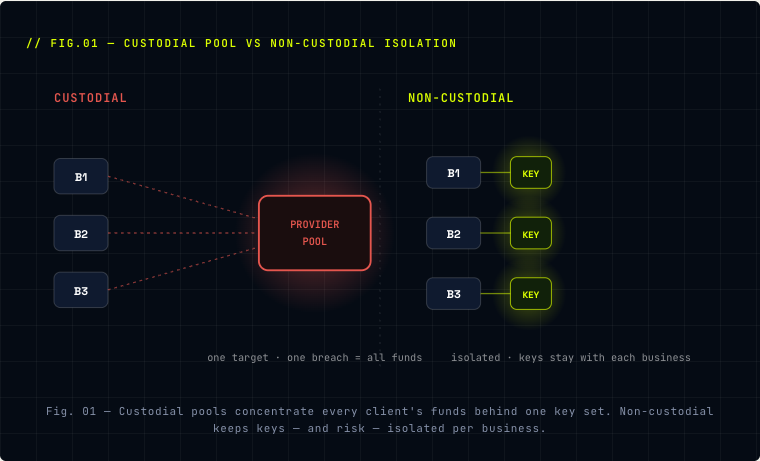
That structural difference is the whole game. Custodial convenience is real, but it is borrowed safety — you are renting someone else's security and inheriting their failure modes. Non-custodial puts the funds, and the responsibility, back in your hands.
02 — Self-custody for a business is not one seed phrase
"Self-custody" still carries a retail image: one person, twelve words on paper, a hardware wallet in a drawer. For a business, that image is the problem, not the solution. A single seed phrase is a single point of failure — lose it and the funds are gone, leak it and they are stolen, and the person who holds it becomes an unacceptable concentration of risk.
Business self-custody means something different. It means keys the company controls, a clear policy for who can move funds, and signing that no single person or vendor can bypass. The keys are an organizational asset governed by rules — not a personal secret kept by whoever set up the wallet.
It helps to separate two things that are often confused:
- Holding the keys — the funds are yours and the provider cannot move them. This is the custody guarantee.
- Operating the keys — who inside your organization can prepare, approve, and sign a transfer, and under what limits. This is governance.
A real setup usually splits funds by purpose — a treasury wallet for reserves with tight controls and few signers, an operational wallet for day-to-day payouts with looser limits — each with its own policy. The provider's job is to make this safe and usable. It is emphatically not to hold the money.
Control comes with responsibility. There is no support desk that can reverse a bad transfer or recover a carelessly lost key. That is exactly why the security model around the keys matters — and why "one device, one seed phrase" is no longer acceptable for business funds.
03 — Defense in depth, not one control
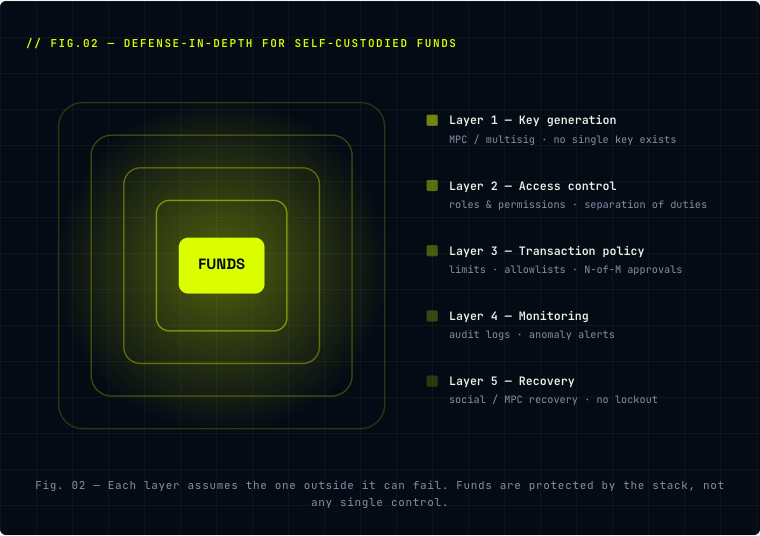
No single control is enough on its own. Strong keys do not help if anyone can trigger a transfer; strict policy does not help if the keys leak; monitoring does not help if there is no way to recover. Robust self-custody is therefore layered: each layer assumes the one outside it might fail, and the funds at the center are protected by the stack as a whole rather than by any one mechanism.
04 — Key management: no single key
The first and deepest layer is how keys are created and stored. The 2026 standard for business funds is simple to state: no single private key should ever sit, whole, on one device. A single key is a single thing to steal, lose, or coerce out of one person — and it quietly undoes every other control you put in place.
Two approaches remove that single point of failure, and they are often combined:
- MPC (multi-party computation) — the private key is split into shares held by different parties or devices. A full key is never assembled anywhere; signing is performed collaboratively across the shares. MPC is chain-agnostic, invisible on-chain, and cheap on gas.
- Multisig — several independent keys exist, and a transaction needs M-of-N of them to sign. The rule is enforced directly on-chain, which makes it transparent and auditable, at the cost of being chain-specific and slightly more expensive.
Around either model sit the operational basics that are easy to skip and expensive to miss: secure storage of shares or keys in HSMs or secure enclaves rather than on laptops; a documented key-generation ceremony so no one person ever sees enough material to reconstruct a key; and rotation, so that a share exposed today does not stay valid forever. None of this is exotic in 2026 — it is simply the baseline that separates a business wallet from a personal one.
05 — Access control and transaction policy
Holding keys safely is half the job. Controlling who can use them, and on what terms, is the other half — and it is where most real-world incidents are actually prevented. A leaked credential or a tricked employee should not be enough to move funds, because the keys are not the only gate.
Access control — who can do what
- Role-based permissions — distinct roles for who can view balances, prepare a transfer, approve one, and sign it. Most people need far less access than they are usually given.
- Separation of duties — the person who prepares a payout is never the only person who approves it, so a single compromised account is not enough to move money.
Transaction policy — what the keys are allowed to do
- Spending limits — per-transaction and daily caps, so a single mistake or breach is bounded in size.
- Allowlisted destinations — funds can move only to addresses approved in advance, defeating most address-swap malware and clipboard attacks.
- Approval thresholds — small payments clear automatically, while a transfer above a set figure requires N approvers before it can sign.
The point of this layer is that policy travels with the keys. In a well-built non-custodial system these rules are enforced cryptographically at signing time — not offered as a user-interface suggestion that the next compromised admin can simply click past.
06 — Monitoring and recovery
Monitoring makes the system observable, so problems are seen in minutes instead of discovered in a post-mortem. At minimum that means a complete, tamper-evident audit log — who acted, what they did, when, the policy result, and the resulting transaction hash — plus anomaly detection on signals like first-time destinations, unusual volumes, or out-of-hours activity, with real-time alerts routed to the right people.
Recovery makes the system survivable. The honest failure mode of naive self-custody is not theft — it is loss: a lost laptop, a departed employee, a forgotten secret. Modern setups remove the single point of loss with seedless, social, or MPC-based recovery, where remaining shares plus a defined procedure restore access. Two things make this real rather than theoretical: the procedure is documented, and the team has actually rehearsed it. A recovery plan no one has tested is a guess, not a control. The same discipline addresses the "bus factor" — no single person's departure should ever be able to lock or lose the funds.
"Custodial asks you to trust a balance sheet. Self-custody asks you to run a process. In 2026, the process is the safer bet — if you actually build the layers."
07 — Honest trade-offs: when self-custody is harder
Self-custody is not free, and pretending otherwise helps no one. It carries genuine operational weight: real key and recovery procedures, team training, role discipline, and infrastructure for policy and monitoring. A business that wants none of that responsibility will find custodial convenient — right up until the custodian is the thing that fails.
For most companies handling meaningful volume, the trade is clearly worth it: no counterparty risk, no shared honeypot, and funds they genuinely control. For very small teams with no operational capacity, a hybrid or managed model can be a reasonable interim step — but it should be chosen with eyes open, because the core question never disappears: who can move the money, and what stops them? Self-custody answers that question in your favor; custodial answers it in someone else's.
08 — A 2026 self-custody baseline (checklist)
If you are moving business funds to self-custody this year, this is a reasonable minimum bar to hold any setup — your own or a provider's — against:
- No single key — MPC or multisig, with shares in secure storage and a clean generation ceremony.
- Role-based access — view, prepare, approve, and sign are separate permissions.
- Separation of duties — at least two people required for transfers above a threshold.
- Transaction policy — per-transaction and daily limits, plus allowlisted destinations.
- Approvals enforced at signing — cryptographically, not as an interface that can be bypassed.
- Full audit logging — every action attributable and exportable.
- Anomaly alerts — new destinations and unusual volume flagged in real time.
- Tested recovery — seedless or MPC recovery with a rehearsed procedure and no single point of loss.
09 — Where CPAY fits
Assembling all of this in-house is possible, but it is a serious engineering project — and one mistake in it can be irreversible. CPAY provides non-custodial wallet infrastructure where the keys stay with the client and the layers come built in: MPC-based wallets, role-based permissions, spending limits and approvals enforced at signing, full audit logs, and recovery options — all exposed through an open API with on-chain transparency. The business gets the security posture of self-custody without having to build every layer from scratch, and without ever handing the keys to a third party.
10 — FAQ
Does non-custodial mean no security responsibility? No — the responsibility shifts to you. The provider can no longer lose your funds, but you manage keys, policy, and recovery. The right infrastructure makes that manageable, not heavier.
MPC vs multisig — what's the difference? Multisig requires M-of-N on-chain signatures from separate keys. MPC splits one key into shares so a full private key never exists in one place; signing happens collaboratively off-chain. MPC is chain-agnostic and cheaper on gas; multisig is enforced directly on-chain.
Can we set spending limits and approvals on a non-custodial wallet? Yes. Policy can require per-transaction and daily limits, allowlisted destinations, and N-of-M approvals for large transfers — without the provider ever holding the keys.
What if we lose a device or a key share? With MPC or social recovery, losing one share or device does not lose the funds. Remaining shares plus a defined recovery procedure restore access — which is why seed-phrase-only custody is no longer the business standard.
Custody is the security question, and every other control depends on the answer. In 2026, protecting business crypto funds starts with holding your own keys — and surrounding them with layers that each assume the others can fail. Get that right, and "not your keys, not your coins" stops being a warning and becomes a guarantee you can operate on.