In the early days of crypto, self-custody was a niche idea — something only hardcore enthusiasts cared about.
Today, it’s becoming the foundation of the next generation of digital finance.
Because when you process, store, or move money on-chain, one question defines everything:
Who truly controls the funds?
What self-custody really means
Self-custody (also known as non-custodial storage) means you — and only you — control your assets.
You hold your private keys, and no third party can freeze, withdraw, or access your funds.
In simple terms:
“Your keys — your crypto.”
That’s what separates crypto from traditional banking systems.
In a custodial setup (like exchanges, custodial wallets, or centralized payment gateways), users deposit funds into a provider’s wallet.
The provider manages withdrawals, holds private keys, and controls settlements.
Self-custody flips that model: all transactions happen directly from your wallet, transparently and verifiably on the blockchain.
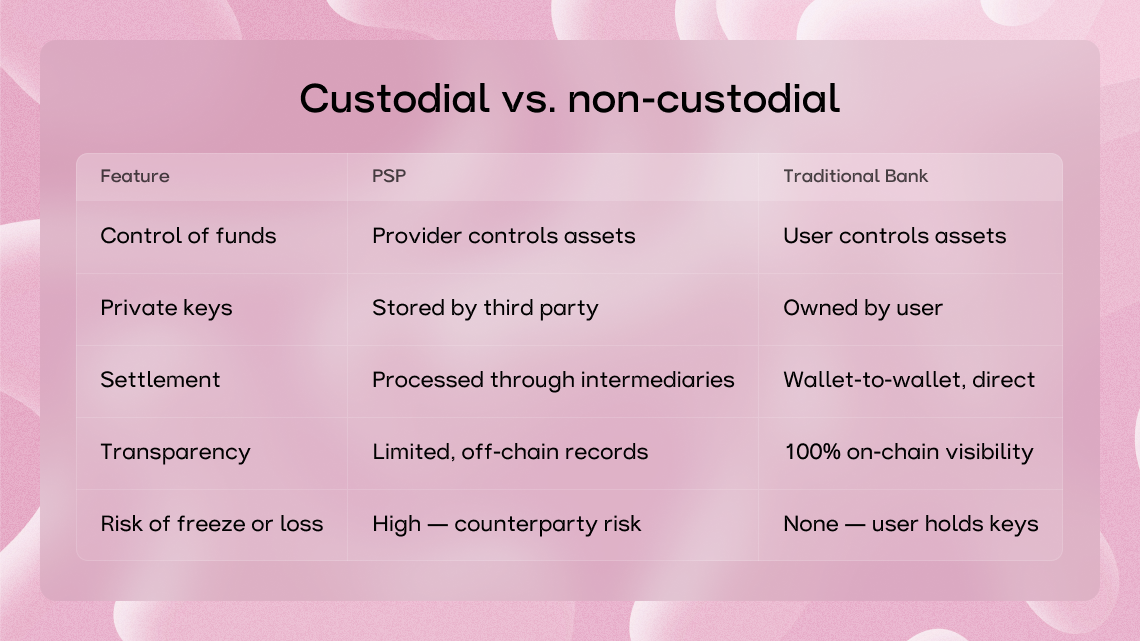
Custodial models offer simplicity but introduce trust risk.
If the provider is hacked, becomes insolvent, or restricted by regulators — your funds can be affected.
Self-custody eliminates that dependency entirely.
Why self-custody matters more than ever
As crypto becomes more regulated, many businesses are rediscovering why self-custody was the core idea of blockchain in the first place:
freedom, transparency, and control.
- Security — When you hold your keys, no third party can lose your assets or get hacked on your behalf.
- Transparency — All payments and settlements are traceable on-chain, in real time.
- Operational independence — Businesses can move funds instantly, without waiting for provider approval or facing withdrawal delays.
- Regulatory resilience — Even if rules change, your operations don’t depend on centralized custody licenses.
That’s why leading enterprises, payment processors, and Web3 platforms are moving toward non-custodial infrastructure — where they maintain control while leveraging the convenience of automated tools.
How CPAY empowers true self-custody
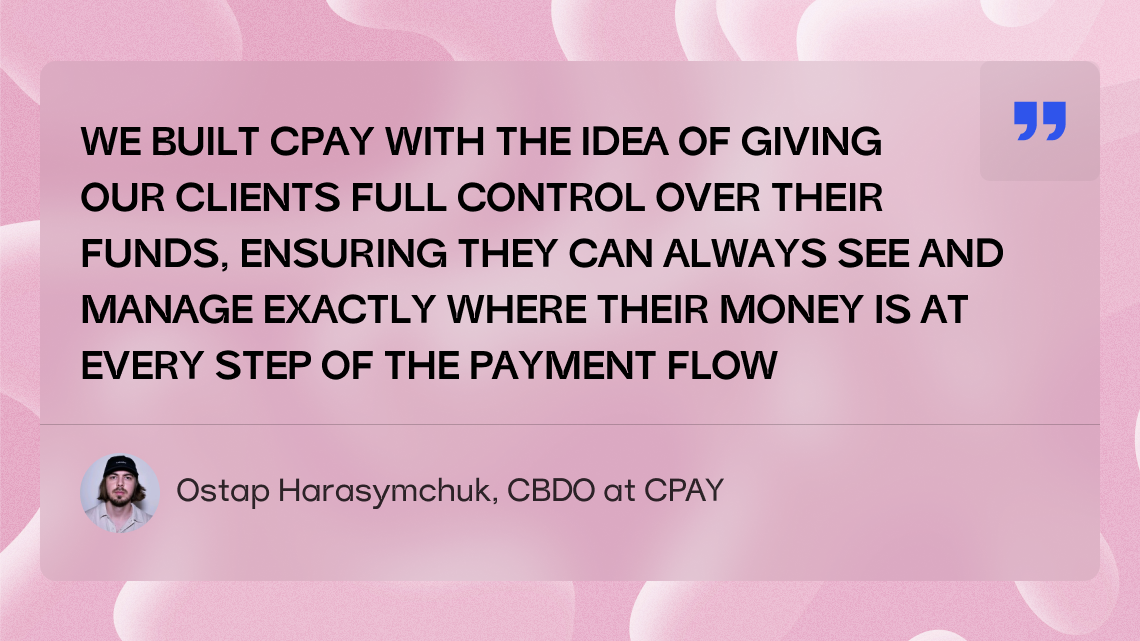
At CPAY, self-custody isn’t a buzzword — it’s a system architecture principle.
We built our payment infrastructure so that clients always own their funds.
Here’s how it works:
- Wallet-to-wallet payments — funds go directly from customer to merchant, without passing through CPAY’s accounts.
- Private keys remain with clients — CPAY never stores, manages, or has access to user keys.
- On-chain transparency — every transaction is verifiable on public blockchains, ensuring real-time settlement proofs.
- Instant settlements — no delays, no batch processing — you get paid instantly in crypto.
- Smart API tools — automate payment logic, conversions, and accounting while keeping custody fully in your hands.
The result: businesses can accept, manage, and route crypto payments securely — with zero custody risk.
The benefits for businesses
Self-custody isn’t just a technical choice — it’s a strategic advantage.
Here’s what companies gain with CPAY’s non-custodial infrastructure:
- Full ownership of capital — no intermediary can block access to your treasury.
- Real-time liquidity — instant access to funds right after each transaction.
- Multi-chain compatibility — support for BTC, ETH, USDT, USDC, and more without separate custodial accounts.
- Regulatory clarity — no mixing of client funds, transparent flow structure for compliance reporting.
- Lower operational risk — less exposure to external security breaches or provider insolvency.
CPAY gives enterprises the tools to process payments — not the control over their assets.
That distinction is what makes the system truly Web3-native.
Challenges and best practices
With great control comes great responsibility.
Self-custody requires proper security discipline — both technical and procedural.
To ensure safety, CPAY helps clients implement:
- Multi-signature (multi-sig) wallet structures to distribute control between multiple authorized parties.
- Hardware wallet integrations for cold storage of long-term funds.
- Role-based access for enterprise teams managing multiple wallets.
- Automated monitoring tools to detect anomalies or suspicious transactions.
This approach combines freedom with security, giving businesses confidence that their funds remain safe — and accessible only to them.
The future of payments is self-custodial
The next wave of digital payments won’t be built on intermediaries.
It will be built on systems where ownership and automation coexist — exactly what self-custody enables.
In a world moving toward programmable finance, keeping control of your assets isn’t just smart — it’s essential.
With CPAY, you get the infrastructure to run payments your way:
securely, transparently, and on your own terms.